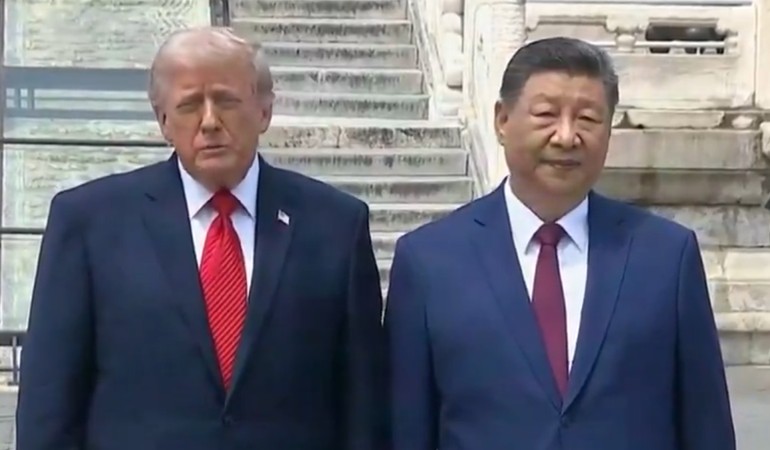
The United States and China agreed that the Strait of Hormuz must remain open, the White House said after talks between President Donald Trump and Chinese President Xi Jinping in Beijing’s Great Hall of the People.
According to a White House readout, Xi also “made clear China’s opposition to the militarization of the Strait and any effort to charge a toll for its use.”
The meeting between the leaders of the world’s two largest economies took place against the backdrop of the continuing U.S.-Iran standoff over the Strait of Hormuz, the strategic maritime corridor through which roughly one-fifth of global oil shipments normally pass.
Since the conflict erupted on February 28, shipping disruptions in the waterway have sent oil prices sharply higher and severely affected energy trade from the Middle East, a critical supplier of crude oil and gas to Asian economies.
China remains the largest purchaser of Iranian oil. The United States has imposed an embargo on trade involving Iranian-linked shipping, while Tehran has meanwhile established a mechanism to levy charges on international vessels transiting the strategic waterway.
The White House said Xi also “expressed interest in purchasing more American oil to reduce China’s dependence on the Strait in the future.”
Xi Urges US-China Partnership, Warns Mishandling Taiwan Issue Risks Conflict
Both leaders agreed that “Iran can never have a nuclear weapon,” according to the statement.
Trump has repeatedly said that Tehran’s commitment to permanently abandon uranium enrichment would be a central requirement of any long-term agreement aimed at ending the conflict.
While Pakistan facilitated the first round of talks between Washington and Tehran, the two sides have not been able to reconvene amid continuing tensions and sporadic exchanges of fire despite a month-long ceasefire.
The White House described the meeting between Trump and Xi as “good” and said the leaders discussed expanding economic cooperation between the two countries, including broader market access for American businesses in China and increased Chinese investment in U.S. industries.
According to the readout, executives from several major American companies also joined part of the discussions.

Ali Imran is a Washington-based journalist, who has worked for leading world news organizations as a correspondent, expert and in editorial positions. He is a published author and poet.