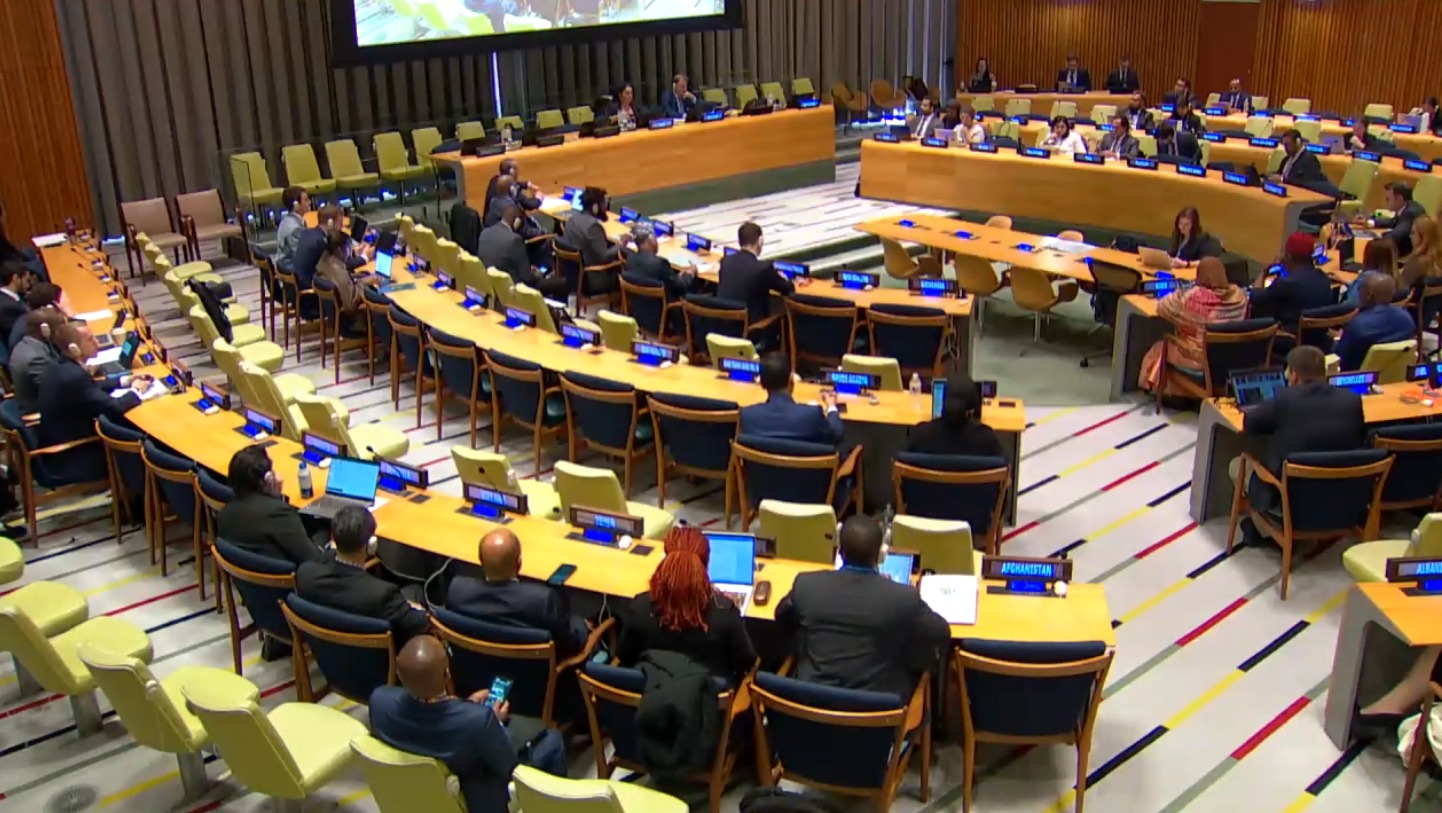
Pakistan and India traded accusations over cross-border terrorism and support for militant groups during a United Nations General Assembly debate on international terrorism on Wednesday, with Islamabad warning New Delhi against backing groups targeting its civilians and security forces.
Speaking during the Legal (Sixth) Committee’s debate on “Measures to Eliminate International Terrorism,” Pakistan’s Deputy Permanent Representative to the UN, Ambassador Usman Jadoon, said Pakistan continued to face attacks by groups including the Tehrik-i-Taliban Pakistan (TTP) and the Balochistan Liberation Army (BLA).
Jadoon accused India of supporting the groups and said they operated from Afghan territory. He also referred to Pakistan’s May 2025 conflict with India, warning that groups supported by New Delhi would face consequences similar to downed jets India’s military suffered during the fighting.
“Fully aware of cost of Indian terrorism, aiding and abetting of TTP and BLA, under the garb of humanitarian aid, they[India] have been actively providing logistical and material support for carrying out terrorist attacks in Pakistan”, says Pakistan’s Consular Jawwad Ajmal while hitting out at Indian propaganda at the UN.
— Anas Mallick (@AnasMallick) October 8, 2026
The loss of Indian fighter jets, including Rafales during the May 2025 conflict is seen as India’s sore point. President Donald Trump has repeated several times that brand new jets were downed in the conflict but stopped short of specifically terming them as Indian losses. The exact number of warplanes India lost in the 87-hour conflict is not know but local and international media captured images of several plane debris on the Indian side. Indian army acknowledged the losses but also did not say how many Indian planes were destroyed by Pakistani retaliation.
“We continue to face terrorist attacks from externally sponsored groups such as the TTP and BLA and its Majeed Brigade, which operate with impunity from Afghan soil with the active support of India,” Jadoon said.
He reaffirmed Pakistan’s condemnation of terrorism “in all its forms and manifestations,” while describing militancy emanating from Afghanistan as a serious security threat. He also cited terrorist violence in West Africa and the Sahel, as well as the Middle East.Jadoon said Pakistan had carried out what he described as “precise, well-planned and calibrated” counterterrorism operations against militant infrastructure and safe havens along its western border, based on intelligence.
“These strikes are strictly targeted at TTP and BLA terrorists and are carried out with high precision and accuracy to avoid civilian casualties,” he said, rejecting allegations to the contrary.
India rejected Pakistan’s accusations during the ensuing exchange of statements.
Exercising India’s right of reply, Indian First Secretary to the UN Raghoo Puri accused Pakistan of supporting cross-border terrorism.
He said Pakistan had for years portrayed itself as both a frontline state in the fight against terrorism and a victim of terrorism, while failing to acknowledge the role of groups it had previously supported.
“For years, Pakistan has presented itself as a frontline state in combating terrorism and as a victim, while masking the fact that the Frankenstein’s the Pakistani state has created and lost control over have moved from wreaking havoc in neighboring countries to doing the same in Pakistan,” Puri said.
Pakistan’s Counsellor at the UN, Muhammad Jawad Ajmal, responded by accusing India of human rights violations and of supporting the Taliban authorities in Afghanistan.
Ajmal said India’s engagement with the Taliban was accompanied by what he described as material and logistical support for attacks against Pakistan. He also cited the case of Kulbhushan Jadhav, an Indian national and former naval officer whose arrest by Pakistan in 2016 became a major source of tension between the two countries.
Why India is facing much broader fallout of conflict with Pakistan
Ajmal further alleged that India had been involved in extraterritorial assassination attempts and killings abroad. He referred to the case of Nikhil Gupta, who pleaded guilty in a US court to involvement in a plot to assassinate a Sikh separatist on American soil, as well as the killing of Canadian Sikh activist Hardeep Singh Nijjar in Canada.
India has rejected allegations that its government ordered such operations.
“Pakistan will defend its sovereignty, territorial integrity, its people and its security,” Ajmal said.
Puri subsequently rejected Pakistan’s response, saying greater international attention should be directed toward combating terrorism rather than what he characterized as “narrative building, misinformation, and disinformation.”
South Asian Tensions Spike After Indian BSF Firing Kills Two Pakistani Civilians
Ajmal accused India’s ruling BJP-led government of institutionalizing Hindutva ideology in state policy and of discriminating against religious and ethnic minorities, including Muslims, Christians and Sikhs, as well as Dalits.
The diplomat criticized India’s policies in Jammu and Kashmir, saying that since 2019 New Delhi had intensified efforts to alter the region’s political and demographic character.
He alleged that these policies were intended to reduce Kashmiris to a minority in the territory and could affect arrangements for a future plebiscite under UN auspices.
“The international community must reject such settler colonialism policies that have no place in the 21st century,” Ajmal said.

Iftikhar Ali is a veteran Pakistani journalist, former president of UN Correspondents Association, and a recipient of the Pride of Performance civil award