Yemen’s Houthis have escalated missile and drone strikes against Saudi Arabia, targeting two airports while Pakistan has firmly rejected claims that its air force is engaged in operations against Houthi rebels.
Saudi officials said they intercepted two Houthi ballistic missiles fired toward Riyadh.
The Saudi coalition vowed to punish the attackers, after the Houthis targeted King Khalid International Airport in Riyadh and Abha International Airport.
According to Saudi Gazette, Maj. Gen. Turki Al-Maliki, spokesperson of the Coalition to Restore Legitimacy in Yemen, said the brutal attacks by the terrorist Houthi militia on civilians and civilian objects in Saudi Arabia will not go unpunished.
“Consequent to the recent Houthi attacks, the Joint Forces of the Coalition launched a comprehensive operation, destroying a total of 82 military targets belonging to the Houthi militia across the governorates of Saada, Al-Hudaydah, Al-Jawf, and Marib.”
The Muslim World League has condemned a Houthi attack on the Taibah electricity distribution station in Medina, Saudi Arabia, saying the facility provides electricity services to Prophet Muhammad’s mosque (Masjid an-Nabawi).
🔴 LIVE updates: https://t.co/X12XTtDOBa https://t.co/5vkgljrs8H
— Al Jazeera English (@AJEnglish) October 2, 2026
In Islamabad, Pakistani officials confirmed that the country has deployed troops to the Kingdom but Thursday rejected a report that Pakistani jets were involved in conducting strikes against the Houthi targets in Yemen.
In a strongly worded contradiction, the Ministry of Information dismissed as “fake and fabricated” a New York Times report that, citing an unnamed source, had claimed that Pakistan Air Force fighter jets were being used against the Houthis.
In a post on X, the ministry shared a screenshot of the article and stated that the story “attributing the employment of PAF aircraft against Houthis is fake and fabricated.” It urged international media houses to avoid speculative reporting about the employment of Pakistan’s military forces under the Makkah Joint Defense Agreement.
“Details of any deployment, if necessary, will be given by the authorities concerned,” the ministry added.
The statement followed an earlier rejection this week of a Reuters report that claimed 30,000 to 40,000 Pakistani troops had been deployed to Saudi Arabia. Officials labeled that account “speculative.”
Pakistan’s Ministry of Information rejected the New York Times report claiming Pakistani Air Force aircraft were used against the Houthis, calling it “fake and fabricated.” https://t.co/3qY1pm7Zh2
— Clash Report (@clashreport) October 8, 2026
Houthi Attacks and Saudi Interceptions
The alliance meeting was convened after a series of Houthi missile and drone strikes targeting Saudi Arabia. Saudi-led coalition forces reported intercepting two ballistic missiles fired toward Riyadh.
A separate missile heading toward the southern city of Khamis Mushait was also intercepted, according to a coalition spokesperson on X.
Yemen’s Houthi rebels claimed responsibility for a strike on King Khalid International Airport in Riyadh. Military spokesman Yahya Saree stated: “Our armed forces targeted King Khalid Airport in Riyadh at midday with a ballistic missile that hit its target.”
#BREAKING: Coalition: Houthi attacks on civilian targets in Saudi Arabia, including King Khalid International Airport in Riyadh and Abha International Airport, “will not go unpunished.” https://t.co/cQAeSyHW4x
— Saudi Gazette (@Saudi_Gazette) October 7, 2026
Saudi Arabia’s Directorate of Civil Defense said debris from a missile intercepted over Riyadh damaged a medical clinic and a kindergarten. “Civil Defense teams in Riyadh responded to the fall of ballistic missile shrapnel following the missile’s interception and destruction,” the statement read. “Standard procedures for such incidents were implemented.”
A Houthi military spokesperson also warned workers at Saudi oil facilities to stay away from sites the group considers targets and renewed threats against airlines and airports, according to Reuters.
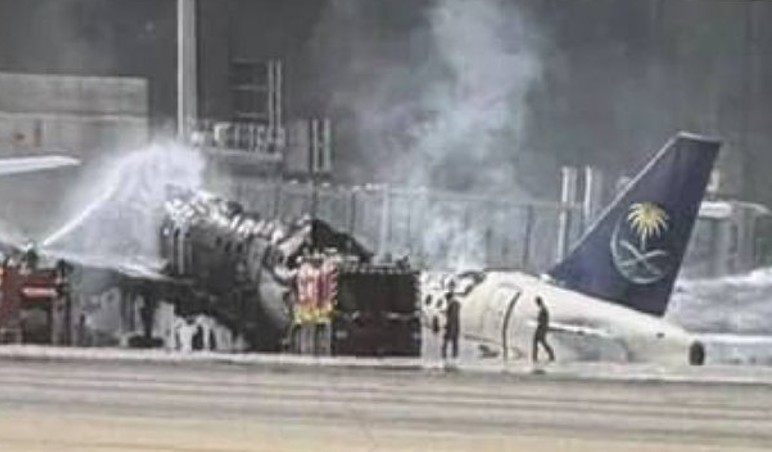
Hours after explosions were reported over the Saudi capital, King Khalid International Airport advised passengers to contact their airlines and check flight status before traveling to the airport. Reuters, citing a witness and three people briefed on the matter, reported smoke rising from a stationary aircraft at the airport. Those sources said the plane was believed to be empty. Saudi authorities have not issued an official confirmation of the incident.
This qoutes a senior Pakistani military official as saying ” Pakistan Air Force fighter jets were being used in strikes against the Houthis.” Another said Pakistan’s role will focus on degrading Houthi drone and missile threats through air support https://t.co/q09GEompdM
— Maleeha Lodhi (@LodhiMaleeha) October 8, 2026
Longstanding Pakistani Presence Confirmed
Islamabad has acknowledged that its forces are already stationed in Saudi Arabia, but framed the deployment as routine rather than a new combat mission.
Speaking to CNN, Director General of Inter-Services Public Relations Lt. Gen. Ahmed Sharif Chaudhry said Pakistani troops have maintained a presence in the kingdom for decades. He described the forces as deployed with “multiple capabilities and domains” in a country that is both a close ally and the center of Islam.
Makkah Alliance Moves Toward Practical Implementation
The latest developments follow an emergency meeting of the Makkah Defence Alliance held in Riyadh on Monday. Pakistan, Saudi Arabia and Türkiye agreed to the rapid deployment of military forces and capabilities in the kingdom.
The defense pact, signed on August 7, is designed to strengthen collective deterrence. Its core principle is that an attack against one member is treated as an attack against all.
A statement issued by Pakistan’s Foreign Office after the Riyadh meeting said the member states had “decided to move immediately to the practical implementation of the collective defiance commitments and to take the necessary measures to provide the agreed military forces and capabilities and ensure their rapid deployment in the kingdom, in accordance with the approved arrangements and the national legislation of the parties, thereby enhancing readiness, military integration, and the collective capacity to confront and counter threats.”
Pakistan’s military spokesperson stressed that the Makkah pact “was not born out of a vacuum,” pointing to longstanding diplomatic, political and military ties among the three countries.
Türkiye Draws Clear Line on Troop Deployment
Türkiye has made clear it will not send forces to fight the Houthis. Foreign Minister Hakan Fidan told reporters that the agreement is defensive in nature.
“This is a defense agreement,” Fidan said.
“This is not an offensive agreement. That is, Turkiye will not send its troops to another country’s territory to launch an attack.”
Broader Context of the Conflict
The Houthis, who are fighting a Saudi-backed government inside Yemen, have also seized key positions around the Bab al-Mandeb strait in the Red Sea. The current escalation occurs against the backdrop of wider regional instability that began with the U.S.-Israel-Iran conflict in late February.
Pakistan has sought to play a mediating role in that larger confrontation. In April 2026 it hosted direct talks in Islamabad between U.S. and Iranian delegations—the first face-to-face engagement between the two sides since 1979—helping facilitate a two-week ceasefire.
As the Makkah Alliance moves from paper commitments to operational readiness, Pakistani officials continue to insist that any decisions on further deployments will be announced only by the competent authorities, not through anonymous media reports.

Kiran Asim is a writer who covers the U.S., Europe, South Asia, and the Middle East. Her reports and analyses look at the geostrategic issues and contemporary developments and their economic and political implications. She also writes about society and education.