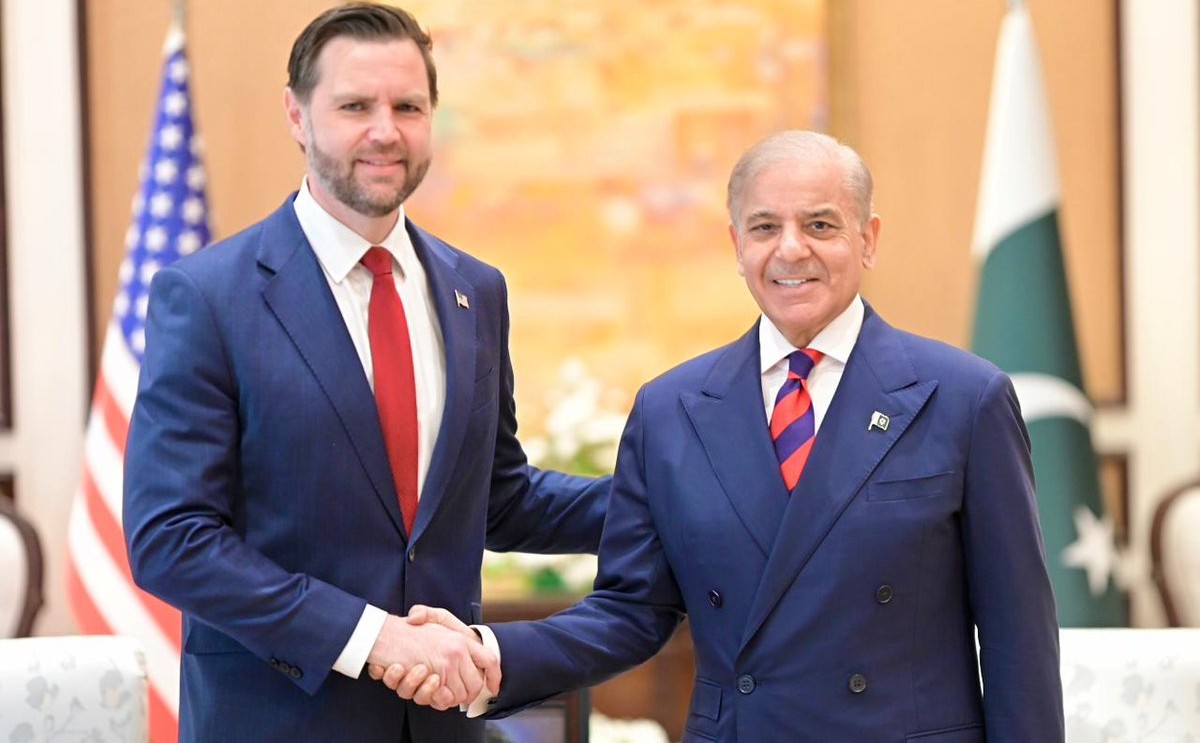
Ahead of U.S.–Iran peace talks—widely seen as a development of profound geopolitical consequence—U.S. Vice President JD Vance and Iranian Parliament Speaker Mohammad Bagher Ghalibaf held separate meetings with host Prime Minister Shehbaz Sharif.
The U.S. delegation arrived in Islamabad on Saturday morning to initiate pivotal negotiations with Iranian leadership. White House Special Envoy Steve Witkoff and senior adviser—and son-in-law of President Donald Trump—Jared Kushner are part of the American delegation for the high-stakes talks.
Vance received a formal welcome at the airport, where Pakistan’s Deputy Prime Minister Ishaq Dar, Chief of Army Staff Asim Munir, and Interior Minister Mohsin Naqvi were present.
In a statement, Pakistan’s Foreign Office said Dar “commended the U.S. commitment to achieving lasting regional and global peace and stability,” while reiterating Islamabad’s readiness to facilitate a durable and comprehensive resolution.
The meeting at the Prime Minister’s House took place shortly after Vance’s arrival.
US Delegation
According to a statement issued by the Prime Minister’s Office, Sharif “commended the commitment of both delegations to engage constructively,” expressing optimism that the dialogue would serve as “a steppingstone toward durable peace in the region.”
The U.S. delegation, led by Vance, also includes officials from the National Security Council, the State Department, and the Department of Defense, reflecting the strategic importance Washington attaches to the negotiations.
Advance teams responsible for security, communications, and technical logistics had arrived in Islamabad earlier.
Iranian Delegation
Parliament Speaker Mohammad Bagher Ghalibaf heads the Iranian delegation to the talks, which follow Tuesday’s agreement on a Pakistan-brokered ceasefire.
The delegation also includes Foreign Minister Abbas Araghchi, Supreme National Defence Council Secretary Ali Akbar Ahmadian, and Central Bank Governor Abdolnaser Hemmati.

The composition of the Iranian delegation underscores Tehran’s intent to engage at both political and economic levels.
A Conflict in Suspension
The negotiations are unfolding against the backdrop of a fragile cessation of hostilities.
The U.S.–Israeli military campaign against Iran, launched on February 28, triggered widespread instability across the Middle East and sent shockwaves through global markets.
A provisional ceasefire, brokered by Pakistan on April 8, has temporarily halted active conflict.
The Islamabad talks are taking place within this limited two-week window, making the diplomatic opportunity both narrow and critical.
First Direct Engagement Since 1979
A defining feature of these talks is their historic nature.
According to Tasnim, this marks the first direct high-level engagement between the United States and Iran since 1979—a year that reshaped the geopolitical landscape following the Iranian Revolution.
US, Iran Prepare for Islamabad Talks as World Watches for Breakthrough
The symbolic and substantive implications are significant. Decades of estrangement, sanctions, proxy conflicts, and diplomatic deadlock have culminated in this rare moment of direct dialogue.
Pakistan’s Strategic Diplomatic Re-emergence
Pakistan’s role as both host and intermediary signals its re-emergence as a consequential diplomatic actor.
By facilitating a ceasefire and enabling direct negotiations, Islamabad has positioned itself at the center of global diplomacy.
Deputy Prime Minister Ishaq Dar reinforced this stance, expressing hope that “parties would engage constructively,” while reiterating Pakistan’s commitment to supporting a “lasting and durable solution to the conflict.”
A Moment of Global Consequence
With senior leadership from both sides engaged in a carefully structured diplomatic framework, the stakes are exceptionally high. Iran’s nuclear program and the restoration of international shipping through the Strait of Hormuz remain central concerns for Washington, while Tehran is pressing for sanctions relief and enforcement of a ceasefire in Lebanon.
The presence of key U.S. figures such as Jared Kushner and Steve Witkoff, under Vance’s leadership, underscores the White House’s investment in the process, while Iran’s senior representation reflects a parallel level of commitment.
The outcome, however, remains uncertain amid continued posturing and sharp rhetoric from both sides.
Pakistan’s Mediation in US–Iran Ceasefire Adds $3 Trillion to Global Markets — Economist
A successful outcome could pave the way for de-escalation, regional stability, and economic normalization. Conversely, failure risks a renewed escalation—potentially more severe than before—at a time when the global economy is already strained by high energy prices, trade disruptions, and reduced oil and gas output.
For now, international attention is firmly fixed on Islamabad—a city that, at this critical juncture, stands at the center of efforts to shape the future of Middle Eastern stability.

Kiran Asim is a writer who covers the U.S., Europe, South Asia, and the Middle East. Her reports and analyses look at the geostrategic issues and contemporary developments and their economic and political implications. She also writes about society and education.

Muhammad Luqman is Associate Editor at Views News Now. He writes on wide-ranging issues including economy, South Asia, the Middle East, agriculture, economy and innovation. Luqman has worked some of the leading news organizations and won acclaim for his original and research-based works.