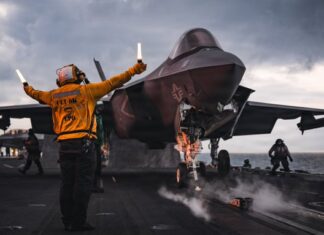
After two weeks of sustained military pressure, the United States has called a halt to offensive operations against Iran—a decision driven by urgent warnings from senior advisers over shrinking regional weapons stockpiles.
The pause was finalized following a Friday meeting between President Donald Trump and senior members of his cabinet. Washington has also signaled a renewed openness to a diplomatic off-ramp for the escalating Strait of Hormuz crisis.
The decision marks a departure from the president’s own rhetoric just days earlier, when he declared U.S. forces were “locked and loaded” and weighing a massive strike campaign. Yet behind the scenes, administration officials are confronting a less flexible reality.
According to The New York Times, concerns over depleting Patriot interceptor missiles and other defensive munitions have become a central factor in the White House calculus. The logistics crunch has been compounded by fears of a wider regional conflagration.
Additional anxieties cited by officials include the potential alienation of Gulf allies, fresh shocks to the global economy, and the unpredictable domestic fallout inside Iran itself, where some advisers warn that heavier bombing could bolster Tehran’s internal cohesion rather than force it back to the table.
US, Iran Exchange Strikes as Trump Signals Major Military Operation
A Fragile Diplomatic Corridor
At the same time, the administration has confirmed that diplomatic channels are now active, though the nature and scope of talks between Washington and Tehran remain opaque.
It is unclear whether the June 17 Memorandum of Understanding—already severely eroded by hostilities since early July—will serve as the foundation for any potential accord.
That interim deal, brokered by Pakistan, had offered a brief window of calm before the current flare-up. Islamabad, still serving as chief mediator, has urgently called for cessation of hostilities to allow diplomacy room to breathe.
The U.S. naval blockade against Iran remains in full effect. As of July 25, CENTCOM has redirected 12 commercial vessels trying to run the blockade, disabled 2 that didn’t comply, and boarded 2 to ensure total compliance.
Earlier today, U.S. forces completed a verification… pic.twitter.com/eyp1N2B9sO
— U.S. Central Command (@CENTCOM) July 25, 2026
Middle East Tensions Smolder Despite Lull
Even as some fronts quieted, the region remained volatile over the weekend.
In the Caspian Sea, Ukraine confirmed it struck an Iranian cargo vessel ferrying military supplies between Iran and Russia—a corridor long used for weapons transfers, according to Western intelligence.
Tehran acknowledged the vessel was Iranian and reported one crew member killed and another wounded.
Meanwhile, in Yemen, the Iran-backed Houthi militia claimed responsibility for rocket and drone attacks on Saudi energy facilities along the Red Sea coast. Saudi-led coalition forces said they retaliated with strikes on Houthi military targets Saturday.
Social media footage verified by The New York Times showed smoke rising near the Saudi Aramco refinery in Jazan, though Riyadh has yet to issue an official statement.
The Houthis have also declared a maritime blockade on Saudi vessels in the Red Sea, firing on passing ships and adding fresh upward pressure on global oil prices.
Pentagon Reinforces as Strategic Debate Intensifies
The apparent pause in fighting has done little to ease fears of a sudden deterioration.
The Pentagon has rushed additional forces, weaponry, and supplies to the region, while U.S. strikes have increasingly targeted railway bridges used by both civilians and Iranian military logistics to supply the southern coastal zone near the strait.
With Trump scheduled to host Israeli Prime Minister Benjamin Netanyahu on Tuesday—their first meeting since Netanyahu advocated in February for a joint U.S.-Israeli offensive, which ultimately began weeks later—the president faces a pivotal choice in the midterm election year.
Oil Surges to $100 a Barrel as Houthi Attacks Escalate Red Sea Crisis
The Central Command has said the U.S. naval blockade of Iranian ports remains in place.
Analysts say the latest calls for restraint appear to endorse continued naval interdiction and sustained economic pressure on Iran. However, they also offer an opportunity for diplomatic negotiations as an open-ended bombing campaign risks regionwide chaos and oil supply disruptions that could prove costly for everyone.

Iftikhar Ali is a veteran Pakistani journalist, former president of UN Correspondents Association, and a recipient of the Pride of Performance civil award