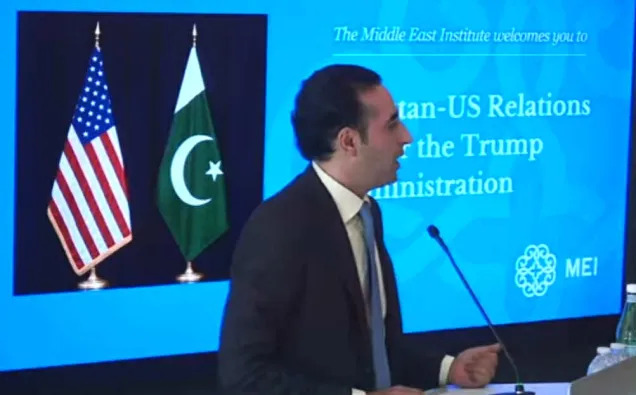
Pakistan’s former foreign minister Bilawal Bhutto Zardari, who is heading a delegation on diplomatic blitz in the U.S. capital, Thursday warned that India’s water war on his country could spiral into a nuclear conflict.
Speaking at the Middle East Institute in the backdrop of last month’s India-Pakistan conflict, Bilawal Bhutto, Pakistan stands for peace in South Asia but has also made it clear that blocking its share of water flowing from Himalayan Kashmir region rivers would be an act of war.
The PPP Chairman and member of Parliament feared that the water wars in the face of looming climate challenges that once sounded a theory could become a precarious reality.
“In the age of climate challenges that are to come, water scarcity and water wars used to be a theory. India shutting off Pakistan’s water supply is laying the foundations for the first nuclear water war. We have said that cutting off our water supply would be an act of war.”
Bilawal Bhutto warned New Delhi against backing out of the longstanding internationally brokered Indus Waters Treaty that governs fair distribution of downstream water between the two countries and called for continued flow of water.
The May 7-10 India-Pakistan deadly clashes rocked the region and which according to President Donald Trump raised fears of a nuclear conflict.
India blamed that a terrorist attack in Pahalgam area of the disputed Kashmir region had a Pakistani link. Islamabad firmly denied the charge and offered to cooperate in a neutral and transparent investigation.
However, India launched aerial strikes into Pakistani cities on May 7 as retributive action against terrorists, but Pakistan said they only killed innocent civilians. Islamabad retaliated with its own strikes against India and downed at least five Indian warplanes including French high-tech Rafales. It was only after President Trump’s diplomatic effort that the two countries agreed to a ceasefire.
In his remarks, Bilawal Bhutto asked Indian Prime Minister Narendra Modi’s government to stop politicizing the issue of combating terror and argued that a resolution to the key Jammu and Kashmir dispute would pave the way for durable peace in South Asia.
Islamabad, he told a gathering of think tank experts, former diplomats, and journalists, sees any move to block water as an existential question, and Islamabad is cautioning the world against the things getting out hand in a sobering manner.
“We don’t say it in a jingoistic manner. We don’t say it with any relish. It is an existential crisis for us. Any country on the planet, no matter their size, their strength or their ability, would fight for their survival and fight for their water.”
An Indian parliamentary delegation is also in D.C. to press New Delhi’s case for its punitive action against terrorists, it alleges orchestrated an April 22 attack that killed 26 tourists.
New Delhi has faced backlash domestically in the wake of embarrassing Indian military losses and lack of support for its attack against Pakistan in South Asia and internationally.
In his remarks at the MEI conference on US-Pakistan relations, Bilawal also drew the world attention to the positives that could result from India-Pakistan cooperation.
“Surely, India and Pakistan working together, we can eradicate terrorism from the subcontinent. India and Pakistan working together can create that conducive environment in Kashmir where the people that live there can live there free from oppression, suffocation, and actually see prosperity. India and Pakistan’s cooperation obviously would require the waters to flow freely, but it should lead to broader cooperation.
“The challenge of climate change and water scarcity is a challenge for Pakistan. It’s also a challenge for India. How are we going to face the coming decade? We’ve already experienced devastating floods, droughts and the manifestation of climate change in various forms.”
Bilawal Bhutto has been critical of Indian prime minister Modi’s policies since declaration that India would not give Pakistan even a single drop of water.
“I believe Pakistan and India working together can meet that challenge as well. If we don’t rise to this occasion, then let there be no mistake, the blame for the carnage, the devastation, the scourge, the quarrel, will lie at the footsteps of Narendra Modi and his government. You’ve heard today, I don’t want to go into repetition.”
While making the case for India-Pakistan cooperative ties, Bilawal Bhutto underlined the importance of a futuristic approach.
“Now they’re damning my generation, future generations, not only to fight over Kashmir, not only to go to full-out war whenever there’s a terrorist attack, but now we’re damning future generations of Indians and Pakistanis to fight over water.
“This is why I am so confident, I am so passionate in our cause. I refuse to damn the people of my country, and I bear no ill will to the people of India. I refuse to damn the youth of India that my children and their children will fight over water, over Kashmir, over terrorists.”
On the U.S. role, he welcomed the ceasefire but underscored that Washington must stop India form flouting the Indus Waters Treaty.
“You cannot allow this precedent to be set in the Pakistan context, because we’ll fight the first war, but it won’t be the last. If India is allowed to cut off our water, that means that every upper riparian with hostilities to a lower riparian now has a carte blanche.
“And if our dialogue and diplomacy in pursuit of peace are to be successful, if we are to talk to India, have a positive dialogue with India, make new arrangements, new deals, perhaps even new treaties with India, then surely they first must abide by the old treaties and take back their decision vis-a-vis the IWT.”

Ali Imran is a Washington-based journalist, who has worked for leading world news organizations as a correspondent, expert and in editorial positions. He is a published author and poet.