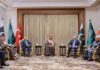
Pakistan has accelerated backchannel diplomatic efforts to bring the United States and Iran back to the negotiating table under the Islamabad Process, media reports said Monday.
According to unconfirmed reports, a second round of talks could take place on Thursday.
U.S. broadcasters, citing officials in Washington and Islamabad, said a second round of negotiations is under active consideration following last week’s rare direct talks, which ended without a breakthrough on the contentious nuclear issue.
VICE PRESIDENT VANCE says the ball is in Iran’s court after peace talks collapsed: “We made very clear, look, these are the things that we’re willing to give, but these are the things that we must have. We must have the enriched material out of Iran. We must have their conclusive… pic.twitter.com/DA9Je52Qu0
— Fox News (@FoxNews) April 13, 2026
Prime Minister Shehbaz Sharif referred to the ongoing efforts on Monday, saying “today, the ceasefire still stands. As I am talking to you, matters that are not resolved, full efforts are underway to resolve them.”
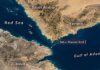
The renewed push comes amid heightened tensions after President Donald Trump announced that the U.S. Navy would begin a blockade of the Strait of Hormuz following the inconclusive Islamabad talks.
The move is aimed at countering Iran’s leverage over the strategic waterway and restricting vessels linked to Tehran, while also signaling Washington’s intent to accelerate progress toward a negotiated settlement.
President Trump also revealed Monday that “right people” from Iran have approached the United States and that they want to make a deal. Vice President JD Vance also left open the possibility of more talks when he said in Islamabad that the U.S. has presented a deal to Tehran.
Analysts say the approach reflects a dual-track strategy — combining coercive pressure with sustained diplomatic outreach — intended to push Iran back toward negotiations and increase the chances of securing a broader agreement.
Trump Says Iran Still Seeking Deal as Pressure Mounts over Strait of Hormuz
According to CNN, officials in the Trump administration are weighing the possibility of another face-to-face meeting with Iranian counterparts ahead of next week’s ceasefire deadline.
Quoting a source familiar with the matter, the report said no final decision has been taken and that planning remains at an early stage.
“We’ve made clear that we absolutely need to see the nuclear material come out of the country of Iran…the ball is in the Iranians’ court because we put a lot on the table.” — VP Vance pic.twitter.com/s4Ki2HqL4U
— Vice President JD Vance (@VP) April 14, 2026
Officials are assessing potential dates and venues, contingent on progress in ongoing backchannel diplomacy involving regional mediators.
“We need to be ready to move quickly if momentum builds in that direction,” the source said.
Iran Says Open to ‘Balanced and Fair’ Agreement as Nuclear Talks with US End in Stalemate
Saturday’s marathon talks in Islamabad — led by U.S. Vice President JD Vance and Iranian Parliamentary Speaker Mohammad-Bagher Ghalibaf — capped weeks of intensive diplomacy involving senior officials and intermediaries from Pakistan, Turkey, Egypt and Oman.
A regional source told CNN that another round of negotiations remains likely, with Turkey actively working to bridge differences between Washington and Tehran.
Separately, CBS News reported that a senior Pakistani official confirmed Islamabad is maintaining active diplomatic engagement with both sides to facilitate a resumption of talks.
Pakistan is soon going to host the 2nd round of Islamabad Talks between Iran and the US. It will give 2nd round of heartburn to the Indian media.
— Ashok Swain (@ashoswai) April 13, 2026
Despite the lack of a breakthrough, Pakistani authorities remain cautiously optimistic that dialogue will continue, urging both Washington and Tehran to return to negotiations at the earliest opportunity.
The immediate objective is to reach a workable understanding before the Pakistan-mediated ceasefire — which began on April 7 — expires around April 22, in order to prevent renewed escalation.
“I think it was the first time that you’d ever seen the Iranian government, the U.S. government meet at such a high level, maybe in the history of the current leadership of Iran. So that’s, I think, a positive—and again, we did make some progress in the negotiation,” says @VP.… pic.twitter.com/PGN6tNZag8
— Rapid Response 47 (@RapidResponse47) April 13, 2026
Although the first round of talks proved inconclusive, both Washington and Tehran praised Pakistan’s leadership — including Prime Minister Shehbaz Sharif and Army Chief Asim Munir — for facilitating what was the first direct engagement between the two sides in nearly five decades. The talks lasted approximately 21 hours.
Pakistan is now awaiting formal responses from both governments on the next steps, the report added.

Kiran Asim is a writer who covers the U.S., Europe, South Asia, and the Middle East. Her reports and analyses look at the geostrategic issues and contemporary developments and their economic and political implications. She also writes about society and education.

Muhammad Luqman is Associate Editor at Views News Now. He writes on wide-ranging issues including economy, South Asia, the Middle East, agriculture, economy and innovation. Luqman has worked some of the leading news organizations and won acclaim for his original and research-based works.