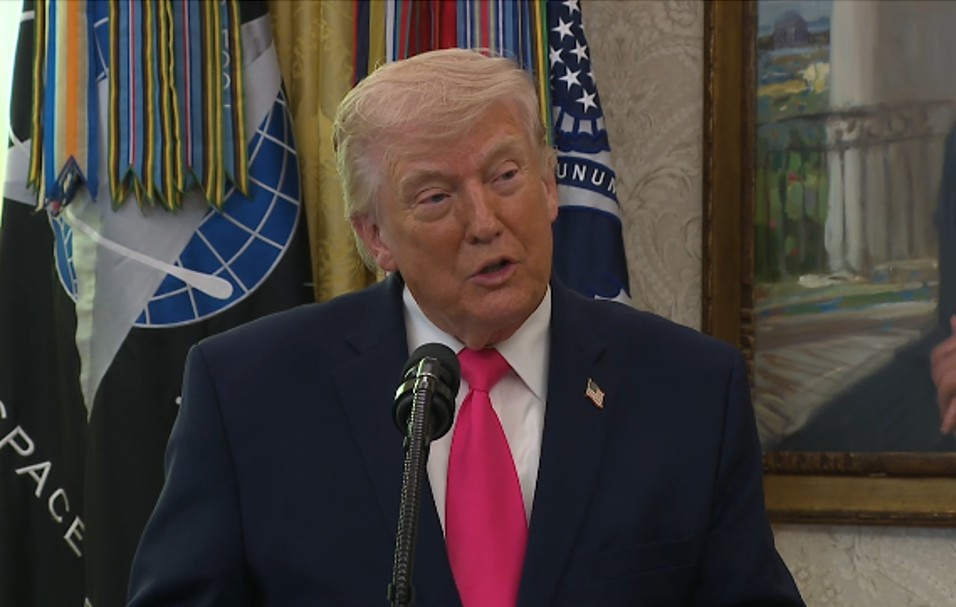
President Donald Trump Monday said the “right people” in Iran still want to make a deal with the United States following their inconclusive meeting in Pakistan while a report indicated Washington was considering preparation for another possible meeting with Tehran.
“We’ve been called by the other side and they would like to make a deal very badly,” Trump said as U.S. military said it was blockading the Strait of Hormuz – a measure being seen as a pressure tactic.
“We’ve been called this morning by the right people, the appropriate people, and they want to work a deal,” he added.
Trump emphasized that Tehran won’t have a nuclear weapon –- an issue which over which the two sides could not reach an agreement, according to Vice President JD Vance, who led the U.S. at the historic Islamabad.
The Islamabad meeting marked the first face-to-face meeting between Washington and Tehran since 1979, which the Iranian revolution changed the course of the Gulf nation.
“We agreed to a lot of things, but we did not agree to that, but I think they will agree to it,” Trump remarked.

A CNN report indicated Monday that diplomatic channels remain cautiously open despite recent setbacks.
The White House has not publicly commented on the report.
The Trump administration officials are internally discussing details for a potential second, in-person meeting with Iranian officials before the ceasefire between Washington and Tehran expires next week.
Citing sources familiar with the talks, the channel reported that “officials are looking at potential dates and locations should ongoing talks with Iran and mediators in the region progress in the coming days.”
“We need to be prepared to stand something up quickly should things head in that direction,” a source told the channel.
These preliminary internal discussions reflect a pragmatic approach by the administration: maintaining readiness for rapid diplomacy even as President Donald Trump has publicly stepped up pressure on Iran, including a naval blockade of the Strait of Hormuz.
From Escalation to Fragile Truce
The current two-week ceasefire was announced by President Trump on April 7, 2026, just hours before a self-imposed deadline after which he had threatened severe consequences, including potential strikes on Iranian infrastructure.
The truce, which also involved Israel, was conditioned on Iran facilitating the reopening of the critical Strait of Hormuz—a vital global oil chokepoint that Tehran had effectively disrupted during the preceding weeks of conflict.
Tensions Surge as US Moves to Blockade Iran, Tehran Threatens Regional Ports
Mediated mainly by Pakistan, the agreement halted US and Israeli airstrikes while allowing Iranian coordination of vessel passage through the strait. It was intended to create breathing room for broader negotiations aimed at addressing core issues: Iran’s nuclear program, ballistic missiles, regional proxy activities, and long-term stability in the Middle East.
High-level talks convened in Islamabad over the weekend represented the most significant direct engagement between US and Iranian officials in almost half a century.
The US delegation, led by Vice President JD Vance and including special envoy Steve Witkoff and Jared Kushner, engaged in marathon sessions—reportedly stretching to 21 hours.
Despite reports of some mutual respect developed during the closed-door discussions, the two sides could not bridge their fundamental gaps, particularly on verifiable commitments regarding Iran’s nuclear ambitions.
Vice President Vance described the outcome bluntly, noting that while no deal was reached, the US had presented what it viewed as its “final and best offer.” Iranian officials, for their part, pointed to perceived violations and unmet preconditions, including developments in Lebanon involving Hezbollah and the release of blocked assets.
Pakistan, which hosted the talks and whose Prime Minister and military leadership played key facilitating roles, expressed surprise at the swift conclusion and continues to urge both parties to preserve the ceasefire.
Current Tensions and the Path Forward
As of Monday, the ceasefire is described by President Trump as “holding well,” yet strains are evident.
Ongoing Israeli operations against Hezbollah in Lebanon have drawn Iranian criticism, with Tehran arguing that a broader de-escalation—including in Lebanon—should accompany any sustained US-Iran dialogue.
The administration’s internal planning for a potential second in-person meeting underscores a dual-track strategy—preparing for possible escalation while keeping diplomatic off-ramps available.
Sources emphasize that any such gathering would depend on progress in indirect talks mediated by regional actors in the coming days. Locations under consideration could build on the Pakistan-hosted model or involve other neutral venues, though nothing has been finalized.
This moment echoes broader patterns in US-Iran relations under President Trump, who has long favored a combination of maximum pressure and opportunistic deal-making.
However, skepticism remains high. Iran has historically approached negotiations with caution and a long-term perspective, while the Trump team has signaled impatience for tangible concessions.
With the ceasefire window closing rapidly—potentially as early as April 22—time is a critical factor.
Views News Now correspondents Muhammad Luqman and Kiran Asim contributed to this report.

Asim Tanveer is a seasoned journalist working for TV and electronic and print media outlets. He has been working for some of the world’s leading news organizations including Associated Press (AP), Reuters, BBC, CNN, CNBC, Star TV, Voice of America and The New York Times for more than 30 years. He has won several awards for his live coverage of events that include a Reuters News Agency World Award and the Pride of Performance award in 1997.

Ali Imran is a Washington-based journalist, who has worked for leading world news organizations as correspondent, expert and in editorial positions. He is a published author and poet.