United Nations Secretary-General Antonio Guterres expressed his deep admiration for Pakistan, recalling the time spent here as High Commissioner for Refugees and praising its mediation role toward ending the U.S.-Iran conflict.
“I could not finish my mandate as secretary-general without coming again to Pakistan. Because Pakistan is deep in my heart,” the outgoing UN chief told PTV as began his visit to the South Asian country.
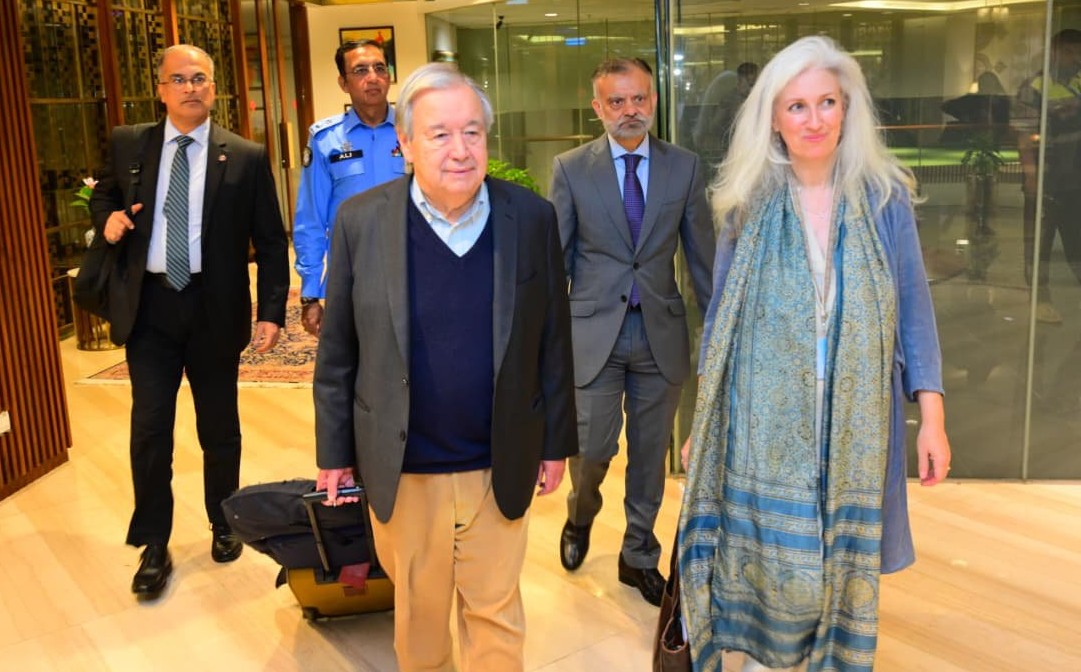
Guterres arrived in Islamabad on Tuesday for a three-day official visit, his second trip to Pakistan after a 2022 solidarity visit focused on catastrophic floods.
The visit, running from October 6 to 8 at the invitation of Deputy Prime Minister and Foreign Minister Ishaq Dar, comes near the end of Guterres’ 10-year tenure, which concludes on December 31.
Deputy Prime Minister/Foreign Minister Senator Mohammad Ishaq Dar @MIshaqDar50 met UN Secretary-General António Guterres @antonioguterres in Islamabad. Discussions covered regional and global issues relating to peace and security, including Palestine, Jammu & Kashmir, Afghanistan, counter-terrorism, and the future of multilateralism.
DPM/FM briefed the UNSG on Pakistan’s positions on Jammu & Kashmir and the Indus Waters Treaty, reaffirming Pakistan’s call for a just and peaceful resolution of the Kashmir dispute in accordance with relevant UNSC resolutions.
DPM/FM highlighted Pakistan’s diplomatic efforts to promote dialogue and de-escalation, including its facilitation of the Islamabad Talks between the US and Iran. He reaffirmed Pakistan’s commitment to dialogue and diplomacy as the most effective means of resolving disputes.
The UNSG appreciated Pakistan’s longstanding contribution to the UN, as well as its diplomatic efforts to promote dialogue, mediation, and de-escalation.
— Ministry of Foreign Affairs – Pakistan (@ForeignOfficePk) October 6, 2026
Personal Connection and Refugee Experience
Speaking to journalists, Guterres made clear the personal significance of the trip.
He recalled his earlier role as UN High Commissioner for Refugees, when he spent a decade observing Pakistan’s response to Afghan displacement.
“I witnessed during my 10 years that the enormous generosity of the Pakistani people receiving the Afghans and sharing everything with them was absolutely unbelievable, of solidarity,” Guterres stated.
He described how Pakistanis had supported one another and displaced people with resilience, courage, and determination during periods when militants advanced close to Islamabad.
“And now I’m seeing again the resilience of the Pakistani people fighting terrorism. And of course, terrorism is something that is unacceptable in all circumstances,” he added.
These comments align with longstanding UN recognition of Pakistan’s role hosting millions of Afghan refugees over decades, often with limited international support.
🇵🇰🇺🇳UN Secretary General Antonio Guterres on his last official visit to Pakistan dropped heavy truth bombs:
‘I witnessed for 10 years the enormous generosity of Pakistanis in receiving Afghan refugees & sharing everything with them. Today, Pakistan is showing resilience against terrorism & demonstrating credibility as an indispensable mediator in major conflicts.’
The truth is that #Pakistan has always stood for innocent people suffering across borders hosting millions of displaced Afghans like brothers, only to get stabbed in the back by terror & betrayal from Kabul.
Every Leader in the world pays Massive respect to Pakistan for always standing on the right side of humanity. 🫡🇵🇰🇺🇳
— T.M (@BlueMist911) October 5, 2026
Praise for Mediation in Major Conflicts
Guterres highlighted Pakistan’s current diplomatic efforts, describing the country as “an extremely important mediator of one of the two most serious conflicts that we have—the Gulf, on one hand, and the Middle East in general—and the war in Ukraine.”
He noted Pakistan’s “enormous capacity of initiative and the credibility that makes it accepted by both sides, which is today very difficult in this divided world.”
He expressed “enormous joy” at being back in Islamabad.
For over two decades in different roles, I have seen #Pakistan as a source of solidarity and solutions.
Pakistan has shown that, even in difficult circumstances, compassion and responsibility must go hand-in-hand.
– @antonioguterres’ full remarks: https://t.co/RHrJ26dsfS https://t.co/t9acGDCzkO
— UN Spokesperson (@UN_Spokesperson) October 6, 2026
In a joint press appearance with Dar, Guterres specifically praised Pakistan’s role in facilitating dialogue between the United States and Iran. He credited Islamabad with helping create conditions that produced the June 17 Islamabad Memorandum of Understanding, a subsequent ceasefire, and a framework for further negotiations.
“Every Pakistani should be proud of that pivotal role,” he said. From Islamabad, he issued a direct call: “End the conflict. Return to diplomacy. Fully restore navigational rights and freedoms in accordance with international law.”
He also linked broader regional peace to the Palestinian people’s right to self-determination, noting Pakistan’s longstanding advocacy on the issue.
Upon landing, Guterres was received by Acting Foreign Secretary Ambassador Nabeel Munir. His schedule includes meetings with President Asif Ali Zardari, Prime Minister Shehbaz Sharif, Dar, and Chief of Defense Forces and Chief of Army Staff Field Marshal Asim Munir. He is also set to visit the headquarters of the United Nations Military Observer Group in India and Pakistan (UNMOGIP) and receive a briefing at the National Disaster Management Authority on Pakistan’s disaster preparedness and early-warning systems.
DPM/FM Senator Mohammad Ishaq Dar @MIshaqDar50 warmly received UN Secretary-General H.E. @antonioguterres at the Ministry of Foreign Affairs at the start of his official visit to Pakistan.
The two will shortly hold talks on Pakistan–UN cooperation and regional and international issues.
@UN
@PakistanUN_NY— Ministry of Foreign Affairs – Pakistan (@ForeignOfficePk) October 6, 2026
Talks Cover Regional and Global Issues
In discussions with Dar, the two sides addressed peace and security matters including Palestine, Jammu and Kashmir, Afghanistan, counter-terrorism, and the future of multilateralism.
Dar briefed Guterres on Pakistan’s positions on Kashmir and the Indus Waters Treaty, reiterating calls for a just resolution of the Kashmir dispute in line with relevant UN Security Council resolutions. He also highlighted Pakistan’s facilitation of the Islamabad talks between the US and Iran and reaffirmed commitment to dialogue as the primary path for resolving disputes.
Guterres appreciated Pakistan’s longstanding contributions to the United Nations and its efforts to promote dialogue, mediation, and de-escalation. Officials described the visit as an opportunity to reaffirm Pakistan’s support for multilateralism centered on the UN Charter and to exchange views on regional and international developments.
Pakistan’s Expanding Middle East Defense Footprint Is Also an Economic Development Test
Broader Context of Solidarity
Observers and Pakistani commentary have underscored that Pakistan has long hosted millions of displaced Afghans, describing the relationship in terms of shared hardship and solidarity, even amid later challenges involving terrorism and relations with Kabul.
Guterres’ remarks framed Pakistan’s record as one of consistent support for people in need and a practical capacity to engage opposing sides in a polarized international environment. Leaders and diplomats have frequently noted this combination of refugee hospitality and mediation credibility.
The visit occurs as Guterres prepares to leave office after two terms. Pakistani officials have presented it as recognition of the country’s role in peacekeeping, disaster resilience since the 2022 floods, and ongoing diplomatic initiatives. Guterres is expected to continue engagements through October 8 before returning to New York.

Kiran Asim is a writer who covers the U.S., Europe, South Asia, and the Middle East. Her reports and analyses look at the geostrategic issues and contemporary developments and their economic and political implications. She also writes about society and education.