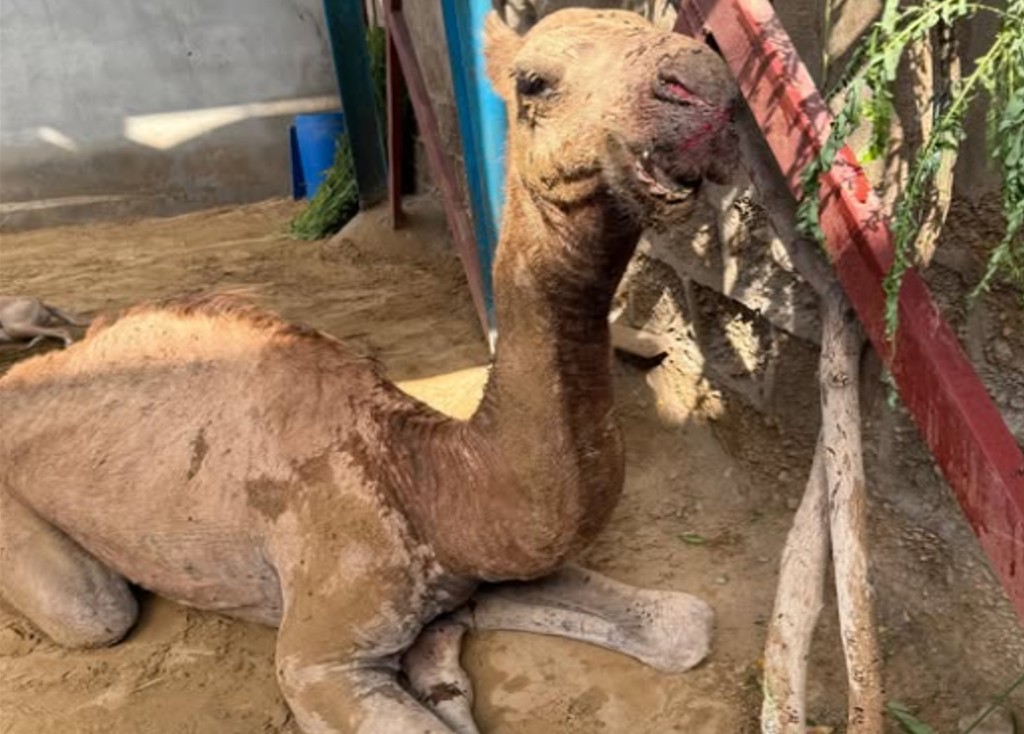
Earlier this month in Sukkur, Sindh, a baby camel was subjected to unspeakable cruelty that has once again exposed Pakistan’s ugly record on animal rights.
For the “crime” of drinking water from a landlord’s property, the animal was tied to a tractor, savagely beaten, its leg mutilated, jaw fractured, and tongue deliberately burned. Images showed the camel writhing in unbearable pain, unable to eat, surviving only on intravenous drips. animals
This was not a random act of violence. It was barbarity performed with impunity in a society where feudal power shields perpetrators and where the state routinely fails to protect its most vulnerable creatures. The camel—later named Sumi by rescuers—has become the latest victim in a country where brutality against animals is not the exception but a recurring headline. animals
The Sukkur case is neither shocking nor new to Pakistanis. Last year, another camel in Sindh had its front leg hacked off after straying into farmland. Its suffering was so extreme that only international intervention and a prosthetic limb offered a semblance of relief.
In Karachi, Noor Jehan, an African elephant, collapsed in a filthy zoo enclosure after months of neglect. She died trapped in concrete, her final hours symbolizing the incompetence and indifference of Pakistan’s municipal authorities.
🚨 ظلم کی انتہا!
سکھر میں بااثر وڈیرے نے کھیت میں پانی پینے پر ایک بے زبان 🐪 اونٹنی کو بدترین تشدد کا نشانہ بنایا اور اس کی ٹانگ توڑ دی 💔😢
انسانیت کا جنازہ نکال دیا گیا… کیا جانوروں کے ساتھ یہ سلوک برداشت کیا جا سکتا ہے؟ 🆘⚖️#Sukkur #AnimalCruelty #Justice ✊ pic.twitter.com/Ok6DeMharP— PakWeather (@Pak_Weather) September 20, 2025
Bears are still trafficked and tortured in underground fighting pits. Street dogs are poisoned en masse in culling drives that amount to little more than state-sanctioned slaughter. Donkeys and horses collapse daily under the weight of overloaded carts, their beatings witnessed on crowded city streets with barely a raised eyebrow.
These are not isolated “incidents.” They form a grotesque catalogue of cruelty, symptomatic of a nation where the law is outdated, governance indifferent, and compassion absent from daily practice.
Pakistan’s main anti-cruelty law, the Prevention of Cruelty to Animals Act, is a relic from 1890. Its penalties are laughable—fines smaller than a dinner bill, jail terms so short they mean nothing.
Recent amendments in Islamabad and Sindh promised reform, but they remain toothless. Laws without enforcement are mere paper shields, and in Pakistan they are trampled with impunity. Police rarely register cases unless social media erupts in outrage. Prosecutors seldom pursue them. Judges often dismiss them as trivial.
The result is a cycle of violence where perpetrators know they will face little more than a slap on the wrist, if even that. The state, by its negligence, becomes complicit.
The mutilation of Sumi the camel lays bare the arrogance of Pakistan’s rural landlord class. In many parts of Sindh and Punjab, feudal lords wield unchecked power, dispensing punishment at will. Violence against animals becomes a grotesque performance of dominance, a reminder to locals of who controls life and death on their land.
Mutilated camel gets back on her feet after year-long recovery
When the perpetrators are powerful, laws collapse. Police hesitate, bureaucrats delay, and politicians just issue hollow condemnations. What justice can an injured camel expect in a system where cruelty itself is a tool of authority?
Pakistan is an Islamic republic, where leaders often invoke religion in politics. Yet when it comes to animals, the gap between belief and behavior is staggering.
Islam is explicit on animal welfare. The Qur’an declares that all creatures form communities like humans. Prophet Muhammad, Peace Be Upon Him, condemned mutilation, cruelty, and neglect. A well-known Hadith (saying of the Prophet) tells of a woman punished in hell for starving a cat, and another forgiven for giving water to a thirsty dog.
Despite this moral clarity, Pakistan ranks among the worst offenders in animal welfare. The cruelty that unfolds daily—in homes, on streets, in farms, in zoos—is a betrayal not just of animals but of the very faith the nation claims to uphold.
Several forces keep this cruelty alive:
Systemic neglect: Veterinary services are scarce, shelters underfunded, and rescue infrastructure almost nonexistent.
Public apathy: Outrage flares only when images go viral. Routine abuse—starving cattle, beaten donkeys, poisoned dogs—barely registers.
Impunity of power: From feudal estates to state-run zoos, those responsible face little consequence.
There ae examples of organizations and individuals taking care of animals and fighting for their protection, and many people love their domesticated animals. Still, a large country like Pakistan needs to step up awareness and enforce the law strictly to ensure animal safety.
At our shelter, love is the language every soul understands 🐾💖
Our workers don’t simply “work” here — they put their hearts into every second. Each smile, each cuddle, each kind touch tells our animals, you are safe, you are loved, you matter. 💕
This is what makes our… pic.twitter.com/zwT683oICa
— Tahira Animal Welfare Foundation – TAWF (@tawf_uk) September 20, 2025
Political cowardice: Animal welfare is dismissed as secondary, never prioritized in parliament, and rarely linked to health, environment, or governance.
This indifference is deadly. Each delay, each weak sentence, each ignored complaint signals to abusers that they can act without fear.
If Pakistan is serious about justice—it must confront this crisis head-on.
- Modernize the law: Outdated colonial statutes must be replaced with comprehensive, enforceable legislation carrying harsh penalties.
- Enforce without fear: Police must be trained and mandated to register and pursue cruelty cases, regardless of the perpetrator’s power.
- Fund veterinary infrastructure: Ambulances, clinics, and shelters must exist not just in cities but in rural districts where most livestock live.
- Cultural and religious education: Sermons, schools, and media must stress that cruelty is un-Islamic, that mercy to animals is a divine command.
- End feudal impunity: No landlord, politician, or official should be untouchable when it comes to acts of brutality.
The world saw Sumi’s mutilated body, her tongue burned, her jaw broken. The images shocked the conscience, but soon they will fade, as they always do. The question is whether Pakistan will allow the cycle to continue.
Animal cruelty here is not a fringe issue—it is a mirror held up to governance, morality, and the nation’s relationship with power and faith. When a camel can be butchered for drinking water, when elephants die in state-run zoos, when bears bleed in fighting pits, the violence reveals more about Pakistan’s society than it does about animals alone.
A country that cannot protect its most defenseless beings has failed in its most basic duty of justice. Pakistanis may quote scripture, proclaim faith, and condemn cruelty in words. But until compassion is enforced in law and practice, the barbarity will continue—quietly, daily, shamefully.
And every new victim, like Sumi, will be less a tragedy than a testament to the nation’s collective failure.
Follow for more: Twitter (X) | Facebook | Instagram | LinkeIn

Kiran Asim is a writer who covers the U.S., Europe, South Asia, and the Middle East. Her reports and analyses look at the geostrategic issues and contemporary developments and their economic and political implications. She also writes about society and education.