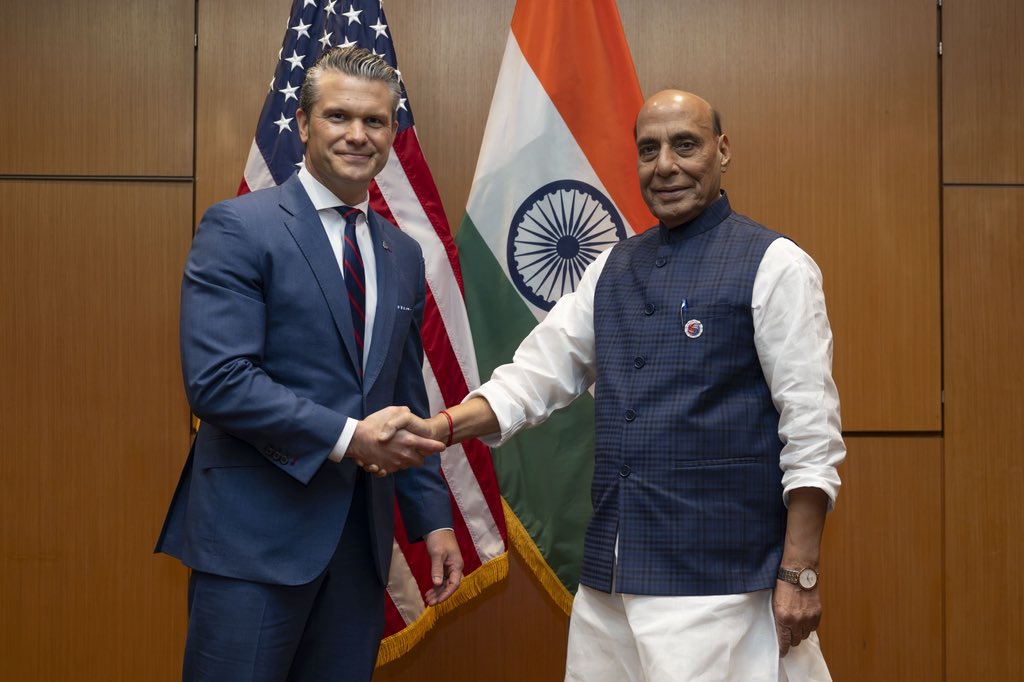
The United States and India Friday entered into a defense framework agreement, with Secretary of War Pete Hegseth describing the partnership as a cornerstone of regional stability and deterrence. defense agreement
“This advances our defense partnership, a cornerstone for regional stability and deterrence,” Hegseth said after inking the agreement with Indian Defense Minister Rajnath Singh in Kuala Lumpur, Malaysia, during a gathering of Asian leaders.
“We’re enhancing our coordination, info sharing, and tech cooperation. Our defense ties have never been stronger,” the U.S. Secretary of War wrote in a post shared on X platform.
I just met with @rajnathsingh to sign a 10-year U.S.-India Defense Framework.
This advances our defense partnership, a cornerstone for regional stability and deterrence.
We’re enhancing our coordination, info sharing, and tech cooperation. Our defense ties have never been… pic.twitter.com/hPmkZdMDv2
— Secretary of War Pete Hegseth (@SecWar) October 31, 2025
The two sides have not shared details of the agreement, which has been signed as Washington and New Delhi seek to put behind frictions over trade and tariff issues including India’s large purchases of Russian oil.
U.S. President Donald Trump, while raising tariffs on Indian products to 50% in August, said New Delhi’s purchases of Russian oil enables Moscow to continue its aggression against Ukraine.
Putin has refused to agree to a ceasefire with Ukraine, despite President Trump’s diplomacy and a meeting with the Russian leader in Alaska.
For his part, the Indian defense minister said the agreement named Framework for the US-India Major Defense Partnership will “usher in a new era in our already strong defense partnership.”
“This Defense Framework will provide policy direction to the entire spectrum of the India-US Defense Relationship. It is a signal of our growing strategic convergence and will herald a new decade of partnership,” he remarked in a post on X.
Rajnath Singh noted that “defense will remain as a major pillar of our bilateral relations.”
Had a fruitful meeting with my US counterpart @SecWar Peter Hegseth in Kuala Lumpur. We signed the 10 years ‘Framework for the US-India Major Defence Partnership’. This will usher in a new era in our already strong defence partnership.
This Defence Framework will provide policy… pic.twitter.com/IEP6Udg9Iw
— Rajnath Singh (@rajnathsingh) October 31, 2025
“Our partnership is critical for ensuring a free, open and rules-based Indo-Pacific region,” Singh added.
Washington has long seen India as a counterweight to China.
India and China have recently taken steps to repair their relationship after engaging in deadly skirmishes in the Himalayan border regions a few years ago.
As President Trump escalated U.S. tariffs on India because of Indian refusal to end Russian oil commerce and strike a trade deal with Washington, Indian Prime Minister Narendra Modi tightened his embrace of President Vladimir Putin and also traveled to China for a meeting with President Xi Jinping.
Modi’s Tightening Embrace of China, Russia amid US Rift – Sovereignty or Strategic Bind?
Modi’s geopolitical posturing apparently aimed at highlighting India’s importance for the West amid new challenges to the U.S.-led world order as Beijing continues to expand its economic partnerships and influence across Asian regions, and Russia shows no signs of halting its war on Europe’s edge.
India has also had acrimonious relationship with its nuclear-armed South Asian neighbor Pakistan.
The two neighboring countries fought a dangerous four-day conflict in May before President Trump intervened to announce a ceasefire on May 10.
Follow for more: Twitter (X) | Facebook | Instagram | LinkeIn

Ali Imran is a Washington-based journalist, who has worked for leading world news organizations as a correspondent, expert and in editorial positions. He is a published author and poet.