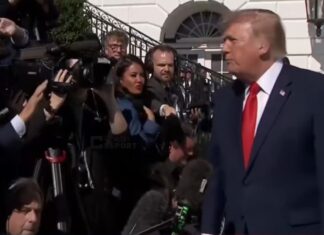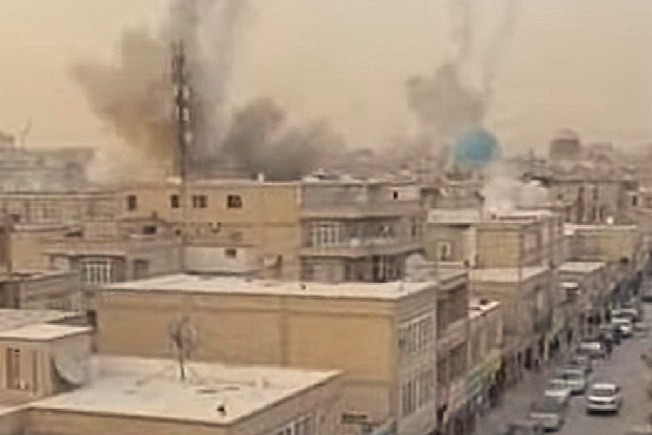
President Donald Trump signaled Monday that U.S. military operations against Iran could extend beyond their initially projected four-to-five-week duration, underscoring Washington’s readiness for a prolonged conflict as tensions escalate across the Middle East.
“We have the capability to go far longer,” Trump said, signaling that the administration is prepared to sustain military pressure if necessary.
The president defended the U.S. decision to launch strikes, arguing that Tehran’s expanding nuclear ambitions and long-range missile development posed an imminent and unacceptable danger.
According to Trump, Iran’s missile program was designed to shield its nuclear weapons development and make it “extraordinarily difficult” for outside powers to intervene.
Trump Announces ‘Major Combat Operations’ in Iran Following Israeli Strikes
“An Iranian regime armed with long-range missiles and nuclear weapons would be an intolerable threat — not only to the Middle East, but to the American people,” he said.
Trump’s remarks came after military leaders reportedly warned that the conflict could stretch beyond early projections, reflecting the scale and intensity of ongoing operations.
Regional tensions have intensified sharply following the killing of Iran’s Supreme Leader, Ali Khamenei, on Saturday.
Iranian forces have since retaliated with strikes targeting oil infrastructure and U.S. military bases in neighboring Gulf states, raising fears of a broader regional war.
Two days ago, the Iranian regime had 11 ships in the Gulf of Oman, today they have ZERO. The Iranian regime has harassed and attacked international shipping in the Gulf of Oman for decades. Those days are over. Freedom of maritime navigation has underpinned American and global… pic.twitter.com/nzdkMVMqZC
— U.S. Central Command (@CENTCOM) March 2, 2026
Speaking at a White House Medal of Honor ceremony, Trump framed the U.S. action as a preemptive measure aimed at preventing a greater catastrophe.
He warned that Iran already possesses missiles capable of striking Europe and U.S. installations abroad — and suggested that the regime was nearing the capability to reach the American mainland.
“The regime already had missiles capable of hitting Europe and our bases, both local and overseas,” Trump said. “They would soon have had missiles capable of reaching our beautiful America.”
Under the U.S. Constitution, only Congress has the authority to formally declare war, though the president may order military action in response to an imminent threat — a constitutional distinction likely to shape the domestic political debate as the conflict unfolds.
Meanwhile, countries across the region are bracing for an uncertain and potentially volatile period, marked by security risks, economic instability and concerns over energy markets, amid reports of a sharp drop in shipping traffic through the Strait of Hormuz and the prospect of wider geopolitical and economic fallout.

Ali Imran is a Washington-based journalist, who has worked for leading world news organizations as a correspondent, expert and in editorial positions. He is a published author and poet.