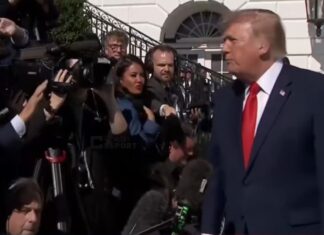
As President Donald Trump met with Chinese President Xi Jinping in Beijing on Thursday, global energy security took center stage in their discussions.
Iran has actively begun enforcing a new toll regime on the Strait of Hormuz while simultaneously allowing select Chinese vessels to pass, creating a complex mix of confrontation and pragmatism that tests great-power diplomacy.
What is Iran’s Toll Structure
Iran has established the Persian Gulf Strait Authority (PGSA) and is now charging transit fees on vessels moving through the critical waterway, which carries about one-fifth of the world’s oil. Ships are required to obtain clearance codes, submit documentation, and pay substantial fees — reportedly up to $2 million for large oil tankers — with payments often accepted in Chinese yuan or cryptocurrency.
White House says US, China Agree Strait of Hormuz Must Remain Open
Iranian officials have already confirmed collecting and depositing the first toll revenues into the central bank.
This move, framed by Tehran as an exercise of sovereignty and compensation for providing security, has drawn strong U.S. warnings against any shipping companies that comply, citing potential sanctions.
Selective Passage Granted to Chinese Ships
In a notable development reported on the same day, Iran has started allowing some Chinese vessels to transit the strait. The semi-official Fars news agency, citing an informed source, stated that this followed requests by China’s foreign minister and ambassador to Iran.
Tehran agreed to facilitate the passage of a number of Chinese ships in line with the two countries’ strategic partnership and after reaching an understanding over Iranian management protocols for the waterway.
This selective relief highlights China’s heavy reliance on Iranian oil and the strength of bilateral ties, even as broader international shipping continues to face restrictions and uncertainty.
Who Wins Economically from the Iran War — US, China, or Neither?
Trump and Xi Agree on Open Access
During their summit, the two leaders addressed the issue directly. The White House said that President Trump and President Xi agreed the Strait of Hormuz “must remain open to support the free flow of energy,” as reported by AFP and Reuters. This joint position underscores a shared interest in preventing further disruptions to global energy markets.
“The two sides agreed that the Strait of Hormuz must remain open to support the free flow of energy,” the White House readout emphasized. For Trump, keeping energy prices stable protects American consumers and businesses, while for Xi it safeguards vital supply lines for the Chinese economy.
Background and Broader Implications
The current tensions stem from earlier 2026 disruptions in the region that prompted Iran to tighten control over the strait. While some vessels have reportedly paid the new fees to ensure safe passage, the United States continues to oppose any formal toll structure on this international chokepoint, viewing it as a dangerous precedent.
Analysts see this situation as a classic great-power contest: Iran using its geographic leverage to generate revenue and assert influence, China securing its energy imports through quiet diplomacy, and the U.S. pushing back to maintain freedom of navigation principles.
The Trump-Xi meeting provided hopeful diplomatic language, but turning agreement into concrete action on fully reopening the strait remains a significant challenge as talks continue.
However, these developments carry direct consequences — potential impacts on gasoline prices, global supply chains, and the effectiveness of U.S. sanctions policy.
As the Beijing summit progresses, the Hormuz question illustrates how regional flashpoints can quickly intersect with superpower relations.

Kiran Asim is a writer who covers the U.S., Europe, South Asia, and the Middle East. Her reports and analyses look at the geostrategic issues and contemporary developments and their economic and political implications. She also writes about society and education.