Bilawal Bhutto-Zardari, head of a major coalition party in Pakistan’s federal government said the government and protesters in Azad Jammu and Kashmir should accept a truth and reconciliation commission as the way out of weeks of deadly unrest.
Speaking to party workers in Muzaffarabad, he said he had pressed for such a body for a month. “All the state had to do was form a truth and reconciliation commission and task it with discerning the truth, and the protesters would have been asked to halt their protests until the commission presented its findings,” Bilawal stated.
The proposal comes as the region holds phased legislative elections under a prolonged communications blackout, with reports claim dozens dead since early June. The conflict centers on governance, economic pressures, and a constitutional dispute over political representation—issues that have left ordinary residents caught between competing claims of legitimacy and security.
Mirpur walo, mujhe aap ki madad chahiye.
27 July ko teer par mohar lagayen aur PPP ko bhaari mandate dein, taa-ke hum riyasat aur ihtijaj karne walon, dono se keh saken:
Sach aur Mafahamat Commision sirf Bilawal Bhutto Zardari ka mutalba nahin. Yeh Mirpur aur Kashmir ke awam ka… pic.twitter.com/17ZVbPd406
— Bilawal Bhutto Zardari (@BBhuttoZardari) July 26, 2026
Roots of the Unrest
Azad Jammu and Kashmir, the Pakistan-administered portion of the disputed Himalayan territory, operates under a semi-autonomous system with its own legislative assembly, prime minister, and courts. Ultimate authority on defense, foreign affairs, and currency rests with Islamabad.
The Joint Awami Action Committee (JAAC), a grassroots coalition of traders, civil society groups, and activists formed in 2023, has led successive waves of protests over inflation, electricity tariffs, flour shortages, and perceived elite privileges.
In 2025 the group issued a 38-point charter of demands. Authorities say most were addressed. The remaining flashpoint is the demand to abolish 12 seats in the 45-member Legislative Assembly reserved for refugees who fled Indian-administered Jammu and Kashmir after 1947 and settled in other parts of Pakistan. JAAC argues these seats dilute local representation because the refugees do not reside in Azad Kashmir and vote from constituencies across Pakistan.
Violence-Marred election in Pakistani Kashmir Triggers Coalition Clash
Officials and the region’s top court maintain the seats are constitutionally protected under the 1974 interim constitution and tied to Pakistan’s broader position on the Kashmir dispute. Abolishing them, they warn, would require a constitutional amendment and could weaken Pakistan’s international claims.
Talks between federal and regional officials and JAAC leaders broke down in late May 2026. On June 5 the Azad Kashmir government banned JAAC under anti-terrorism legislation, accusing it of engaging in violence, acquiring weapons, and planning to disrupt public order. Mobile and internet services were suspended across much of the territory—restrictions that remain largely in place.
Escalation and Competing Narratives
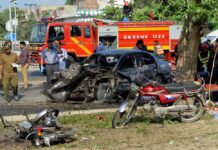
Violence reportedly intensified around Rawalakot in Poonch district. Authorities report that on June 7–8 armed individuals linked to JAAC opened fire on security forces, laid siege to the Combined Military Hospital (CMH), disrupted medical services, and left several law-enforcement personnel dead or wounded. Police described a planned attack that endangered patients and staff. Officials later said the hospital was cleared and services restored.
#PAKWatch🇵🇰: Today, PAK AUTHORITIES OPENED FIRE on protestors in Rawalakot, Kashmir.
PAK = MILITARY RUNS THE SHOW = 3RD WORLD.
IT’S TIME FOR THE PAK MILITARY GOV’T TO TAKE THE EXIT DOOR.
FREE IMRAN KHAN.
pic.twitter.com/1BLX6tIQV3— Steve Hanke (@steve_hanke) July 28, 2026
JAAC leaders rejected the account. They accused security forces fired on peaceful protesters gathered near the hospital after the death of a supporter, describing the state’s response as a “massacre.” Casualty figures from that weekend alone varied: reports cited four security personnel and several civilians or protesters killed, with dozens injured on both sides.
As per Dawn newspaper reporting, the crackdown continued with arrests of leaders, restoration of earlier cases against activists, and reports of supply disruptions while some JAAC figures publicly appealed for external help. Leader Sardar Aman Khan reportedly called on India for humanitarian assistance, citing shortages of food and medicine, and urged the opening of the Line of Control.
Pakistani officials have pointed to such statements, along with alleged militant elements and foreign funding, as evidence that the protests serve an anti-state agenda. Information Minister Attaullah Tarar recently described the unrest as driven by militants pursuing a foreign agenda backed by Indian funding. JAAC has denied these charges and framed its campaign as a demand for local rights and accountability.
Human rights groups, including Amnesty International, have expressed concern over the use of lethal force, the ban on the group, mass arrests, and the prolonged communications blackout that hinders independent verification of events and casualties.
🟥Once again India through its proxy JAAC attempts to incite violence in Azad Jammu & Kashmir (AJK) and bring about riots and public disorder!
🟥Every citizen has the right to protest peacefully but that does not mean they can use protests as an opportunity for riots and… pic.twitter.com/FQOMi0pgDd
— Pakistan Armed Forces News 🇵🇰 (@PakistanFauj) July 29, 2026
Elections Under Shadow
Legislative elections began on July 27 in phases. Early unofficial results from Mirpur division showed the Pakistan Muslim League-Nawaz leading. Violence flared again around polling, particularly in Rawalakot and Mirpur, with JAAC supporters and security forces clashing.
Some reports put the overall death toll in dozens since June—mostly protesters, alongside security personnel—though exact numbers remain difficult to confirm amid restricted access.
Both major parties have traded allegations of rigging and violence at polling stations. According to Pakistan Today.
Bilawal, whose party holds significant strength in the region, has criticized the handling of the crisis and warned against turning “Azad” Kashmir into an occupied one. He has also accused authorities of prioritizing partisan interests over national ones.
A Path Forward?
The core dispute remains unresolved: how to balance historical refugee representation linked to the unfinished Kashmir question with growing demands for local political voice and economic relief.
Government officials insist the ban and security measures were necessary to prevent anarchy and protect constitutional institutions. JAAC and its supporters maintain they are pursuing legitimate grievances and that force has only deepened alienation.
Bilawal’s call for an independent truth and reconciliation commission seeks to interrupt the cycle. Whether the government, the banned protest movement, and the broader political class will accept a mechanism that examines all sides remains uncertain.

Asim Tanveer is a seasoned journalist working for TV and electronic and print media outlets. He has been working for some of the world’s leading news organizations including Associated Press (AP), Reuters, BBC, CNN, CNBC, Star TV, Voice of America and The New York Times for more than 30 years. He has won several awards for his live coverage of events that include a Reuters News Agency World Award and the Pride of Performance award in 1997.