
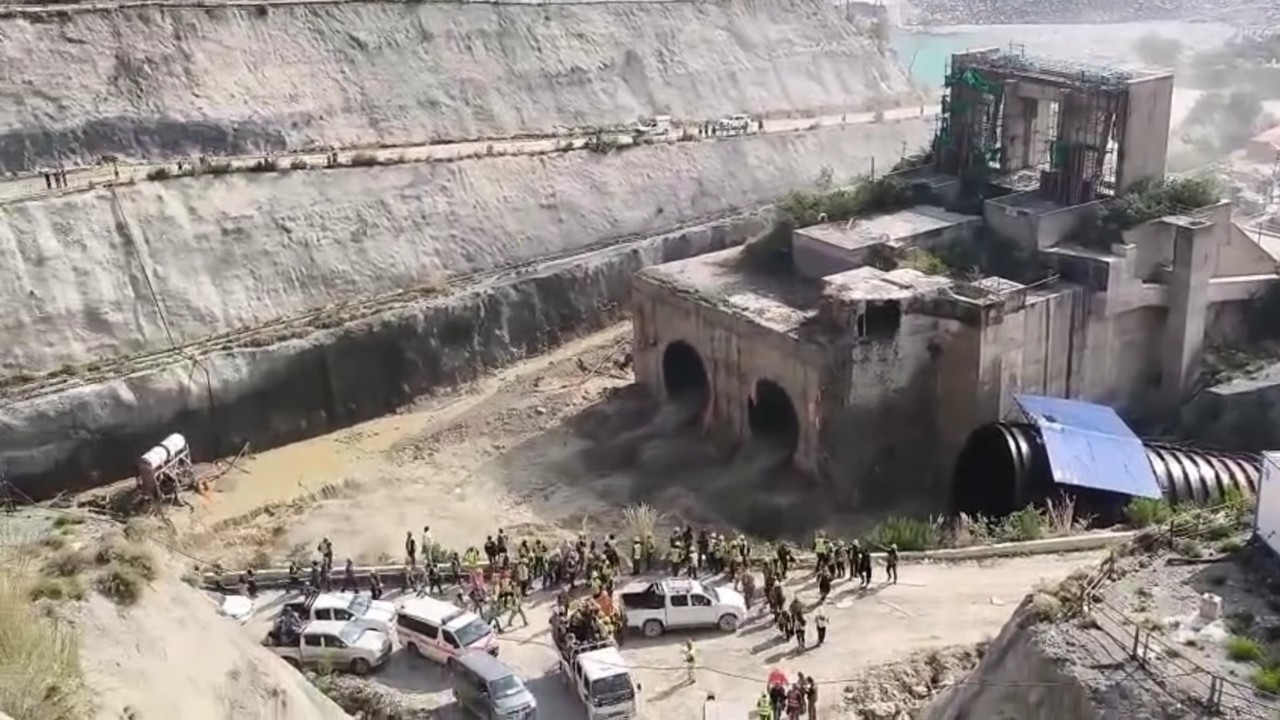
A rock mass gave way during excavation at the Tarbela Dam’s fifth extension hydropower project on Monday, sending water rushing into nearby work areas and prompting an immediate evacuation of crews as Pakistan declared emergency to deal with the situation in the world’s largest earth-and-rock-fill dam, a critical source of electricity and lifeline for agriculture.
According to Pakistan’s Water and Power Development Authority, the incident occurred at the T-5 project, a major expansion of one of the country’s largest dams on the Indus River. An emergency was declared, construction was halted, and workers were moved to safer ground. Officials reported no casualties or injuries.
The turquoise appearance of the Indus River downstream of the dam is largely attributable to the substantial quantities of suspended silt and clay carried in the water discharged through the spillways, which are channels positioned on either side of the main structure.
With a volume of approximately 142 million cubic meters, Tarbela Dam is recognized as the world’s largest earth-and-rock-fill dam, according to NASA. It rises 147 meters above the riverbed of the Indus. Its reservoir covers an area of around 37 square kilometers. Since its construction, the dam has played a vital role in Pakistan’s water management system by storing and regulating water supplies to support the country’s agricultural sector.
During excavation of the 2nd Bench Connecting Tunnel at Tarbela 5th Extension, weak rock collapsed causing Intake Pit water to enter the tunnel. All workers are safe. No damage to main tunnel, powerhouse, tailrace or switchyard. Reports of tunnel collapse are incorrect. https://t.co/XuPKYH0eRG
— WAPDA (@wapda_pr) November 9, 2026
How the Flooding Happened
Wapda said the collapse took place while crews were excavating the second bench of a connecting tunnel. A section of weak rock gave way, allowing water from the intake pit to flow into the tunnel and the under-construction powerhouse.
“All workers were immediately evacuated safely,” the authority stated. It added that the water in the intake pit had been fully drained and that no further inflow was reaching the downstream work areas. Dewatering operations at the powerhouse were already under way.
Damage Assessment Under Way
Authorities are evaluating possible damage to the tunnel, powerhouse and surrounding structures. Haripur Deputy Commissioner Waseem Ahmed, citing project officials, confirmed that assessments were in progress.
Senior Wapda officials, the project engineer and the contractor were on site examining the situation and determining next steps, according to the authority’s statement.
Wapda specifically rejected circulating reports that the main T-5 tunnel had collapsed. It clarified that the primary tunnel, the under-construction powerhouse, the tailrace culvert and the switchyard remained undamaged. The authority again stressed that no workers had been hurt or killed.
A senior district administration official said there was currently no threat of flooding or inundation in areas downstream of the dam.
🚨🚨
تربیلا ڈیم کا T.5 پراجیکٹ ٹوٹ گیا بڑی تباہی کا خدشہ ! چین کے تعاون سے بننے والے اس پراجیکٹ میں سابق چیئرمین واپڈا کی 7 ارب کرپشن کی نشاندہی کئی مہینے پہلے ہم کر چکے ہیں https://t.co/SQUWL2Ee6t— Hammad Hassan (@HammadHassan30) November 9, 2026
Additional Water Releases and Public Advisory
Separately, Swabi Deputy Commissioner Nasarullah Khan said extra water had been released from Tarbela Dam for unavoidable operational reasons. The release was expected to raise flows and water levels in the Indus River.
He urged residents to take precautions and completely avoid bathing, swimming or boating in the river. “All citizens are requested to take precautionary measures… to prevent any untoward incident,” Khan said. He also advised people to ignore rumors and rely on official channels for accurate information.
Project Already Facing Major Delays and Cost Overruns
The latest incident adds to existing concerns about the T-5 project. In July, a government-appointed inquiry committee assigned responsibility for an earlier cofferdam collapse to all three main parties—the contractor, the consultant and Wapda itself. Unauthorized design changes made after the contract was signed were identified as a key factor.
That earlier collapse contributed to a delay of at least two years and a cost increase of more than 285 percent. The project’s estimated cost rose from 82 billion Pakistani rupees to 317 billion rupees. Originally scheduled for completion in 2026, the expansion is now targeted for the end of June 2028.
Once finished, the fifth extension is designed to add 1,530 megawatts of generating capacity. Construction is being financed with loans of $390 million from the World Bank and $300 million from the Asian Infrastructure Investment Bank.
Officials continue to monitor the site and river conditions as dewatering and damage assessments proceed.

Asim Tanveer is a seasoned journalist working for TV and electronic and print media outlets. He has been working for some of the world’s leading news organizations including Associated Press (AP), Reuters, BBC, CNN, CNBC, Star TV, Voice of America and The New York Times for more than 20 years. He has won several awards for his live coverage of events that include a Reuters News Agency World Award and the Pride of Performance award in 2010.




