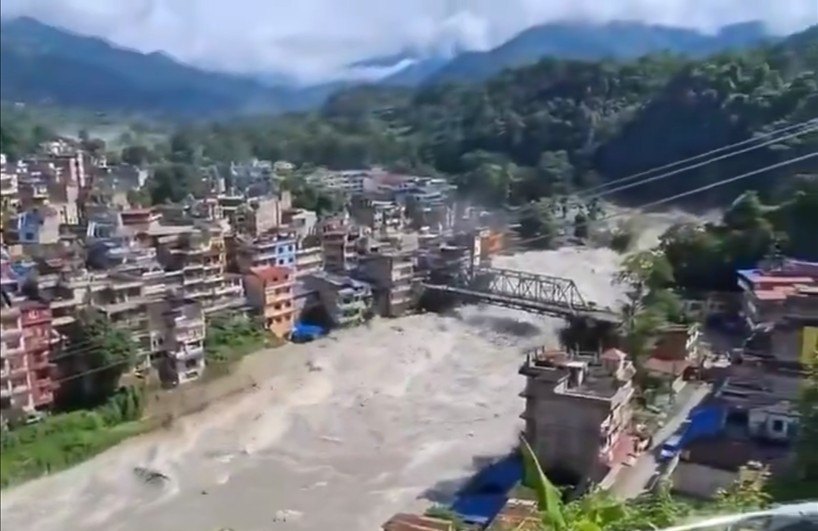
Rescue teams on Thursday intensified efforts to locate more than 1,000 people missing after catastrophic floods and landslides struck communities along the Nepal-Tibet border, killing at least 165 people and devastating villages, roads and other infrastructure.
The disaster has left hundreds of foreign nationals unaccounted for. Nepal’s Tourism Ministry said 468 tourists remained missing, including 393 foreign nationals, while Chinese authorities reported 558 people missing in Tibet, among them 260 foreigners.
Nepal’s tourism authorities said missing foreign nationals included citizens of India, Australia, Britain, Malaysia, the Netherlands, Portugal, South Africa, South Korea and the United States. At least 47 Americans were reported missing.
The United States said it was closely monitoring the disaster and working with Nepalese authorities to locate and assist U.S. citizens in affected areas.
This is not a movie. Security cameras at the Nepal-Tibet border just recorded a flash flood burying an entire border crossing in real time. Ground and aerial footage show the scale of what hit the region. Hundreds still missing. pic.twitter.com/jV01hPPTUE
— Sean Hannity 🇺🇸 (@seanhannity) August 26, 2026
In a statement issued Wednesday, the U.S. Department of State expressed condolences to victims and said it was sending a disaster response adviser to the region. Washington also pledged $500,000 through its global award with Catholic Relief Services to provide emergency shelter, relief supplies and water, sanitation and hygiene assistance to affected communities.
The U.S. Embassy in Kathmandu urged American citizens in affected areas to follow local authorities’ instructions and monitor emergency information. The embassy is also assisting families seeking information about relatives in Nepal.
The floods struck early Wednesday after what scientists say was a glacial collapse that generated a massive debris flow. The U.S. Geological Survey initially classified the event as a magnitude 4.4 earthquake, but subsequent analysis of seismic data, long-period waves and satellite imagery found no earthquake had occurred.
A horrific scene of severe flooding at the Rasuwagadhi border point on the Nepal-Tibet border.
The strong currents wreaked havoc across the area, leaving 400 pilgrims and 105 Indian tourists also missing in the Nepal floods.#NepalFloods #Nepal #Rasuwa #FlashFlood #Floods pic.twitter.com/dwAX12Gj7l— Ravi Pandey🇮🇳 (@ravipandey2643) August 26, 2026
Instead, the agency concluded that a glacier collapse had unleashed a torrent of water, mud and rock that surged downstream through the Bhote Koshi and Trishuli river valleys.
Dramatic footage from the Chinese side showed a huge wall of mud and debris crashing into a multi-storey building, while people fled as the torrent swept away vehicles and structures.
Nepali police said 162 bodies had been recovered, with deaths reported across seven districts as floodwaters moved downstream toward Chitwan in southern Nepal. Authorities warned that the toll could rise as rescue workers reach isolated and heavily damaged areas.
On the Chinese side, state broadcaster CCTV reported three deaths at Gyirong Port in Tibet and said 558 people remained missing, including 260 foreign nationals. Chinese authorities deployed hundreds of emergency workers, vehicles, sniffer dogs and speedboats for search-and-rescue operations.
Many of those missing are believed to have been tourists. The area is a major route between Kathmandu and Lhasa and also serves pilgrims travelling toward Mount Kailash, a sacred destination for Buddhists and Hindus.
The scale of destruction has left entire communities buried under mud. David Fisher, Nepal head of the International Federation of Red Cross and Red Crescent Societies, said villages and market areas had been wiped out. The organization is sending emergency supplies, including blankets, first-aid equipment, stretchers and body bags.
Residents described the force of the floodwaters as overwhelming. Raju Bhadel, a businessman from Nepal’s Nuwakot district, said his brother-in-law called in distress after his home was swept away. Three family members were rescued, but his brother remained missing.
Teacher Manok Mishra, also in Nuwakot, said he watched nine trucks disappear into the floodwaters, with people still inside.
Environmental historian Ruth Gamble of La Trobe University described the event as resembling an “inland tsunami” that travelled nearly 170 kilometers down the Bhote Koshi valley.
Scientists have warned that rising temperatures are accelerating glacier melt in mountainous regions, increasing the risk of glacial lake outburst floods and other glacier-related disasters. Experts also cautioned that another surge could occur if debris continues to obstruct a river upstream.
Qianggong Zhang, head of climate and environmental risks at the Kathmandu-based International Centre for Integrated Mountain Development, said authorities were concerned about the possibility of a second flood because a blockage remained in the river near the Nepal-China border.
Nepal’s army has deployed aircraft to evacuate residents and assist rescue operations, while authorities ordered people living in vulnerable river communities to move to safer areas.
Chinese President Xi Jinping has called for every effort to locate and rescue those still missing. Meanwhile, authorities in Tibet’s Shigatse warned that roads remained vulnerable to mudslides and advised against travel in affected areas.
With hundreds of foreign nationals still unaccounted for on both sides of the border, rescue operations are continuing amid fears that the full human and economic cost of the disaster has yet to emerge.

Kiran Asim is a writer who covers the U.S., Europe, South Asia, and the Middle East. Her reports and analyses look at the geostrategic issues and contemporary developments and their economic and political implications. She also writes about society and education.

Muhammad Luqman is Associate Editor at Views News Now. He writes on wide-ranging issues including economy, South Asia, the Middle East, agriculture, economy and innovation. Luqman has worked some of the leading news organizations and won acclaim for his original and research-based works.