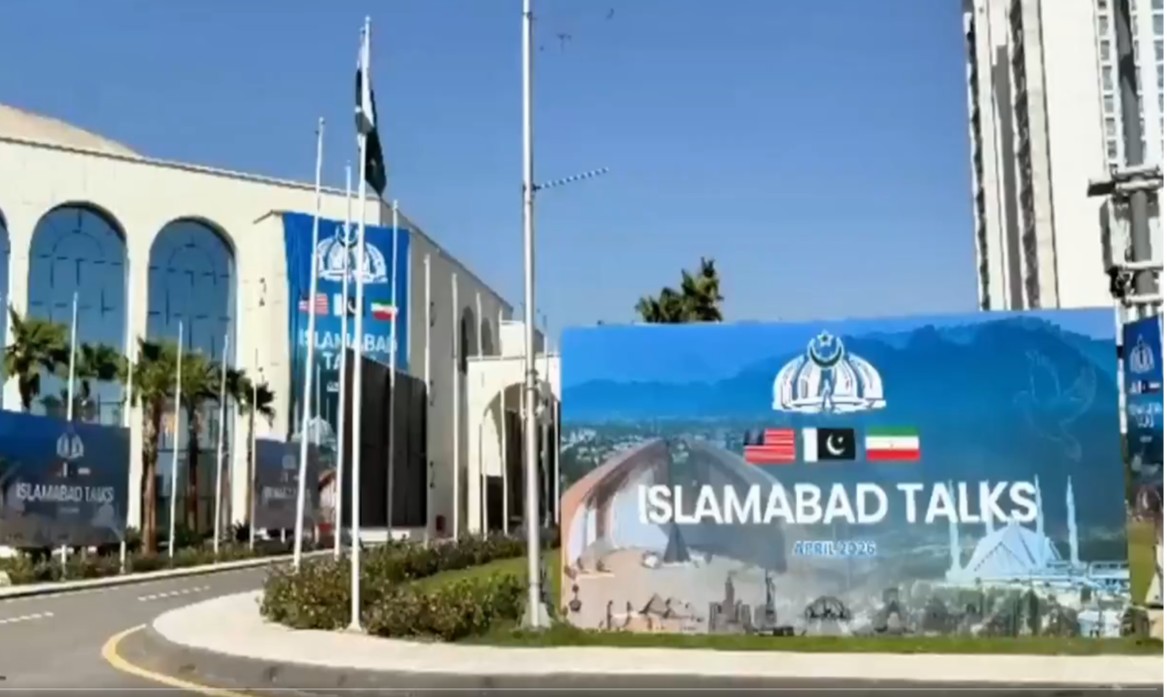
The United States and Iran entered peace talks in Islamabad Tuesday, with Pakistan mediating at the start as the world intently watched for breakthrough after six weeks of intense conflict that killed thousands, rattled energy markets and choked off international shipping through Tehran-controlled Strait of Hormuz.
Views News Now correspondents report from Islamabad that Pakistan mediated the three-way talks on top of the parleys after which the two sides are engaged directly to build on last Tuesday’s ceasefire agreement.
The talks have continued for more than six hours.
In Washington, the White House confirmed that delegations from the United States, Iran and Pakistan are holding face-to-face meetings.
According to AP a Pakistani official said talks “are progressing well.”
The two sides have so far held two rounds of talks, with Pakistani political and military leaders encouraging them to reconcile their differences.
After a break at the conclusion of the first round, U.S. and Iranian officials reconvened for a second round of negotiations on Saturday night.
In the second round, both delegations were accompanied by technical experts as discussions resumed.
Pakistani leaders pushed the sides to narrow their differences and work toward a durable framework for regional stability. The dialogue is continuing in a generally constructive atmosphere and reportedly the U.S. and Iranian officials are making progress.
The two sides face a raft of tough issues including Iran’s nuclear program, reopening of the Hormuz waterway, end to attacks on Iran and ceasefire in Lebanon. Tehran said before the talks that its frozen assets should be released immediately.
This is the first highest diplomatic engagement between the United States and Iran since 1979, when revolution toppled the Shah of Iran, straining ties with Washington and exacerbating tensions in the Middle East.
The U.S. delegation is led by Vice President JD Vance and includes Jared Kushner, son-in-law of President Donald Trump, as well as Middle East envoy Steve Witkoff.
Iran is represented by Parliament Speaker Mohammad Bagher Ghalibaf and Foreign Minister Abbas Araghchi, alongside other senior officials.
The talks are taking place during a two-week pause in hostilities, following a temporary ceasefire brokered by Pakistan on April 8. Prior to the direct meeting, both sides exchanged proposals through Pakistani mediators.
According to a Pakistani source, the initial round of direct talks lasted two hours before both delegations adjourned for a break.
US Vice President and Pakistan PM meet ahead of US-Iran Talks in Islamabad pic.twitter.com/Rd8XMRCsm2
— Views&News (@ViewsNewsMag) April 11, 2026
On the eve of its high-stakes negotiations with the United States in Islamabad, Iran made eleventh-hour demands—an immediate unfreezing of Iranian capital held abroad and full implementation of a cessation of hostilities in Lebanon.
The shift in tone was led by Parliamentary Speaker Mohammad Baqer Alibar, who claimed on X that these were not new demands but prior agreements that Washington has failed to uphold. He made it clear: no fulfillment, no negotiations.
This hardline rhetoric was echoed by Foreign Minister Abbas Araghchi, who expanded the scope by demanding an immediate end to Israeli airstrikes in Lebanon.
Trump Voices Optimism on US-Iran Talks as Delegations Head to Pakistan
Despite the escalating tension, Pakistani officials said Iranian representatives are expected to arrive for the talks.
However, these sudden “pre-negotiation” hurdles have left the international community wondering whether the meeting is now a non-starter.
The United States has remained silent so far, offering no formal response to Tehran’s pivot.
Iranian Delegation Lands for Islamabad Talks; Vance to Lead US Side
Trump’s “Armed” Ultimatum
President Donald Trump has adopted a starkly aggressive posture, signaling that the U.S. is preparing for the immediate failure of diplomacy. In a recent interview with the New York Post, he revealed that American warships are currently being outfitted with “the best ammunition” to resume military strikes against Iran should the Pakistan summit collapse.
Trump emphasized the urgency of the situation, stating:
“We’re going to find out in about 24 hours. We’re going to know soon.”
Vance’s Cautious Diplomacy
Vice President JD Vance, leading the American delegation to Islamabad, offered a more measured but equally firm perspective during his flight.
While expressing “cautious optimism” about a positive outcome, he issued a blunt warning to Tehran: Washington will not be “played.”
From Fragile Truce to Formal Talks: US, Iran Converge in Islamabad
Vance made it clear that if Iranian negotiators attempt to manipulate the process or stall for time, they will face a U.S. team entirely unreceptive to further discussion.
The Economic Stumbling Block
Beneath the military threats lies a massive financial divide. Ongoing U.S. sanctions have trapped tens of billions of dollars in Iranian assets—primarily oil and gas revenue—in foreign accounts. This frozen capital remains Tehran’s primary grievance and a central point of contention that could either serve as a bargaining chip or become the ultimate deal-breaker in the coming hours.
The diplomatic mission in Pakistan is unfolding against a backdrop of crumbling stability and escalating bloodshed in Lebanon. While a temporary reprieve was intended to pave the way for peace, the reality on the ground tells a much darker story.
A Truce in Name Only
Earlier this week, President Trump agreed to a Pakistan-brokered two-week truce, issued just moments before a self-imposed deadline that threatened further regional escalation.
However, this “ceasefire” has proven to be extremely fragile, failing to halt the cycle of violence or build the trust necessary for diplomacy to take root.
Lebanon
The primary reason for the continued instability is a significant caveat in the agreement.
Both Israeli and U.S. officials have explicitly stated that the ceasefire does not cover military operations against Hezbollah.
Israeli air campaigns in Lebanon have persisted without pause—a move that Tehran and Beirut argue completely undermines the integrity of the broader peace effort.
The Human Toll of the Conflict
The statistics coming out of Lebanon paint a grim picture of the humanitarian crisis.
Lebanese authorities report over 1,830 deaths since March 2. In a tragic irony, violence surged immediately after the ceasefire was announced. Major strikes on densely populated areas resulted in more than 300 additional deaths in just a few days.
One of the most devastating strikes occurred in the southern city of Nabatieh. A direct hit on a government facility claimed the lives of 13 internal security officers, a loss confirmed by President Joseph Aoun.
The Diplomatic Push Faces Roadblocks
As the clock ticks toward the scheduled talks, the bombardment shows no signs of slowing. Through Friday, Israeli strikes continued to rain down across southern Lebanon, with reports of fresh casualties emerging from various towns.
This relentless military pressure remains the single biggest hurdle to the success of the Pakistan negotiations.
Pakistan’s Mediation in US–Iran Ceasefire Adds $3 Trillion to Global Markets — Economist
The political atmosphere in Tehran has hardened significantly, driven by the uncompromising rhetoric of the nation’s new leadership.
Ayatollah Mojtaba Khamenei, who recently assumed the role of Supreme Leader following the death of his father, has issued a defiant mandate that categorically rejects any diplomatic compromise lacking strict accountability.
The Mandate: Reparations and Retaliation
In a forceful address, the Supreme Leader framed Iran’s objectives not merely as a return to the status quo, but as a demand for justice. He has vowed that Iran will pursue full compensation for the destruction wrought during the conflict, making it clear that the “criminal aggressors” who targeted Iranian soil will face consequences.
“We will certainly not leave unpunished the criminal aggressors who attacked our country,” he declared, signaling a shift toward a policy of active retribution.
A New Negotiating Posture
This shift indicates that Tehran is no longer viewing the Pakistan summit through the narrow lens of sanctions relief.
Instead, the leadership has expanded its platform to include:
- Formal demands for the repayment of economic and infrastructural losses
- High-level demands that go beyond previous nuclear or diplomatic frameworks
- The insistence that military actions against Iran must be answered with legal or physical retaliation before peace can be finalized
By centering “blood money” for martyrs and compensation for veterans in his messaging, Mojtaba Khamenei has signaled to the world—and to the negotiators in Islamabad—that Iran’s price for peace has risen substantially.
The Battle for the Strait of Hormuz
Iran is leveraging its geographic dominance over the Strait of Hormuz—the world’s most vital oil artery—to force Washington’s hand. While roughly 140 vessels (carrying 20 million barrels of oil) navigated the Strait daily before the war, recent reports indicate that traffic has slowed to a trickle.
In a show of regional control, Iranian supertankers—some carrying up to 2 million barrels of crude—continue to pass through the Strait unhindered, while foreign commercial shipping remains largely blocked. This maritime disruption has triggered a global energy shock, driving inflation higher and raising the risk of a broader economic slowdown.
The Nuclear Wildcard
Beyond the shipping lanes, Iran is entering the Islamabad summit with a potent “nuclear card” on the table. Tehran has amassed over 400 kilograms of uranium enriched to near weapons-grade levels. This stockpile serves as Iran’s ultimate insurance policy.
Trump Rules Out Iran Nuclear Enrichment, Signals Sanctions Relief Ahead of Islamabad Talks
International monitors warn that this level of enrichment places Iran at the threshold of developing a nuclear weapon—a reality that adds immense pressure on U.S. negotiators to reach a deal before a potential “breakout” becomes irreversible.
The Limits of Containment
The current crisis has also cast a harsh light on the limitations of Western diplomatic and military strategies.
Despite claims from Washington that Iran’s capabilities have been successfully “contained,” Tehran’s regional influence remains formidable.
Iran maintains a sophisticated inventory of long-range missile and drone systems capable of striking targets across neighboring states. Combined with an advancing nuclear enrichment program, this posture ensures that even if a ceasefire is reached, the underlying threat to regional stability will persist.
The Saudi Stake in the Crisis
While the spotlight remains on the primary combatants, Saudi Arabia has stepped into the diplomatic arena with a quiet but strategic focus on the economic fallout of the conflict.
The presence of the Saudi finance minister in Islamabad signals a pivotal shift: Riyadh is no longer viewing this purely as a military standoff, but as a systemic threat to the global financial order.
Riyadh is uniquely vulnerable to the current instability for several reasons:
- Recent Iranian drone and missile strikes have targeted Saudi energy facilities, demonstrating that even a neighboring war has direct consequences for Saudi sovereignty
- As a nation reliant on stable Gulf shipping, disruption in the Strait of Hormuz poses an existential threat to Saudi oil exports and economic planning
- Long-standing rivalries with Iran mean that any concession made in Pakistan could shift the balance of power in Yemen, Syria, or Iraq
A New Negotiation Pillar: Economic Stability
By sending its top financial official rather than a purely military or diplomatic envoy, Saudi Arabia is pushing for a “financial peace” framework that includes:
- Stabilizing oil prices, which have fluctuated sharply during the conflict
- Ensuring the full reopening of shipping lanes, rather than the “selective transit” currently practiced
- Acting as a bridge to ensure that any U.S.–Iran deal does not come at the expense of Gulf security
Riyadh’s engagement suggests that any truly conclusive agreement must address regional economic and energy security—not just bilateral grievances.
The Final Word
The Islamabad summit has evolved from a bilateral meeting into a high-stakes arena where the future of the Middle East hangs in precarious balance.
As Vice President JD Vance and the Iranian delegation prepare for their first sessions, the global community watches closely.
The coming 24 hours may provide a definitive answer: will this summit be remembered as the moment the world stepped back from the brink—or as the final failed attempt at diplomacy before a far more devastating confrontation?

Kiran Asim is a writer who covers the U.S., Europe, South Asia, and the Middle East. Her reports and analyses look at the geostrategic issues and contemporary developments and their economic and political implications. She also writes about society and education.

Muhammad Luqman is Associate Editor at Views News Now. He writes on wide-ranging issues including economy, South Asia, the Middle East, agriculture, economy and innovation. Luqman has worked some of the leading news organizations and won acclaim for his original and research-based works.

Asim Tanveer is a seasoned journalist working for TV and electronic and print media outlets. He has been working for some of the world’s leading news organizations including Associated Press (AP), Reuters, BBC, CNN, CNBC, Star TV, Voice of America and The New York Times for more than 20 years. He has won several awards for his live coverage of events that include a Reuters News Agency World Award and the Pride of Performance award in 2010.