President Donald Trump Tuesday insisted Iran has agreed to allow international nuclear inspectors into the country, characterizing the concession as a sweeping victory for U.S. national security and a turning point in Middle East diplomacy.
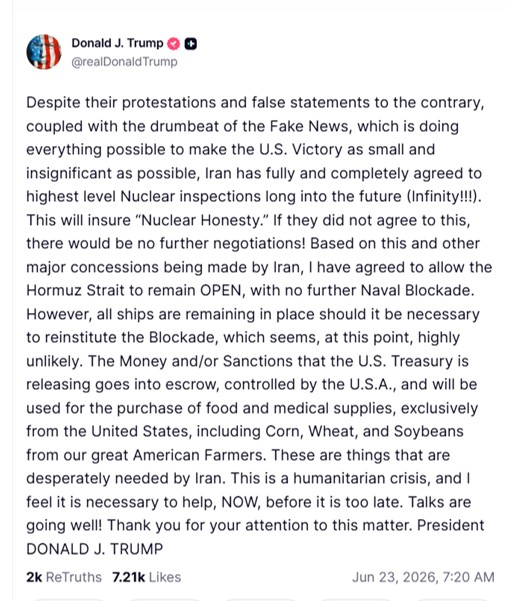
In a lengthy Truth Social post Tuesday, Trump declared that Iran—”despite their protestations and false statements to the contrary”—has fully and completely consented to the highest-level nuclear inspections “long into the future (Infinity!!!)”
The President framed the agreement as a guarantee of what he termed “Nuclear Honesty,” warning that without this commitment, all negotiations would cease entirely.
“If they did not agree to this, there would be no further negotiations!”
Trump dismissed media coverage of the development as a coordinated effort by “Fake News” to diminish the scale of the U.S. achievement, insisting that the inspection deal represents a major and lasting win.
The dispute over Iran’s nuclear enrichment has been at the core of Washington’s negotiating posture. Before the war erupted on February 28, the two countries were holding negotiations on the issue through intermediaries.
President Trump underscored that Iran’s binding commitment to renounce uranium enrichment remains the single most critical component of any enduring peace arrangement with Tehran.
Complementing that demand, the Trump administration has placed renewed emphasis on the removal of Iran’s existing enriched uranium stockpile—much of which, according to the President, lies buried deep beneath the debris of nuclear sites targeted by U.S. forces in 2025.
The administration views the extraction and disposal of this material as non-negotiable, arguing that even a clandestine enrichment capability would undermine the integrity of the inspections regime and leave the region perpetually vulnerable to breakout scenarios.
In exchange for Iran’s nuclear concessions, Trump wrote in the post that he has agreed to keep the Strait of Hormuz open, with no further naval blockade imposed at this time.
However, he emphasized that all U.S. naval assets will remain in position, ready to reinstate the blockade instantly should circumstances require—a move he characterized as both a precaution and a show of continued strength.
Addressing the economic dimensions of the agreement, Trump detailed that any funds or sanctions relief released by the U.S. Treasury will be placed into an American-controlled escrow account.
Those funds, he specified, will be strictly earmarked for the purchase of food and medical supplies—and exclusively from U.S. suppliers, including corn, wheat, and soybeans from American farmers.
The president described this provision as a direct benefit to both domestic agriculture and the Iranian people, whom he characterized as facing a dire humanitarian crisis.
“I feel it is necessary to help, NOW, before it is too late,” Trump wrote, adding that talks are “going well” and expressing gratitude for public attention to the matter.
The statement comes after Vice President JD Vance led a U.S. delegation at the opening talks with Iran—through mediators Pakistan and Qatar—and caps a high-stakes diplomatic pivot, one that the administration portrays as a model of coercive negotiation yielding measurable results.
Tehran has pushed back on some of the American claims made after the first round of talks, which followed an initial agreement between the two sides toward fully resolving contentious issues, including the nuclear stockpile and sanctions against Iran.
Washington has waived some sanctions against Iran, allowing Tehran to carry out international oil trade during the 60-day window in which the two sides would seek to arrive at a final peace agreement to end the conflict.
According to Pakistan and Qatar, the key mediators, both Washington and Tehran agreed to a roadmap toward addressing the outstanding disputes in line with the initial peace deal, known as the “Islamabad Memorandum of Understanding.”
Ali Imran is a Washington-based journalist, who has worked for leading world news organizations as a correspondent, expert and in editorial positions. He is a published author and poet.