President Donald Trump‘s response to the controversy surrounding Nvidia co-founder and former CEO Jensen Huang has offered a revealing glimpse into the competing priorities shaping Washington’s approach to China: protecting America’s technological supremacy, safeguarding national security and avoiding a confrontation that could destabilize relations between the world’s two largest economies.
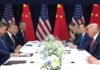
The controversy has become more than a question of corporate conduct as Trump and Chinese President Xi Jinping prepare to meet on the sidelines of the Asia-Pacific Economic Cooperation (APEC) leaders’ summit in Shenzhen, China.
The controversy involves Huang’s reported relationship with Chinese businesswoman Alice Huang, a former executive at Singapore-based technology company Megaspeed, who is suspected by U.S. intelligence officials of having links to Chinese intelligence. The FBI is investigating the allegations, although the Justice Department has not established that she was acting as a Chinese spy. Separately, U.S. authorities are investigating whether advanced Nvidia artificial intelligence chips were illegally diverted to China through overseas data centers and other intermediaries.
It has exposed the strategic importance of semiconductor technology in the widening U.S.-China rivalry and the competing pressures on the Trump administration over how far to go in restricting Beijing’s access to critical American technology.
The fallout has also unsettled investors. Nvidia shares fell 4.1% on Monday, although the decline coincided with broader market losses and should not be attributed solely to the controversy. Huang’s departure and the uncertainty surrounding the company’s leadership have nevertheless added to concerns about corporate governance and the stability of one of the world’s most strategically important technology companies. Nvidia’s dominance in advanced chips has made it central to the global artificial intelligence industry, leaving its fortunes increasingly exposed to the geopolitical contest over access to cutting-edge computing technology.
Q: Did you trust US Intelligence that Jensen Huang was having an affair with a Chinese spy?
Trump: I don’t know she is a Chinese spy. I haven’t heard that. I don’t know that she is a spy. Usually what happens, a beautiful woman that comes from China, they say she is a spy. I don’t know she was a spy at all
— Headquarters (@HQNewsNow) November 16, 2026
The political consequences are also coming into sharper focus following the November 3 elections, with lawmakers from both parties demanding greater scrutiny of the administration’s handling of the affair, its export-control policies and the apparent divisions within Trump’s Cabinet over the transfer of advanced chips to China. The episode could provide fresh ammunition for lawmakers questioning whether Washington has been sufficiently tough in preventing strategically sensitive American technology from reaching Beijing, particularly as the administration seeks to balance national security concerns against the need to maintain a working relationship with China.
Trump, however, appeared to play down the controversy and signaled that he would be open to Huang returning to Nvidia. Asked by reporters whether he wanted to see the company’s co-founder reinstated as chief executive, the president said, “I would not mind. I would not mind that.” He added, “I think he learned a big lesson.” His remarks amounted to a notably sympathetic response to a controversy that has raised questions about corporate influence, national security and the vulnerability of America’s technological advantage. Nvidia’s board, however, is not currently considering Huang’s reinstatement.
The president also dismissed suggestions that Huang’s reported relationship with Alice Huang had placed U.S. national security at risk. “It was not put at risk, and our country is now stronger than ever before,” Trump told reporters. He went further in questioning the allegations, saying: “I don’t know that she is a spy. Usually, what happens with that is that any woman coming to the country that’s a beautiful woman that comes from China, they say she’s a spy. I don’t know that she was a spy at all.”
The controversy has nevertheless exposed tensions within the administration over the enforcement of restrictions on advanced semiconductor exports to China. Treasury Secretary Scott Bessent has publicly criticized the Commerce Department, led by Howard Lutnick, for delaying action against Megaspeed, a Singapore-based technology company whose former executive is at the center of the allegations. Bessent said the Treasury, Defense and State departments, together with the Office of the U.S. Trade Representative, had supported placing Megaspeed on the Commerce Department’s Entity List for months. The dispute has raised questions about whether commercial and diplomatic considerations have been allowed to dilute the administration’s national security safeguards.
Trump acknowledged that Lutnick may have delayed placing the company on the list but defended the decision as necessary to avoid jeopardizing relations with Beijing.
“He was doing that because you could have — if you didn’t delay it, if you didn’t do something — you could have a blow-up with China,” Trump said.
“We’re having a very good relationship with China right now, and I understand both sides of it, and I’ll make a decision. But I understand very well both sides.”
The remarks capture the dilemma at the heart of the U.S.-China rivalry: Washington wants to prevent Beijing from acquiring technologies that could erode America’s economic and military edge, but it must also manage a relationship in which trade, investment, technology and diplomacy are increasingly inseparable.
Breaking news: US President Donald Trump has said he ‘wouldn’t mind’ seeing Jensen Huang reinstated as chief executive of Nvidia, just days after the co-founder of the US chipmaker resigned amid a spiralling infidelity scandal. https://t.co/gf2L9L99dk https://t.co/yoyYBoHLHK
— Financial Times (@FT) November 16, 2026
A Battle for Economic and Strategic Influence
The economic relationship between the United States and China is entering another decisive phase as Trump and Xi prepare for talks on the sidelines of the APEC leaders’ summit in Shenzhen on November 18–19. The immediate challenge is to preserve their fragile trade arrangement, which is approaching its January 2027 deadline.
Nearly two years of confrontation have produced successive tariff increases, retaliatory restrictions and negotiations, but little progress on the fundamental disagreements over market access, manufacturing, technology and strategic resources.
The rivalry now extends well beyond bilateral trade. Control over critical supply chains, advanced technology and industrial capacity has become central to the economic and strategic competition between the two powers.
Trump:
China plays games with us. We play games with China. https://t.co/AqnIvuYEai
— Clash Report (@clashreport) November 16, 2026
From Trade Deficits to Economic Pressure
After returning to the White House in January 2025, Trump revived his tariff-based approach toward China, initially imposing a 10% duty on Chinese imports in February over concerns about fentanyl trafficking and immigration.
Beijing retaliated by targeting American coal, liquefied natural gas, crude oil and automobiles, while restricting exports of five metals important to defense manufacturing and clean-energy industries.
Washington subsequently doubled its fentanyl-related tariffs to 20%. China responded with additional duties of 10% to 15% on American agricultural products, affecting approximately $21 billion in U.S. exports.
The targeting of agriculture was politically significant, given the importance of American farmers to Trump’s domestic support. Beijing demonstrated that its retaliation could reach beyond industrial goods and affect politically sensitive sectors of the U.S. economy.
Tariffs were increasingly becoming instruments of economic and diplomatic pressure.
The April Escalation and the Cost of Retaliation
The confrontation reached its most dramatic stage in April 2025, when Trump announced his sweeping reciprocal tariff program, popularly known as Liberation Day.
Washington initially imposed a 34% tariff on Chinese goods, prompting matching retaliation from Beijing. U.S. tariffs subsequently climbed to 84% and then 125%, while China’s retaliatory duties also reached 125%.
The escalation disrupted business planning, threatened manufacturing supply chains and unsettled international markets. China also expanded restrictions on rare-earth exports and issued warnings concerning travel to the United States.
Chinese Premier Li Qiang hailed what he called the ‘truly extraordinary’ achievements of China and Southeast Asia in the face of global trade restrictions, expressing Beijing’s commitment to free trade at a regional summit ahead of US President Donald Trump’s arrival https://t.co/yX2ye3zquR
— Reuters (@Reuters) November 16, 2026
The episode exposed the limitations of tariffs as a negotiating instrument. Although higher duties can pressure trading partners, they also increase costs for domestic businesses and consumers.
Negotiations in Geneva in May 2025 produced the first significant breakthrough. Both governments agreed to suspend their most severe tariffs for 90 days. The United States reduced its tariffs on Chinese goods from 145% to 30%, while China lowered duties on American products from 125% to 10%. The suspension was subsequently extended for another 90 days in August.
The agreement offered temporary relief but left the underlying trade and technology disputes unresolved.
Rare Earths and Technology: China’s Strategic Advantage
China’s dominance in rare-earth processing has emerged as one of its strongest sources of leverage in the trade confrontation.
Rare earths are essential to advanced electronics, electric vehicles, renewable-energy equipment and defense systems. Restrictions on their supply can therefore disrupt entire industries rather than simply increase the cost of individual imports.
In October 2025, Beijing widened its rare-earth export controls, prompting Trump to threaten an additional 100% tariff on Chinese imports and introduce export controls targeting critical software. His administration also raised the possibility of restrictions on Boeing aircraft parts.
The confrontation highlighted the difference between conventional trade disputes and strategic economic competition. While tariffs raise import costs, restrictions on critical minerals and advanced technology can threaten industrial production and national security.
Washington has consequently sought to reduce its dependence on Chinese supply chains and strengthen domestic industrial capabilities. Beijing, meanwhile, has demonstrated that its position in critical mineral processing gives it considerable influence over global manufacturing.
Trump:
China plays games with us. We play games with China. https://t.co/AqnIvuYEai
— Clash Report (@clashreport) November 16, 2026
Diplomacy Prevents a Complete Breakdown
Despite the escalation, neither government was prepared to allow the economic confrontation to continue indefinitely.
In October 2025, Trump and Xi reached a trade truce following discussions in South Korea. Washington agreed to reduce certain tariffs, while Beijing committed to action against fentanyl precursor chemicals, renewed purchases of American soybeans and a pause in expanded rare-earth export restrictions.
The agreement restored some stability but remained dependent on both sides honoring their commitments.
Diplomatic engagement continued in May 2026, when Trump visited Beijing for a summit with Xi. The two governments announced plans to establish Boards of Trade and Investment to provide institutional channels for managing economic disagreements and promoting commercial cooperation. China also agreed to purchase Boeing aircraft and American agricultural products.
The initiatives suggested a willingness to make economic relations more predictable. However, they did not resolve the wider disagreements over technology, industrial competition and market access.
Washington’s Tariff Strategy Faces a Legal Challenge
Trump’s trade strategy also encountered a significant domestic obstacle in February 2026, when the U.S. Supreme Court ruled that the president could not use emergency powers under the International Emergency Economic Powers Act (IEEPA) to impose tariffs.
The decision invalidated the China-related fentanyl tariffs and the reciprocal tariff regime introduced under that authority, limiting the administration’s ability to use emergency powers to impose broad import duties.
Trump responded by introducing a temporary 10% global tariff under a different statutory authority.
Although the ruling did not end his administration’s broader tariff policy, it changed the legal framework within which it could operate. It also demonstrated that Washington’s trade strategy was subject not only to international negotiations but also to domestic institutional constraints.
Forced-Labor Allegations Expand the Dispute
Another dimension emerged in July 2026, when Washington imposed additional tariffs of 10% or 12.5% on goods from 60 trading partners following investigations into their failure to introduce and effectively enforce prohibitions on imports produced using forced labor.
China was among the economies subject to the 12.5% rate, although certain product exemptions applied. Other trading partners received lower rates based on commitments or measures to prohibit forced-labor imports.
The measures extended the trade confrontation into labor standards and supply-chain accountability, adding further uncertainty for exporters and international manufacturers.
They also illustrated how economic restrictions have become increasingly connected with wider political and human-rights considerations.
The White House Summit: Progress Without a Comprehensive Agreement
The diplomatic process continued in September 2026, when Trump hosted Xi at the White House.
The meeting produced limited progress, with analysts describing the outcome as a stalemate rather than a decisive breakthrough. Both governments agreed to pursue reciprocal tariff reductions covering a group of non-sensitive goods, while the deadline for a broader trade agreement was pushed into 2027.
The proposed reductions offered some commercial relief but left the central disagreements unresolved.
The discussions nevertheless reinforced the importance of maintaining communication between Washington and Beijing, particularly when economic decisions in one country can have immediate consequences for businesses and markets in the other.
Both governments appeared determined to avoid another major confrontation without abandoning their broader economic objectives.
The January 2027 Deadline and the Next Test
In November 2026, Washington and Beijing moved forward with an agreed two-month extension of their tariff truce. The arrangement has kept the temporary settlement alive while negotiations continue, with January 10, 2027, emerging as a key deadline for several suspended trade measures.
The two governments have also held the first official meeting of their Board of Trade, providing a more structured platform for addressing outstanding economic issues.
The upcoming APEC meeting in Shenzhen presents another opportunity for Trump and Xi to prevent a return to the tariff escalation witnessed in 2025. According to Reuters’ November 17 reporting, the leaders are expected to focus on preserving the fragile arrangement ahead of its January expiry.
At the same time, the Nvidia controversy has brought advanced semiconductor technology back to the center of the U.S.-China relationship. On November 16, the Trump administration announced further restrictions on shipments of advanced AI chips to overseas data centers in countries including Singapore, Thailand, Malaysia, Indonesia and Brazil, where U.S. authorities consider the risk of diversion to China to be elevated.
The new rules also impose licensing requirements on overseas data centers providing significant computing capacity to companies headquartered in China. The measures demonstrate that Washington is seeking to close potential export-control loopholes beyond China’s borders, even as Trump prepares for high-level diplomatic talks with Xi.
The stakes extend beyond tariffs. Washington is concerned about China’s growing industrial and technological capabilities, while Beijing wants to protect access to international markets and resist restrictions that could constrain its economic development.
B0th countries need access to important markets, strategic materials and technologies. The challenge will be to identify areas of practical cooperation without requiring either side to compromise its central strategic priorities.
The World Cannot Afford an Endless Economic Confrontation
The U.S.-China trade conflict illustrates how economic interdependence can become a source of strategic competition. Over the past two years, both countries have demonstrated that tariffs, export controls and restrictions on critical resources can be used to influence a major trading partner. But these measures also create uncertainty, disrupt manufacturing and increase costs across international supply chains.
The United States continues to pursue greater industrial independence and tighter control over strategically important technologies. China, meanwhile, has demonstrated that its manufacturing strength and dominance in critical mineral processing provide substantial leverage in international negotiations.
Neither country can ignore the economic consequences of a prolonged confrontation. The repercussions would extend well beyond Washington and Beijing, affecting countries dependent on international trade, imported energy, industrial materials and access to both markets.
Analysts say the upcoming Trump-Xi meeting should therefore not be viewed as an attempt to end the U.S.-China rivalry, but as an effort to prevent it from becoming economically destructive. A solution will matter not only to the world’s two largest economies but also to the stability of the wider international trading system.

Ali Imran is a Washington-based journalist, who has worked for leading world news organizations as a correspondent, expert and in editorial positions. He is a published author and poet.

Kiran Asim is a writer who covers the U.S., Europe, South Asia, and the Middle East. Her reports and analyses look at the geostrategic issues and contemporary developments and their economic and political implications. She also writes about society and education.