From being an unlikely candidate in one of the world’s most complex geopolitical crises, Pakistan has stepped forward as a key diplomatic player in the Middle East conflict — a ceasefire-brokering role few nations have been willing or able to assume given the scale, sensitivities, and risks involved.
Bringing multiple stakeholders to the table, navigating deep mistrust, and helping bridge positions between the United States and Iran — two adversaries known for unpredictable and often maximalist approaches — represents a significant diplomatic undertaking.
The effort to pause a high-stakes conflict, even temporarily, reflects both the magnitude of the challenge and the level of coordination required.
The Pakistani breakthrough came just over an hour before President Donald Trump’s stated deadline of wiping out a “whole civilization.”
With the greatest humility, I am pleased to announce that the Islamic Republic of Iran and the United States of America, along with their allies, have agreed to an immediate ceasefire everywhere including Lebanon and elsewhere, EFFECTIVE IMMEDIATELY.
I warmly welcome the…— Shehbaz Sharif (@CMShehbaz) April 7, 2026
As the world watched with bated breath, Pakistan’s Prime Minister Shehbaz Sharif, who had been in constant contact with global leaders, posted on X just hours before the U.S. deadline, making an urgent last-minute appeal to both Trump and Iran to allow diplomacy a chance through a proposed two-week ceasefire.
Trump had set 8 p.m. Tuesday U.S. Eastern Standard Time as the deadline before the U.S. would launch strikes on Iran’s power plants and infrastructure.
The White House’s initial response indicated that President Trump was aware of the request and that a decision would follow.
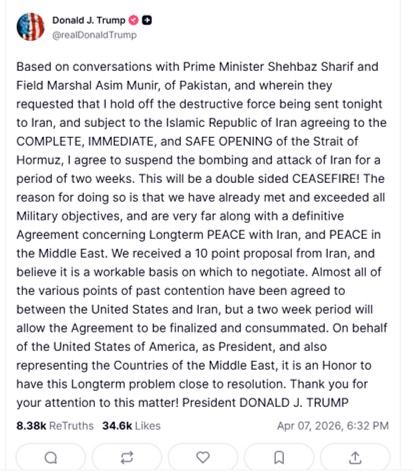
As the evening unfolded on the U.S. East Coast and the deadline approached, Trump announced in a Truth Social post that he had accepted the proposal and would postpone military action against Iran.
However, in the hours and days leading up to the deadline, two key players — China and U.S. Vice President JD Vance — also contributed meaningfully to the outcome of the Pakistan-led diplomatic effort. While Vance and Pakistani leaders engaged in discussions over proposals and key details, Beijing played a role in persuading Tehran to agree to the ceasefire.
The White House acknowledged Beijing’s role and indicated that Vice President Vance remained closely involved in the process leading up to the ceasefire decision.
Acknowledgment of Pakistan’s role has come directly from the top leadership of both sides. President Trump, in a Truth Social post, credited Islamabad’s leadership, stating: “Based on my conversations with Prime Minister Shehbaz Sharif and Army Chief Asim Munir of Pakistan, I have agreed to suspend the bombing and attacks on Iran for a period of two weeks as we work toward a broader agreement.”
On the Iranian side, the Supreme National Security Council also expressed appreciation for Pakistan’s mediation efforts. Foreign Minister Abbas Araghchi shared the message, acknowledging Islamabad’s role in facilitating dialogue at a critical juncture in the conflict and expressing gratitude to Islamabad.
Statement on behalf of the Supreme National Security Council of the Islamic Republic of Iran: pic.twitter.com/cEtBNCLnWT
— Seyed Abbas Araghchi (@araghchi) April 7, 2026
With a two-week ceasefire now in place, the focus has shifted to formal negotiations scheduled in Islamabad on April 10. Vice President Vance is expected to lead the American delegation, while Iran’s parliamentary leadership is set to represent Tehran’s position in the talks.
The breakthrough follows weeks of escalating tensions that had raised fears of a broader regional war and disrupted global energy markets. At the center of those concerns was the Strait of Hormuz, a critical artery for global oil shipments, where instability threatened supply routes and triggered sharp price volatility.
Global leaders have broadly welcomed the ceasefire, viewing it as a rare opening for diplomacy. UN Secretary-General Antonio Guterres urged all parties to use the pause to pursue a lasting and comprehensive peace, while countries across the Gulf and beyond emphasized the importance of maintaining the truce and ensuring freedom of navigation.
Several nations, including Saudi Arabia, Egypt and Turkey, stressed that the ceasefire must be followed by sustained dialogue to address underlying tensions. Others, such as Germany and Malaysia, specifically highlighted Pakistan’s role, with Malaysian Prime Minister Anwar Ibrahim describing its diplomacy as “tireless and courageous.”
🇵🇰 معروف چینی ماہرِ عالمی امور Victor Gao نے اہم بیان دیتے ہوئے کہا:
“میرا خیال ہے کہ پوری دنیا کو پاکستان کو بہت زیادہ کریڈٹ دینا چاہیے، کیونکہ پاکستان نے ایران اور امریکہ کو قریب لانے میں نہایت اہم اور ناگزیر کردار ادا کیا، جس کے نتیجے میں دو ہفتوں کی جنگ بندی ممکن ہوئی۔”… pic.twitter.com/fGQVeQjMtN
— Arbaz Raza Bhutta (@ArbazReza01) April 9, 2026
European leaders also underscored the need for a long-term solution. European Union foreign policy chief Kaja Kallas said the agreement offers a chance to step back from escalation, while European Commission President Ursula von der Leyen described it as an important moment for de-escalation.
Despite the optimism, uncertainty remains. The ceasefire is temporary and fragile — as indicated by differences over control of Hormuz waterway and Israeli actions in Lebanon — and deep divisions between Washington and Tehran persist. Analysts say the upcoming talks in Islamabad will be critical in determining whether the current pause can evolve into a broader and more durable agreement.
For now, Pakistan’s emergence as a central mediator in one of the most volatile conflicts in recent years marks a notable shift in diplomatic dynamics — one that has drawn both recognition and cautious optimism from across the international community.
China, the largest importer of Iranian oil, was also a key influence in encouraging Tehran to engage in negotiations. China’s Foreign Ministry commended Pakistan’s efforts in facilitating the ceasefire and expressed full support for the diplomatic initiative.
Pakistan the one who was the facilitator to make peace between the US & China during the Cold War era. Pakistan the one who is facilitating to make peace between the US & Iran during the post-Cold War era. Spiteful Jaishankar may call them anything, but no one has this record.
— Ashok Swain (@ashoswai) April 8, 2026
Recognition of Islamabad’s role extended beyond official statements from Western and regional capitals. Several prominent analysts described the development as a landmark moment for Pakistani diplomacy — particularly at a time when the world faced the real prospect of a wider regional conflict with significant consequences for global trade and the economy.
Chinese international affairs expert Victor Gao described Pakistan’s role as “indispensable.”
“I believe the entire world should give Pakistan a great deal of credit, because Pakistan played a highly important and indispensable role in bringing Iran and the United States closer, which resulted in a two-week ceasefire,” he said.
“Without Pakistan’s mediation, the world could have faced a major economic crisis.”
Tonight, Pakistan achieved one of its biggest diplomatic wins in years. It also defied many skeptics and naysayers that didn’t think it had the capacity to pull off such a complex, high stakes feat.
But what matters the most is it helped avert a potential catastrophe in Iran.— Michael Kugelman (@MichaelKugelman) April 8, 2026
U.S. expert Michael Kugelman, a senior fellow at the Atlantic Council, described Pakistan’s diplomatic effort as “one of the biggest diplomatic wins in years.”
“Tonight, Pakistan achieved one of its biggest diplomatic wins in years. It also defied many skeptics who doubted its capacity to pull off such a complex, high-stakes feat. Most importantly, it helped avert a potential catastrophe in Iran,” he said.
For a country grappling with economic and security challenges along the Afghan border and with India on its eastern frontier, as well as deep internal political divisions, Pakistan’s diplomatic moment presents a significant opportunity to enhance its international standing. It also underscores the need to address domestic and regional challenges as it seeks to move forward as a responsible nuclear power focused on peace and development. Pakistan may be evolving from its image a decade ago as part of the Afghan problem into a country — with immense human resource potential — that is not just part of the solution but an active and willing partner in advancing global peace.

Ali Imran is a Washington-based journalist, who has worked for leading world news organizations as a correspondent, expert and in editorial positions. He is a published author and poet.