
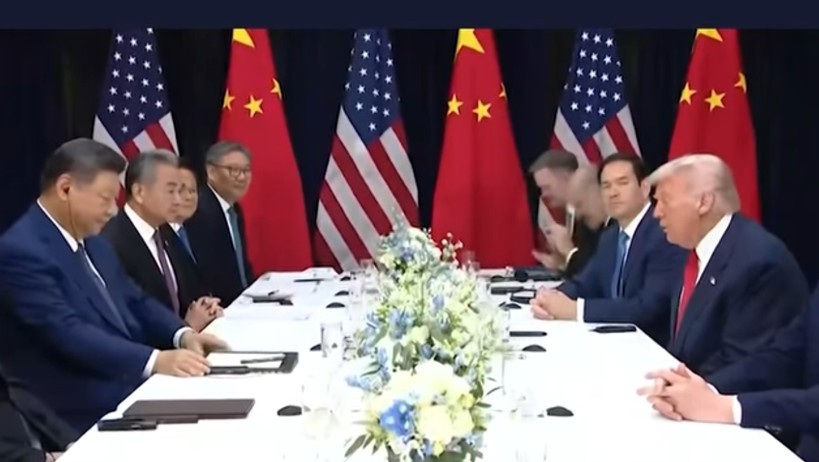
President Donald Trump embarks on a visit to China this week alongside a delegation of leading American executives, highlighting the strong commercial focus of the summit with President Xi Jingping as Washington and Beijing attempt to steady increasingly strained relations.
The visit will be Trump’s first trip to China since 2017, when Beijing staged an elaborate state reception in his honor.
The participation of top American tech and business leaders during the summit reflects the significance of trade and investment relations between the world’s two largest economies.
The two leaders last met on October 30, 2025, in South Korea, when the United States and China agreed to reduce trade restrictions, reaching a one-year truce with reciprocal concessions on contentious issues.
US, China ease trade war as Trump, Xi agree to one-year truce
According to White House officials, several corporate leaders are slated to join Trump for talks with Chinese President Xi Jinping in Beijing.
Among those expected to participate are Tim Cook of Apple, Elon Musk of Tesla and SpaceX, and Larry Fink of BlackRock, as well as senior figures from Meta, Visa, JPMorgan Chase, Boeing and Cargill. The delegation is also expected includes senior executives such as Kelly Ortberg, Ryan McInerney, Stephen Schwarzman, Jane Fraser and David Solomon.
The broad industry representation — spanning finance, aviation, manufacturing, agriculture and technology — reflects efforts by both governments to stabilize economic ties amid ongoing disputes involving tariffs, export restrictions and sanctions.
Media reports suggest Boeing is seeking to use the summit to advance discussions on a major aircraft deal with China. The negotiations reportedly involve a possible order of up to 500 Boeing 737 MAX jets, along with widebody aircraft equipped with engines manufactured by GE Aerospace.
If completed, the purchase would mark China’s first significant Boeing order in nearly a decade and could become one of the largest aircraft agreements in commercial aviation history.
Meanwhile, Jensen Huang, chief executive of NVIDIA, is not expected to attend the Beijing trip. A source familiar with the matter said the administration is concentrating primarily on agriculture and aviation issues rather than chip-related negotiations.
The Trump administration had earlier approved exports of Nvidia’s H200 artificial intelligence chips to China, although U.S. Commerce Secretary Howard Lutnick said in April that Chinese firms still faced domestic regulatory obstacles to acquiring the technology.
Compared with Trump’s last visit to Beijing nearly eight years ago, the geopolitical environment has shifted considerably, with China emerging more assertive economically and diplomatically and Xi viewed as more experienced in handling Washington’s negotiating tactics.
The summit was delayed earlier this year because of the Iran conflict — comes at a sensitive moment as both countries attempt to prevent further deterioration in relations amid tensions over trade, Taiwan and broader global security concerns.
The meeting is also being closely watched by regional allies including Japan and Taiwan, particularly as the ongoing Middle East conflict and the repositioning of U.S. military assets have raised questions about Washington’s strategic capacity in the Asia-Pacific region.

Ali Imran is a Washington-based journalist, who has worked for leading world news organizations as a correspondent, expert and in editorial positions. He is a published author and poet.







