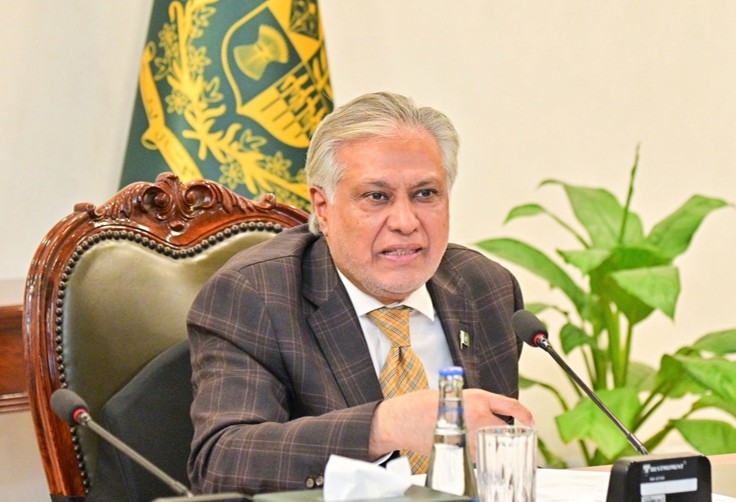
Pakistan’s facilitative role in advancing potential U.S.-Iran negotiations to end the war appears to have entered a critical phase, as Islamabad’s top diplomat heads to Beijing with the objective of broadening acceptance of its diplomatic effort.
The Foreign Ministry in Islamabad said Foreign Minister Ishaq Dar’s meeting with his Chinese counterpart Wang Yi would provide an opportunity for “in-depth discussions on regional developments,” though it did not explicitly mention the diplomatic push to initiate U.S.-Iran talks.
Ahead of his visit, Dar shared remarks by Chinese Foreign Ministry spokesperson Mao Ning, who said China “commends and supports Pakistan’s mediation effort for de-escalation and stands ready to enhance communication and coordination” toward a ceasefire and peace in the region.
U.S. President Donald Trump’s reported desire to secure a deal before an April 6 deadline, along with his call for an immediate agreement, underscores the urgency of the diplomatic effort.
Trump Says US in ‘Serious’ Talks With ‘Reasonable’ Iran Regime, Issues Warning if No Deal Reached
Meanwhile, some experts suggest Iran may be seeking a major guarantor for any prospective agreement with the United States, while other say Islamabad will ask Beijing to use its influence with Iran to woo it to the negotiating table, although Pakistan remains the only country Iran has reposed its trust in during the ongoing crisis.
The United States has not publicly commented on any potential Chinese role in the diplomatic push, and President Donald Trump’s recent statements indicate that Washington is seeking to retain control over the negotiation process and advance it on its own terms, as outlined in a reported 15-point proposal conveyed to Tehran through Pakistan.
Trump has also indicated that the United States is engaged in both direct and indirect contacts with Iran as he follows a dual-track approach to diplomacy, calling for an immediate response to ceasefire proposal while also threatening military action in the case of non-acceptance of the diplomatic route.
Significantly, Trump has also called Iran’s new regime as “more reasonable.”
Ishaq Dar’s trip to Beijing likely signifies that Pakistan is seeking Chinese endorsement, strategic synchronization, and added diplomatic weight before moving further into a mediation role on the Iran war. It reflects a bid to enlarge Pakistan’s relevance while ensuring that any… https://t.co/heHuAGckTp
— Rabia Akhtar (@Rabs_AA) March 30, 2026
Iranian-American author and expert on Middle Eastern affairs Vali Nasr noted in a social media post that Tehran is seeking guarantees in any potential deal with Washington.
“Word is that Pakistan’s foreign minister is going to Beijing to get a guarantor for the potential deal. Likely that is Iran’s condition for talks with the US. And FM would not be going to China without having floated the idea with both Washington and Beijing. No guarantees of China biting, but Beijing is now the frontline in the diplomatic effort,” he wrote.
Pakistan may also be seeking to balance its mediatory role between Washington and Iran through these consultations with Beijing.
Dr. Rabia Akhtar, Dean of Social Sciences at the University of Lahore, said the visit “likely signifies that Pakistan is seeking Chinese endorsement, strategic synchronization, and added diplomatic weight before moving further into a mediation role on the Iran war.”
Iran has asked for guarantees in any deal with US. Word is that Pakistan Foreign Minister is going to Beijing to get a guarantor for the potential deal. Likely that is Iran’s condition for talks with US. And FM would not be going to China without having floated the idea with both…
— Vali Nasr (@vali_nasr) March 30, 2026
“It reflects a bid to enlarge Pakistan’s relevance while ensuring that any de-escalatory initiative it carries is anchored in a wider Asian power framework rather than seen as merely servicing a U.S. agenda,” she wrote on X.
Despite Islamabad’s close ties with Beijing, it remains unclear how far China would be willing to back the initiative as a participant or whether it would assume the role of a guarantor in a highly volatile, multi-country conflict.
It also remains unclear how Washington would respond to such an Iranian demand.
China commends and supports Pakistan’s mediation effort for deescalation and stands ready to enhance communication and coordination with Pakistan and others to jointly work for a ceasefire and peace in the region. @ForeignOfficePk #MiddleEast #Iran pic.twitter.com/EjxWRUvxck
— Mao Ning 毛宁 (@SpoxCHN_MaoNing) March 30, 2026
China, however, has significant stakes in a successful outcome of Pakistan-led diplomacy, as it remains the largest importer of Iranian oil and conducts substantial trade through the Strait of Hormuz, a critical artery for global energy shipments. The maritime corridor is virtually closed to the U.S., Israel and American allies.
Islamabad has already secured backing from key Middle Eastern players, including Saudi Arabia, Türkiye, and Egypt. The foreign ministers of these countries participated in a recent quadrilateral meeting in Islamabad alongside Dar. Other regional states, including Kuwait, have also expressed support for Pakistan’s initiative.
Meanwhile, European Commission President António Costa held discussions with Prime Minister Shehbaz Sharif on the evolving Middle East situation. According to Islamabad, both sides agreed that dialogue and diplomacy must prevail to restore regional peace and stability.
Pakistan is the rare country that has warm ties w/US & Iran but also the GCC states, Turkey & China. Heck, its ties w/Russia are good too. This may not bring piece to the Mideast, but it gives Pakistan diplomatic alignments that line up well to position itself as a facilitator.
— Michael Kugelman (@MichaelKugelman) March 30, 2026
Pakistan’s coordination with China is significant, given their deep defense and economic ties. Analysts say Islamabad recognizes that any durable regional role it seeks must remain acceptable to Beijing.
“So, the visit may reflect a careful balancing act: Pakistan wants to be useful to the United States in crisis diplomacy without appearing to drift strategically away from China. That is a very Pakistani form of statecraft under pressure — not neutrality in the abstract, but calibrated alignment management,” Dr. Akhtar said.

Ali Imran is a Washington-based journalist, who has worked for leading world news organizations as a correspondent, expert and in editorial positions. He is a published author and poet.

Kiran Asim is a writer who covers the U.S., Europe, South Asia, and the Middle East. Her reports and analyses look at the geostrategic issues and contemporary developments and their economic and political implications. She also writes about society and education.