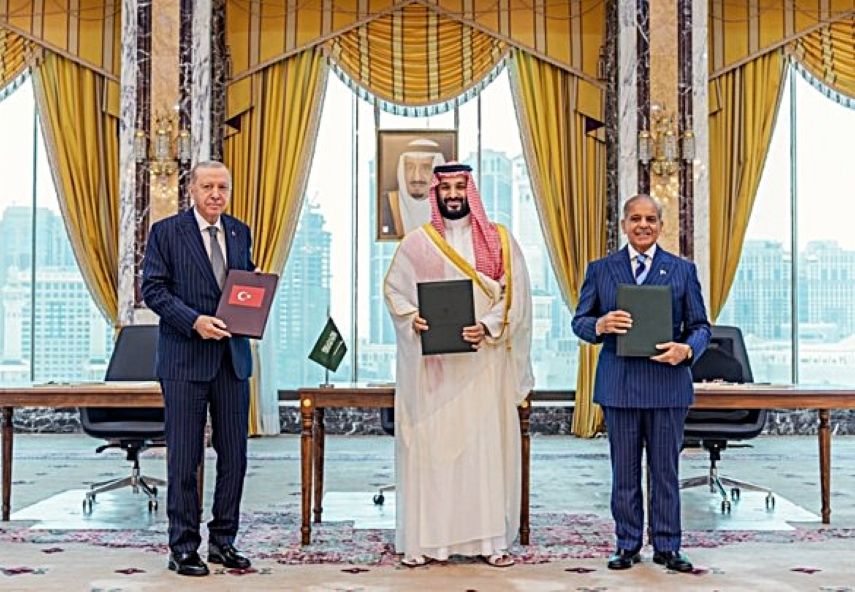
Pakistan on Sunday said this week’s landmark defense agreement concluded by Pakistan, Saudi Arabia and Turkiye is open to any country in the region that is prepared to accept its core principles.
Deputy Prime Minister and Foreign Minister Ishaq Dar also underlined that the arrangement is strictly defensive, seen by experts as one of most significant strategic development in the Middle East, which has been wracked by a spate of recent conflicts involving major powers and militant proxies.
Possibility of Broader Membership
The suggestion that the Makkah Joint Defense Agreement, signed in the Saudi city on Friday, could expand followed remarks a day earlier by Turkiye’s foreign minister indicating that Egypt might eventually join it.
Officials say the agreement is designed to reinforce collective deterrence.
Under its terms, an armed attack on any one of the three signatories is to be treated as an attack on all of them.
Pakistan, Saudi Arabia and Turkiye Sign Joint Defense Pact in Makkah
This provision mirrors the collective defense commitment contained in NATO’s Article 5, which provides that an armed attack against one or more members shall be considered an attack against them all, and that each member will assist by taking such measures as it deems necessary, including the use of armed force, in accordance with the right of individual or collective self-defense recognized in Article 51 of the United Nations Charter.
The Foundational Purpose and Principles
In a post on X, Foreign Minister Ishaq Dar described the arrangement as the Makkah Accord and set out its underlying purpose.
He said the agreement “reflects the depth of the brotherly relations between the leadership and peoples of the three countries” and represents “the culmination of years of discussions and coordination, with a common desire to strengthen strategic cooperation in addressing multifarious peace and security challenges and advancing regional peace, stability and prosperity.”
Dar made clear that the pact does not cancel or supersede any existing bilateral or multilateral agreements that the three countries maintain among themselves or with other states and organizations.
He restated that any external armed attack on one of the three states would be regarded as an attack on all, and noted that this approach is consistent with the right of individual and collective self-defense under Article 51 of the UN Charter.
Pakistan and Türkiye have stressed that the Makkah Joint Defense Agreement signed with Saudi Arabia is purely defensive, not directed against Iran or any other country and could expand to include other regional states that share its principles.https://t.co/1VJXRjFTXv
— Saudi Gazette (@Saudi_Gazette) August 9, 2026
He emphasized again that the accord is “purely defensive” in character.
“It is not targeted against any country and its sole purpose is to further strengthen our ongoing efforts towards peace, stability and prosperity in the wider region,” he said.
Dar added that the Makkah Accord “remains open to any country in the region willing to uphold its fundamental principles and resolve differences through mutual respect, cooperation and peaceful means.” He linked the agreement to the main tenets of Pakistan’s foreign policy and expressed Islamabad’s readiness to continue working with other regional partners for lasting peace and stability.
Turkish Foreign Minister’s Comments on Egypt and Expansion
On Saturday, Turkish Foreign Minister Hakan Fidan told the state-run Anadolu news agency that he expected Egypt to join the arrangement once certain technical matters were settled.
“Egypt is already our natural partner on all issues. I believe that at the next stage, Egypt will also be among us in the alliance.
“We already act toward one another as if we were alliance members. There are a few technical issues. Once these are implemented, there is no reason for Egypt not to be part of it,” Fidan said.
Q: Is there a principle in the Türkiye–Saudi Arabia–Pakistan defense agreement similar to NATO’s Article 5?
Turkish Foreign Minister Hakan Fidan: Technically, it’s the same. That’s why you establish a security pact. pic.twitter.com/Npsf5e92HC
— Clash Report (@clashreport) August 8, 2026
He noted that some other countries had expressed interest in joining but preferred not to be identified publicly.
Fidan said the preferred structure would keep Turkiye, Saudi Arabia and Pakistan as the three founding core members responsible for setting the principles, standards and long-term framework of the alliance, with additional countries able to join subject to the approval of the core members.
“Under our president’s vision, we should not remain limited to three countries. We should grow,” he stated.
Fidan also observed that Pakistan’s inclusion gives the initiative a wider geographic scope than the traditional Middle East, reflecting a broader regional outlook.

Kiran Asim is a writer who covers the U.S., Europe, South Asia, and the Middle East. Her reports and analyses look at the geostrategic issues and contemporary developments and their economic and political implications. She also writes about society and education.