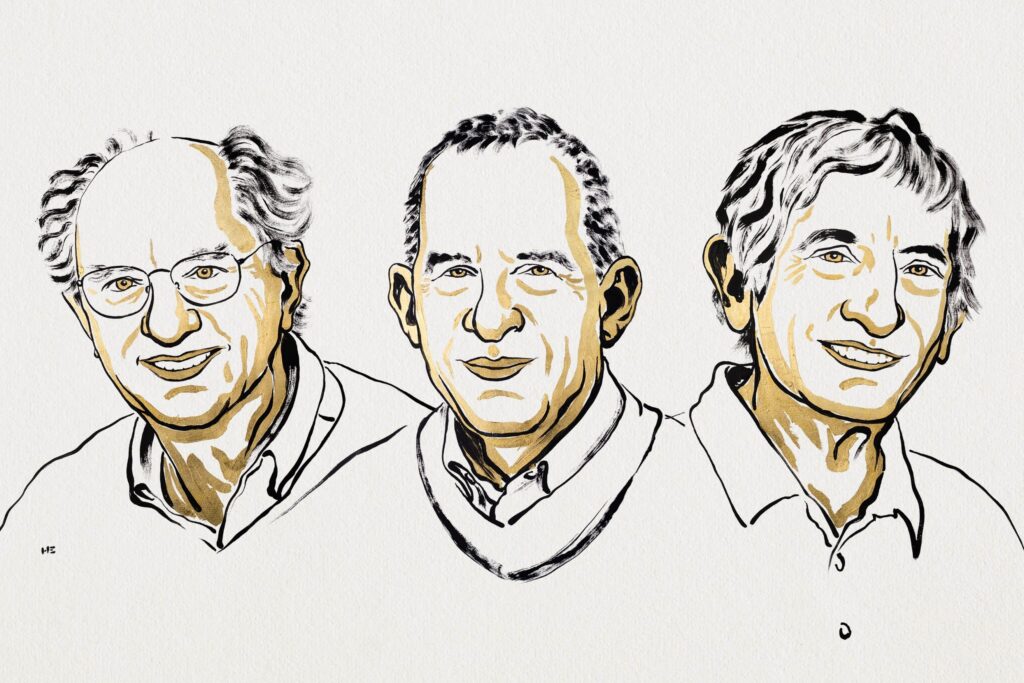
The 2025 Nobel Prize in Physics to John Clarke, Michel H. Devoret, and John M. Martinis “for the discovery of macroscopic quantum mechanical tunnelling and energy quantization in an electric circuit.” Quantum Mechanics
The award by the Royal Swedish Academy of Sciences cites a series of groundbreaking experiments, the laureates demonstrated that the strange and counterintuitive principles of quantum mechanics—usually confined to the atomic and subatomic world—can manifest in systems large enough to hold in one’s hand.
Their work marks a pivotal moment in our understanding of how quantum phenomena can appear on a macroscopic scale.
Making Quantum Mechanics Tangible
One of the fundamental questions in modern physics is: How large can a system be while still displaying quantum behavior?
While quantum mechanical effects typically vanish as systems increase in size and complexity, Clarke, Devoret, and Martinis showed that under the right conditions, quantum phenomena such as tunnelling and energy quantization remain observable even in relatively large systems.
Their experiments, conducted in the mid-1980s, involved superconducting circuits—electrical systems that conduct current with zero resistance. These circuits included Josephson junctions, where superconducting materials are separated by a thin insulating layer. This setup created a controlled environment ideal for probing quantum effects.
Quantum Tunnelling and Energy Quantization on a Large Scale
In these circuits, the superconducting current behaves as if it forms a single, unified particle-like entity that spans the entire system. Initially, the system is in a state where current flows with no measurable voltage—essentially “trapped” in a quantum well.
Remarkably, the system can spontaneously tunnel out of this zero-voltage state, transitioning to a new state where a voltage appears—clear evidence of quantum mechanical tunnelling.

The researchers also observed that the system absorbed and emitted energy only in discrete amounts, or quanta, exactly as predicted by quantum mechanics. This phenomenon, known as energy quantization, further reinforced that large-scale systems can indeed follow the rules of the quantum world.
A Foundation for Future Technologies
“This prize celebrates the remarkable way that century-old quantum mechanics continues to yield new surprises,” said Olle Eriksson, Chair of the Nobel Committee for Physics. “It also underscores how profoundly useful it is, forming the foundation of all modern digital technology.”
Quantum mechanics already underpins technologies such as transistors—the building blocks of microchips in computers. The insights from this year’s laureates now pave the way for the next generation of quantum technologies, including:
- Quantum computers
- Quantum cryptography
- Quantum sensors
Their work not only deepens our fundamental understanding of the universe but also brings us closer to practical applications that could redefine the technological landscape of the future.
Follow for more: Twitter (X) | Facebook | Instagram | LinkeIn

Huma Nisar is Associate Editor at Views and News. She also writes opinion articles on health, society and diet.