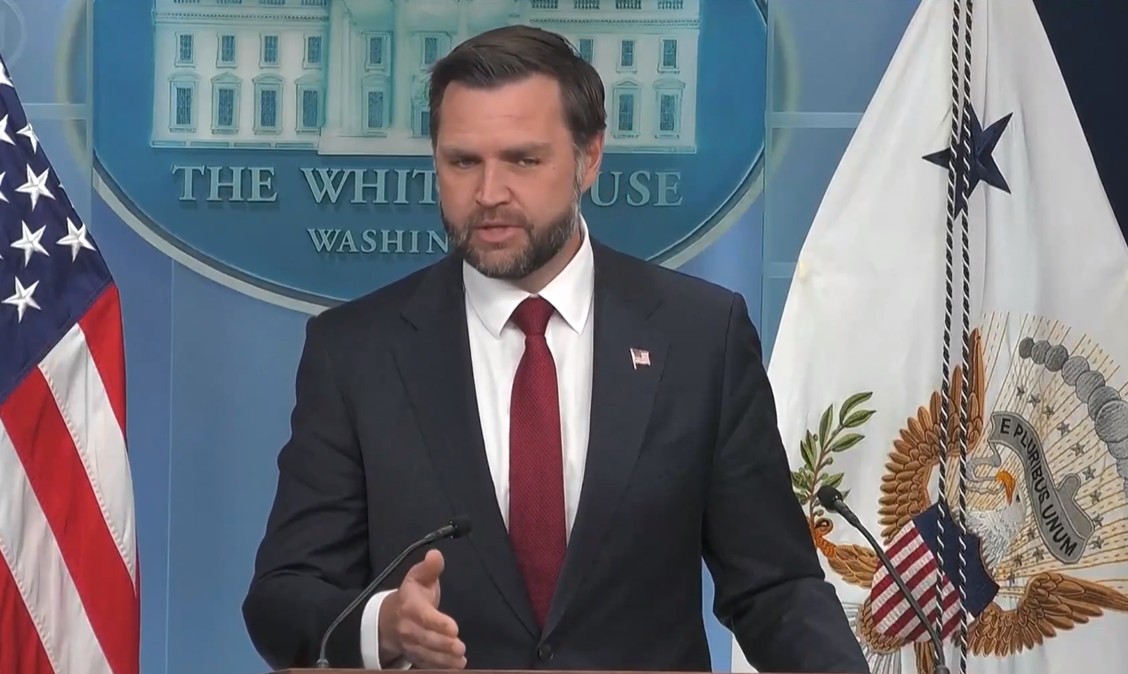
Vice President J.D. Vance said Thursday that he would not characterize the ongoing hostilities between the United States and Iran as a “war,” while also indicating that a resolution depends on Tehran halting its attacks on commercial ships transiting the Strait of Hormuz.
“I wouldn’t call it a war,” Vance told reporters during a White House briefing.
“Right now, there’s no active shooting. I recognize there have been places where this has flared up,” he said, referring to the recent resumption of hostilities between U.S. and Iranian forces this week.
When asked about a timeline for ending the conflict, Vance replied: “When you ask, ‘When will this end?’ you’re asking me a question like, ‘When will the Iranians stop shooting at ships?’ I think the reality is, I don’t know the answer to that question. You would have to ask the Iranians.”
WATCH IN FULL: @VP takes questions from the press pic.twitter.com/j9RSJkDyaZ
— Rapid Response 47 (@RapidResponse47) September 3, 2026
Vance’s careful wording appears aimed at downplaying the political implications of the six-month-old conflict for the Republican Party, as President Donald Trump leads the party into the midterm elections on November 3, with control of both chambers of Congress at stake.
Despite reaching a preliminary ceasefire agreement on June 17, the two sides have continued exchanging strikes and counterstrikes, mainly near the Strait of Hormuz.
The U.S. has enforced a naval blockade of Iranian ports as part of efforts to pressure Tehran into submission, while Iran has targeted commercial vessels to assert its control over the strategic oil-shipping route.
U.S. strikes against Iran’s Islamic Revolutionary Guards Corps indicate that President Trump has resumed his two-track pressure strategy against Iran, following the imposition of fresh sanctions, which he described as the “Economic D-Day” for Iran.
Trump also claimed that the United States possesses virtually unlimited supplies of mid- to high-grade ammunition and is prioritizing domestic stockpiling while planning to resume sales to allies.
He added that his administration would ask European allies to reimburse costs related to weapons previously provided to Ukraine under the Biden administration.
“We are producing munitions at levels never seen before. We are stockpiling and preparing for any contingency that could happen,” Trump said. “We are keeping them for ourselves rather than selling them to others, but sales to allies will soon resume.”
In response, Iran has targeted U.S. military sites in neighboring oil-rich Gulf countries, including Kuwait and the United Arab Emirates. This week, Saudi Arabia also accused Tehran of setting two of its oil tankers on fire in the region.
Iran has remained defiant in the face of American pressure and has reiterated that it will not compromise on its national interests.

Muhammad Luqman is Associate Editor at Views News Now. He writes on wide-ranging issues including economy, South Asia, the Middle East, agriculture, economy and innovation. Luqman has worked some of the leading news organizations and won acclaim for his original and research-based works.

Kiran Asim is a writer who covers the U.S., Europe, South Asia, and the Middle East. Her reports and analyses look at the geostrategic issues and contemporary developments and their economic and political implications. She also writes about society and education.