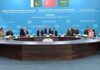
Senior officials from Iran and the three members of the Makkah Defesce Alliance — Saudi Arabia, Pakistan, and Türkiye — held their first high-level joint meeting in Tehran on Monday.
The gathering took place against a backdrop of heightened regional tensions, including Houthi attacks on Saudi territory and the broader fallout from U.S. and Israeli military actions involving Iran.
Both the Houthi attacks on Saudi Arabia and the U.S.-Iran tensions appear to have factored into discussions.
Fears of renewed U.S.-Iran hostilities have grown as President Donald Trump has threatened Tehran withe severe consequences if it does not accept a proposal resume peace talks on reopening the Strait of Hormuz, and ultimately resolving the uranium enrichment issue.
The meeting produced no dramatic announcements or detailed public statements from most participants. Instead, the four countries issued a brief joint statement agreeing to continue dialogue aimed at strengthening cooperation on regional peace and security.
Iranian state media and independent reports described the atmosphere as constructive, even as officials kept their comments limited.
According to Israeli C14News channel, the Makkah Alliance members presented a new regional diplomatic proposal. Citing a major European Think Tank, the channel said a mediator group consisting of Turkey, Pakistan, Saudi Arabia, and Qatar has made the new offer that Tehran is reportedly considering.
The reported proposal includes end to the U.S. naval blockade of Iranian ports, relief from sanctions affecting oil exports, guarantees against renewed attacks, access to $6 billion in frozen funds, transportation of Iranian uranium to a third country and a complete reopening of the Strait of Hormuz.
None of the participating nations has confirmed or publicly commented on the proposal.
🚨🇮🇷🇸🇦🇹🇷🇵🇰🇶🇦 A new regional diplomatic proposal is reportedly on the table for Iran. According to a major European Think Tank, a mediator group consisting of Turkey, Pakistan, Saudi Arabia, and Qatar has extended an offer that Iran is currently considering.
The reported proposal includes:
-End to the US naval blockade of Iranian ports
-Relief from sanctions affecting oil exports
-Guarantees against renewed attacks
-Access to $6 billion in frozen funds
-Moving Iranian uranium to a third country
-Complete reopening of the Strait of Hormuz— C14 News | EN (@c14english) October 26, 2026
Who Attended and What Was Said
Saudi Arabia was represented by Defense Minister Prince Khalid bin Salman. Pakistan sent Chief of Defence Forces and Chief of Army Staff Field Marshal Asim Munir, along with Interior Minister Mohsin Naqvi. Türkiye’s National Intelligence Organization chief Ibrahim Kalin also participated.
On the Iranian side, the talks were hosted by Mohsen Rezaei, secretary of Iran’s Supreme National Security Council. Foreign Minister Abbas Araghchi joined, and the visiting officials later met President Masoud Pezeshkian.
Pezeshkian used the occasion to call for “regional unity.” According to Iranian state media and reports in Dawn and other outlets, he stressed that Muslim nations should stand together against external threats, resolve differences through cooperation, and pursue security and development. He expressed support for any understanding that strengthens solidarity in the region and reiterated Iran’s position that it does not seek nuclear weapons while affirming its right to peaceful nuclear activities under international obligations.
Rezaei later described the discussions as “very good.” He told Iranian state television that a new and positive atmosphere appeared to be forming in the region, noting the significance of three major countries visiting Tehran despite external pressures. “If our four countries sit together, many of the region’s problems can be resolved,” he said in comments reported by multiple outlets including Matrix Mag and Arab News.
Reports circulating of initial terms involving Mecca Pact partners (Saudi Arabia, Turkey, Pakistan), Iran & Russia:
Attacks on Iran pause. Iran cuts support to the Houthis. Tehran gets ~$6B unfrozen and the Strait of Hormuz reopens. Russia takes Iran’s enriched uranium. Sanctions ease gradually, with IAEA inspectors eventually allowed back in.
Talks ongoing in Tehran today. Details unconfirmed and fluid.— Ali K.Chishti Official (@thewirepak) October 26, 2026
Saudi officials framed the visit more cautiously. Saudi Deputy Minister for Public Diplomacy Rayed Krimly stated on X that the trip formed part of ongoing efforts by Makkah Pact members to de-escalate the current crisis, promote dialogue, and support mediation efforts led by Qatar and Pakistan. He emphasized the alliance’s role in reinforcing regional security and stability while working with all countries in the region.
Pakistani and Turkish officials offered little public commentary beyond confirming participation. Iranian Foreign Ministry spokesman Esmaeil Baghaei noted that the meeting stemmed from a proposal made by Field Marshal Munir during a visit to Tehran the previous week.
Saudi Arabia’s Core Concerns
For Riyadh, the immediate and pressing worry is the sharp escalation of attacks by Yemen’s Houthi movement. In recent weeks, Houthi drones and missiles have struck Saudi territory, including targets near Medina and facilities linked to civilian infrastructure and energy networks. These strikes have injured dozens and tested Saudi air defenses, prompting the activation of the Makkah Joint Defence Agreement earlier this month.
Saudi officials view the Houthis as Iran-aligned and see the attacks as a direct threat to the kingdom’s territorial integrity and the safety of its holy sites and population centers. The Makkah pact — which treats an armed attack on one member as an attack on all — was designed in part as a defensive response to such threats. Riyadh wants its partners to help deter further strikes while exploring diplomatic channels to reduce the risk of a wider regional war that could draw in more actors.
Beyond the Houthis, Saudi Arabia is concerned about the spillover effects of the broader U.S.-Israeli campaign involving Iran. Any expansion of that conflict could further destabilize the Gulf, disrupt shipping lanes, and increase pressure on Saudi security resources. The Tehran meeting gave Saudi leaders a chance to convey these concerns directly and test whether dialogue with Iran could help contain the risks.
Makkah Alliance Members Rush to Tehran in Last-Ditch Bid to Avert Wider Confrontation
Iran’s Key Concerns
Iran approaches the talks from a different set of pressures. Tehran faces the ongoing consequences of U.S. and Israeli military actions, which Iranian officials describe as aggression with far-reaching regional fallout. Iranian Foreign Ministry spokesman Esmaeil Baghaei said discussions would cover “Israel’s expansionist policies, developments in the Palestinian territories and Lebanon, and the repercussions of U.S. and Israeli military action against Iran.”
Iranian leaders worry about isolation and the risk of further military escalation. They also monitor related issues such as the status of the Strait of Hormuz, reports of naval restrictions, and the possibility of renewed strikes. At the same time, Tehran seeks to avoid being locked into permanent confrontation with its neighbors and wants to demonstrate that regional problems can be addressed through collective Muslim-majority cooperation rather than external intervention.
President Pezeshkian’s emphasis on unity reflects this priority: Iran wants to show it is open to practical arrangements that reduce tensions while defending what it sees as its legitimate security and nuclear rights. The presence of Makkah Pact members in Tehran was presented by Iranian officials as evidence that isolation efforts have limits.
Why the Meeting Matters
The Makkah Joint Defence Agreement, signed in August 2026 by Saudi Arabia, Pakistan, and Türkiye, treats an armed attack on one member as an attack on all. The pact was activated earlier in response to escalating Houthi strikes on Saudi targets. Analysts and officials have described the agreement as defensive in nature, with no named adversary, though the Houthi campaign has tested its practical limits.
Monday’s talks marked the first formal high-level contact between Iran and all three Makkah Pact members since those tensions intensified.
Reports from Dawn, Al Jazeera, and Middle East Eye indicated the agenda covered regional security, the consequences of military actions involving Iran, developments in Palestine and Lebanon, and ways to prevent wider conflict. Some accounts mentioned discussions of a possible regional non-aggression framework, efforts to halt Houthi attacks, the status of the Strait of Hormuz, and related naval issues.
POTENTIAL WARTIME DISRUPTIONS: The United States and Britain are separately preparing for disruptions that could leave military installations and households without essential services, as Western governments respond to potential wartime threats and risks to critical infrastructure.
The Pentagon is developing plans requiring major U.S. military bases to operate independently for at least 90 days if war or cyberattacks disrupt electricity, water, communications, and supply chains, according to a report.
Meanwhile, Britain is urging households to stockpile enough food, drinking water, and other emergency supplies to manage at least three days without essential services.
— NEWSMAX (@NEWSMAX) October 27, 2026
Pakistan’s Continuing Balancing Act
Field Marshal Munir’s presence and earlier proposal for the talks highlight Pakistan’s careful positioning. Islamabad has deepened defense cooperation with Saudi Arabia under the Makkah framework, including discussions of rapid deployment of forces and capabilities. At the same time, Pakistan has sought to keep channels open with neighboring Iran and avoid being drawn into broader confrontation.
The initiative allows Pakistan to honor its commitments to Saudi Arabia while preserving dialogue with Iran. Officials in Islamabad have repeatedly described the Makkah pact as consistent with the UN Charter and focused on collective defense rather than offensive aims.

Kiran Asim is a writer who covers the U.S., Europe, South Asia, and the Middle East. Her reports and analyses look at the geostrategic issues and contemporary developments and their economic and political implications. She also writes about society and education.