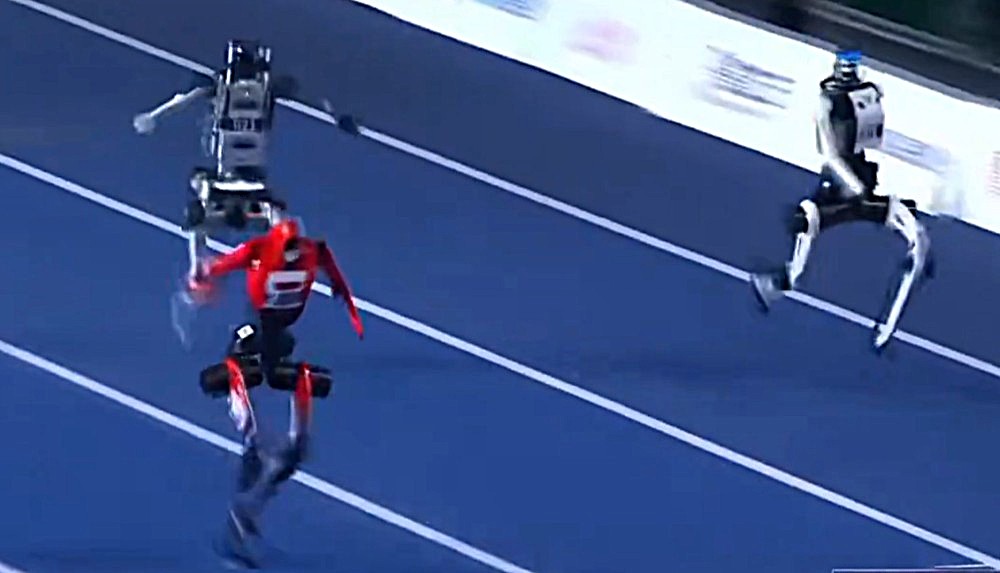
The finish line wasn’t the problem. It was everything after.
At the World Humanoid Robot Games in Beijing, two Chinese robots—Tiangong Ultra and Honor’s Lightning—blazed through 100 meters in 9.39 and 9.47 seconds, respectively. Both crushed Usain Bolt’s untouchable 9.58-second world record. Both made history.
Then both promptly forgot how to be robots.
Tiangong Ultra veered sideways into spectators before pile-driving into a thick safety mat. Lightning buckled, collapsed, and had to be stretchered off the track like a fallen sprinter. No victory laps. No raised arms.
⚡️⚡️OMG HOLY SHIT‼️
A humanoid robot ran 100m in 9.39s at World Robot games 😳
Record of Usain Bolt shattered by a machine!! pic.twitter.com/Q7G0L2hfsb
— Nikhil (@nikhilx22) August 22, 2026
Just the humbling sight of cutting-edge engineering eating concrete—because raw speed means nothing if you can’t stop.
But here’s the real story: last year, Tiangong Ultra ran the same race in 21.5 seconds. This year? It shaved more than half that time off. Next year? It’s already winning half-marathons faster than human world-record pace—50 minutes and 26 seconds, to be exact.
China isn’t just building faster robots. It’s building the future of manufacturing, logistics, and daily life—with machines that are sprinting toward us at breakneck speed. The only question isn’t how fast they can go.
It’s what happens when they get here.
Humanoid robots competed in various events on day one of the World Robot Games, with one even breaking Usain Bolt’s world record in the 100 meter sprint.
More than 2,000 humanoid robots were participating in the event, the organizer said. https://t.co/9rBEYZtcnB pic.twitter.com/Zi5HlrdauD
— ABC News (@ABC) August 22, 2026
Beijing has declared humanoid robotics a strategic industry, and investors are betting big—one maker, Unitree, hit a $50B valuation overnight.
So yes, the finishes were chaotic. The landings were ugly. But the takeoff?
That’s history in motion.
Because speed isn’t just about medals anymore.
It’s about how fast the future is arriving—and whether we’re ready to catch it.

Huma Nisar is Associate Editor at Views News Now. She also writes opinion articles on health, society and diet.