In a significant diplomatic gesture toward Iran, Saudi Arabia has signaled a new phase in regional relations by sending a high-level delegation to the state funeral of Iran’s late Supreme Leader, Ayatollah Ali Khamenei.
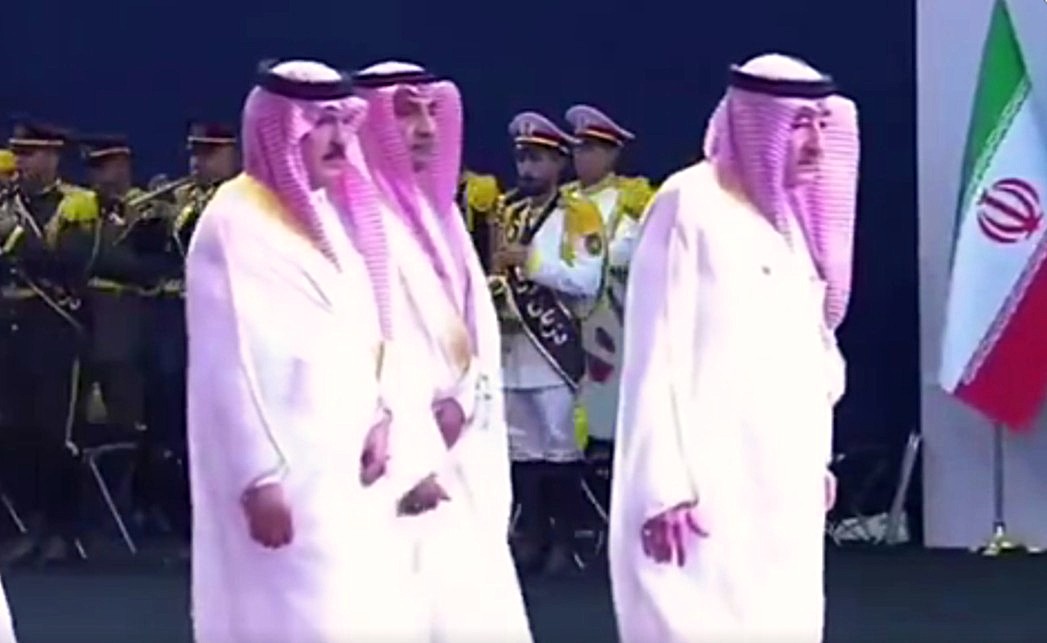
Saudi Arabia’s King Salman bin Abdulaziz and Crown Prince Mohammed bin Salman conveyed their condolences to Iranian President Masoud Pezeshkian through Deputy Foreign Minister Waleed Elkhereiji, who attended the funeral ceremonies in Tehran. The Saudi Foreign Ministry announced the move on Saturday, describing it as an expression of sympathy with the Iranian leadership and people.
Khamenei was assassinated on February 28, the first day of the war when U.S. and Israeli launched coordinated attack on Iran. Khamenei is being honored in a series of funeral ceremonies expected to continue for several days. His flag-draped coffin was placed at Tehran’s Grand Mosalla alongside those of family members who were also killed in the attack.
🇮🇷 Iran didn’t welcome delegations at Khamenei’s funeral with diplomacy. It handed out ideological verdicts through Quranic verses.
Saudi Arabia: a verse on believers routing “disbelievers” in battle.
Turkey: “those who strive rank above those who stay behind.”
Lebanon: “make no… https://t.co/hCRWklG93S pic.twitter.com/efVlVWlXef— नवेंदु राणा (@rananavend) July 5, 2026
Beyond the solemnity of the occasion, Saudi Arabia’s decision to send an official representative carries significant geopolitical implications.
Political analysts view the move as another indication of the Kingdom’s ongoing reconciliation with Iran despite years of rivalry and recent regional tensions which saw Tehran target sites in Saudi Arabia and several other Gulf neighbors, citing their support for attacks on Iran.
Riyadh’s move to send a high-level delegation to Tehran for Khamenei’s funeral underscores Riyadh’s growing emphasis on diplomacy, regional stability, and de-escalation in the Gulf.
Saudi Arabia Proposes Regional Non-Aggression Framework with Iran
The funeral ceremonies, taking place across Tehran, Qom, and culminating in Mashhad, highlight a broader transformation in Gulf-Iran relations and the evolving strategic landscape of the Middle East.
What is behind the Saudi-Iran Rapprochement?
According to The Guardian newspaper, the Saudi-Iran rapprochement accelerated after Crown Prince Mohammed bin Salman held his first direct meeting with a senior Iranian official, breaking years of diplomatic deadlock and opening channels for practical cooperation.
One of the most notable outcomes has been progress toward ending the long-running conflict in Yemen, which for years served as the principal arena for Saudi-Iranian proxy competition.
Besides UAE, Saudi Arabia also fired back at Iran during conflict
A reduction in hostilities has eased humanitarian suffering while enabling both countries to redirect attention toward economic development, regional security, and diplomatic engagement.
Strategic Neutrality During the 2026 Conflict
The evolving relationship was further tested during the regional conflict that erupted on February 28, 2026, involving Iran, Israel, and the United States.
According to reports cited by The New York Times, Saudi Arabia adopted a policy of strategic restraint during the crisis. Some earlier reports suggested Riyadh allowed the U.S. to launch operations through its airspace in the region under U.S. pressure.
The latest iteration of Riyadh’s position came when Saudi Press ran a news story on Saturday, reporting that “Saudi Arabia has formally informed both the United States and Iran that it will not allow its airspace or territory to be used for any military strike against Tehran.”
Riyadh reportedly declined to allow its airspace to be used for operations targeting Iran and instead prioritized efforts aimed at preventing further regional escalation.
Analysts believe this approach reflects Crown Prince Mohammed bin Salman’s broader strategic vision, which increasingly emphasizes regional stability and economic transformation under Vision 2030 over prolonged geopolitical confrontation.
Pakistan’s Critical Role in Quiet Diplomacy
Meanwhile, Islamabad, which has a mutual defense pact with Riyadh, came forward as an important facilitator of regional diplomacy during the crisis.
Pakistan not only mediated the U.S.-Iran conflict but through discreet backchannel communications, it also helped maintain dialogue between Gulf stakeholders and supported efforts to reduce tensions between Iran and its adversaries.
Pakistan Navigates Delicate Diplomacy After Iran Strikes on Saudi Arabia
Pakistan’s longstanding relations with both Riyadh and Tehran enabled it to serve as a trusted intermediary at a critical moment.
Saudi Arabia’s support for these diplomatic efforts further reinforced Pakistan’s role as a bridge between the Gulf and South Asia.
A New Direction in Saudi Foreign Policy
Saudi Arabia’s participation in Khamenei’s funeral represents more than a symbolic gesture. It reflects the Kingdom’s broader strategic recalibration under Crown Prince Mohammed bin Salman, emphasizing dialogue, regional cooperation, and pragmatic diplomacy.
Observers suggest several factors are driving this policy shift, including the desire to reduce the costs of proxy conflicts, adapt to an increasingly multipolar international order, and create conditions conducive to economic growth and investment.
Potential areas for future cooperation between Riyadh and Tehran include energy market coordination, maritime security in the Gulf, regional infrastructure development, and expanded economic engagement.
For Pakistan, the success of its diplomatic outreach has further enhanced its profile as a regional mediator capable of facilitating dialogue between key Middle Eastern powers.
Looking Ahead
Saudi Arabia’s decision to attend the funeral could pave the way for additional confidence-building measures, including expanded trade, cultural exchanges, improved pilgrimage coordination, and cooperation on shared regional challenges such as climate resilience and maritime security.
Nevertheless, significant obstacles remain. Deep-rooted ideological differences, unresolved security concerns, and the competing interests of external powers will continue to shape the trajectory of Saudi-Iran relations.
For policymakers and international observers, Riyadh’s outreach reflects the increasingly fluid nature of alliances in the Middle East.
As the region adapts to shifting geopolitical realities, Saudi Arabia appears to be pursuing a more pragmatic foreign policy—one that seeks coexistence and stability alongside the protection of its national interests.
By participating in this historic funeral, Saudi Arabia is doing more than paying its respects. It is sending a powerful diplomatic message that could help redefine Gulf politics and reshape the regional balance of power.

Kiran Asim is a writer who covers the U.S., Europe, South Asia, and the Middle East. Her reports and analyses look at the geostrategic issues and contemporary developments and their economic and political implications. She also writes about society and education.