China, the largest importer of Iranian oil, has urged restraint and encouraged Tehran to pursue negotiations with the United States, signaling a growing international push for diplomacy as the Middle East conflict continues to escalate.
In a phone call with Iranian Foreign Minister Abbas Araghchi, Chinese Foreign Minister Wang Yi stressed the importance of dialogue over confrontation.
“Talking is always better than to keep fighting,” Wang said, with the Foreign Ministry adding, “It is hoped that all parties can seize every opportunity and window for peace and start the peace talks process as quickly as possible.”
Beijing’s message comes amid mounting global concern over the economic fallout of the conflict, with rising oil prices and disruptions to trade routes linked to tensions around the Strait of Hormuz, a critical artery for global energy supplies.
Chinese FM Wang Yi held a phone conversation with Iranian FM Seyed Abbas Araghchi.
Wang called on all parties to seize every opportunity and window for peace and start peace talks as soon as possible.
He stressed China will continue to uphold an objective and just position,… pic.twitter.com/7T2JcOWdjm
— Lin Jian 林剑 (@SpoxCHN_LinJian) March 24, 2026
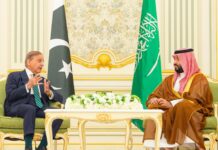
The diplomatic push is being reinforced by regional actors. Pakistan has said it is ready to host talks between Washington and Tehran, positioning itself as a potential facilitator at a time of heightened uncertainty.
On Monday, U.S. President Donald Trump said Washington had held “productive” discussions with Iran and suggested a possible framework for agreement, indicating that Tehran’s stance on nuclear weapons would be a central issue.
In Islamabad, Pakistan’s Deputy Prime Minister and Foreign Minister Ishaq Dar met with Chinese Ambassador Jiang Zaidong on Tuesday, where both sides underscored the urgency of de-escalation.
Pakistan emphasized the “urgent need to promote de-escalation in the Middle East and the wider region through dialogue and diplomacy,” according to a Foreign Office statement.
Chinese Ambassador Jiang Zaidong called on the Deputy Prime Minister/Foreign Minister Senator Mohammad Ishaq Dar @MIshaqDar50 today. Discussions focused on the unfolding regional and global developments.
DPM/FM underscored the urgent need to promote de-escalation in the Middle… pic.twitter.com/WNKIXd4xs4
— Ministry of Foreign Affairs – Pakistan (@ForeignOfficePk) March 24, 2026
The discussions also covered broader regional and global developments, with both countries agreeing to remain in close contact on issues of mutual interest.
Analysts say Pakistan’s position reflects both diplomatic alignment and strategic necessity. Deep economic and security linkages with the Middle East—and close ties with China—mean prolonged instability in the region carries direct consequences for Islamabad.
At the same time, Islamabad has close ties with Washington as reflected in the recent telephonic conversation between Pakistan Army Chief and President Trump a part of the diplomatic push the start negotiations on ending the Iran conflict.
Donald J. Trump Truth Social Post 10:46 AM EST 03.24.26 pic.twitter.com/UNLDseZir6
— Commentary Donald J. Trump Posts From Truth Social (@TrumpDailyPosts) March 24, 2026
As the conflict enters a critical phase, coordinated calls for restraint from Beijing and Islamabad highlight a widening effort to steer the crisis toward negotiations rather than further escalation.
Meanwhile, a Chinese-owned vessel navigated a fee-based transit corridor between Larak and Qeshm islands—established by Iran earlier this month—according to its location transponder data, cited by AP.
The Panama-flagged ship Newvoyager is the first Chinese-owned container vessel known to have used the route, the Chinese financial news outlet Caixin reported.

Kiran Asim is a writer who covers the U.S., Europe, South Asia, and the Middle East. Her reports and analyses look at the geostrategic issues and contemporary developments and their economic and political implications. She also writes about society and education.

Muhammad Luqman is Associate Editor at Views News Now. He writes on wide-ranging issues including economy, South Asia, the Middle East, agriculture, economy and innovation. Luqman has worked some of the leading news organizations and won acclaim for his original and research-based works.