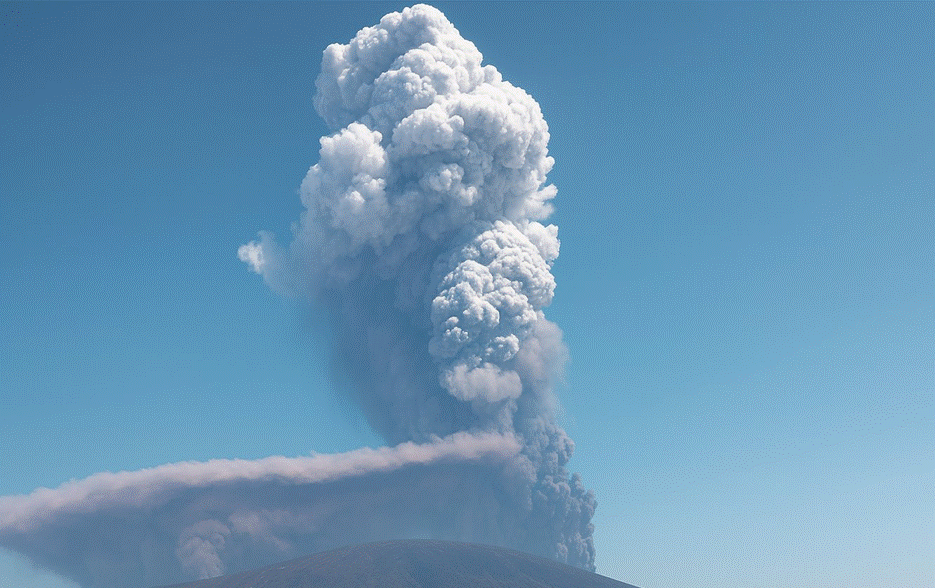
In a rare geological event, Ethiopia’s Hayli Gubbi volcano has erupted for the first time in nearly 12,000 years, sending massive plumes of ash and smoke into the atmosphere and triggering widespread aviation disruptions in India and alerts in Pakistan.
The volcano, located in Ethiopia’s Afar Region, erupted on November 23, 2025, for several hours, spewing an ash column rising 10–15 kilometers high and rapidly darkening the surrounding horizon.
Video circulating on X captured the eruption at its peak, and satellite imagery confirmed that the event was visible from space.
Ash Cloud Reaches India and Beyond
Strong upper-level winds carried the ash plume across the Arabian Peninsula and into South Asia. The cloud drifted over several Indian states—Gujarat, Rajasthan, Delhi-NCR, Punjab, Haryana, and parts of Maharashtra—before moving toward Nepal’s hill regions, the Himalayan belt, and further east.
Key Facts About the Eruption in Ethiopia Yesterday:
🔸 Volcano: The eruption happened at Hayli Gubbi, a shield volcano in Ethiopia’s Afar Region.
🔸 Timing: It erupted on 23 November 2025, around 08:30 UTC.
🔸 Dormancy: This is the first confirmed eruption in more than 12,000… pic.twitter.com/2nz8i2DQRC
— Volcaholic 🌋 (@volcaholic1) November 24, 2025
The India Meteorological Department (IMD) projected that the volcanic cloud would clear Indian skies by Tuesday evening as it continued moving toward China.
Despite the scale of the plume, India recorded only minimal ashfall at ground level. Meteorological observers noted that the cloud contained sulphur dioxide and fine particles, with small to moderate traces of volcanic ash. While significant air-quality deterioration in India is unlikely, some effects may occur over Nepal’s highlands, the Himalayan region, and the Terai.
Air Travel Affected
The eruption caused substantial disruption to aviation across the region. Multiple flights in India were cancelled or diverted as authorities monitored satellite imagery and coordinated with global volcanic ash advisory centers.
Aviation experts warned that volcanic ash can severely damage aircraft engines, making rerouting essential.
Pakistan Issues Aviation Alert
The Pakistan Meteorological Department (PMD) reported that the ash cloud—carried by upper-atmospheric winds—had drifted toward southern Pakistan after passing over Yemen and Oman. Apart from aviation hazards, the PMD stated that no other threats were expected.
🌋 ERUPTION ALERT — Erta Ale (Hayli Gubbi), Ethiopia
The Biggest Lava Lake on Earth Just Roared Back to Life
Images & Articles: https://t.co/00hpNCh9Zx
SpaceTracker Journal — 23 November 2025Last night in the Afar Depression, the Erta Ale shield volcano—known locally as Hayli… pic.twitter.com/Nb35ruTml4
— SpaceTracker.space (@Ammar1176708) November 24, 2025
The PMD issued an aviation watch alert, noting that domestic flights cruising around 35,000 feet and international flights flying between 40,000 and 45,000 feet could face engine risks if they encountered the cloud. Officials are actively tracking its movement.
According to the Toulouse Volcanic Ash Advisory Centre (VAAC), the plume reached extreme altitudes and affected airspace above southern Saudi Arabia, Yemen, Oman, and Pakistan’s coastal belt—some 3,700 kilometers from the eruption site.
Despite this reach, the PMD said Karachi is unlikely to be directly impacted. A spokesperson noted that projections indicate the plume will drift mostly over the deep Arabian Sea, Oman, and the Mumbai flight region at around 50,000 feet.
Earlier, the cloud was detected 60 nautical miles south of Gwadar, prompting urgent advisories for aviation and disaster-management authorities. PMD spokesperson Anjum Nazeer Zaighum later confirmed that the cloud would remain far offshore while continuing its eastward trajectory.
Local Impact in Ethiopia
Eyewitnesses in the Afar Region described the eruption as extraordinarily powerful. One resident told The Addis Standard that the blast occurred about eight kilometers from the main cone. Afar TV reported a “massive eruption,” noting that its force exceeded anything in living memory. Tremors were reportedly felt as far as Djibouti, Tigray, and multiple towns in the Wollo zone.
FlightRadar tracking data early Monday showed the ash cloud moving toward the Arabian Peninsula and the Arabian Sea, with projections indicating its arrival over parts of Pakistan within 18 hours. VAAC interactive maps suggest the cloud may pass over southern Sindh before drifting northeast toward India.
A Rare Geological Event
Hayli Gubbi, rising roughly 500 meters within Ethiopia’s tectonically active Rift Valley near the Eritrean border, has no documented eruptions in the Holocene epoch.
The Smithsonian Institution’s Global Volcanism Program confirmed the absence of eruptions in the past 12,000 years. Volcanologist Simon Carn of Michigan Technological University also noted that the volcano “has no record of Holocene eruptions.”
Regional and national authorities are actively monitoring the plume’s trajectory to ensure the safety of aviation operations and safeguard coastal communities.

Muhammad Luqman is Associate Editor at Views News Now. He writes on wide-ranging issues including economy, South Asia, the Middle East, agriculture, economy and innovation. Luqman has worked some of the leading news organizations and won acclaim for his original and research-based works.