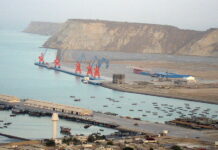
The United States has warned shipping companies they could face fresh sanctions for making payments to Iran in exchange for safe passage through the Strait of Hormuz, as the critical oil transit route remains largely closed due to ongoing military tensions.
In an alert issued Friday, the Office of Foreign Assets Control (OFAC) said any form of payment to Iranian authorities linked to transit through the strait could trigger penalties. The warning extends beyond cash transactions to include digital assets, barter arrangements, in-kind transfers, charitable contributions, and even payments made via Iranian diplomatic missions.
Chokepoint Disruption and Escalating Pressure
The move comes amid continued instability in the region despite a fragile ceasefire and stalled indirect talks between Washington and Tehran.
The Strait of Hormuz—through which roughly one-fifth of global oil and gas trade typically flows—has been severely disrupted following hostilities that began on February 28. Iran has effectively restricted passage by targeting and threatening vessels, while selectively offering escorted transit along routes closer to its coastline, at times in exchange for fees.
The United States, meanwhile, has enforced a naval blockade on Iranian ports since April 13, further tightening pressure on Tehran’s economy. According to United States Central Command, dozens of commercial vessels have already been turned away from the region.
Shipping congestion has intensified, with hundreds of vessels reportedly delayed within or near the strait, amplifying uncertainty in global energy markets.
Oil Markets on Edge
The disruption has triggered a scramble among importing nations to secure alternative energy supplies, raising concerns about sustained price volatility.
Speaking on the situation, Donald Trump noted that a reopening of the strait could ease global oil prices, underscoring the waterway’s central role in energy stability.
Iran Proposes Conditional De-escalation
Behind the scenes, Iran has floated a two-phase de-escalation proposal aimed at reopening the strait, according to officials familiar with the discussions.
In the initial phase, Tehran is seeking an immediate cessation of hostilities along with firm guarantees that neither the United States nor Israel will launch further attacks. In return, Iran has indicated it would allow maritime traffic to resume.
However, the proposal also calls for the lifting of U.S. sanctions and an end to the naval blockade—conditions that Washington has so far resisted.
More complex issues, including Iran’s nuclear program, would be deferred to a second phase of negotiations. Iranian officials have emphasized that any final agreement must recognize the country’s right to enrich uranium for peaceful purposes.
A report by The Wall Street Journal suggested that Tehran may be showing some flexibility in its stance, though significant differences remain and any breakthrough is expected to be both difficult and protracted.
Pakistan’s Mediatory Role
Pakistan, which hosted the first-ever direct talks between the United States and Iran on April 11, has continued its mediatory efforts amid the ongoing crisis. According to officials, Tehran conveyed its latest de-escalation proposal to Washington through Islamabad.
However, the future trajectory of the negotiations remains uncertain. There is no clarity on whether the two sides will meet again in the near term, and significant gaps persist in their positions. It is also unclear whether Pakistan will convene another—potentially decisive—round of talks.
Washington Holds Firm
President Trump has dismissed the current proposals as insufficient, reiterating that any agreement must decisively address Iran’s nuclear ambitions.
“We will not let Iran obtain nuclear weapons,” he said, adding that the United States would not rush into a deal that fails to resolve underlying risks.
Trump also claimed that recent U.S. military actions, including strikes involving B-2 bombers, had significantly weakened Iran’s military capabilities.
Tehran Signals Openness—With Conditions
Iran, for its part, has indicated a willingness to return to negotiations—but only under less confrontational conditions.
Abbas Araqchi said Tehran remains open to diplomacy if Washington abandons what he described as “threatening language.”
“Iran has always supported a diplomatic solution,” he said, while warning that negotiations cannot proceed under pressure. He added that Iran’s armed forces remain fully prepared to respond to any escalation and that national security would not be compromised.
High Stakes for Global Trade
The standoff over the Strait of Hormuz has become a defining flashpoint in global energy security, with implications far beyond the region.
As negotiations remain uncertain and military tensions persist, the situation continues to place strain on international shipping and oil markets alike.
For now, tankers remain delayed, diplomacy remains fragile, and the cost of prolonged disruption is being measured in both economic and geopolitical terms.

Kiran Asim is a writer who covers the U.S., Europe, South Asia, and the Middle East. Her reports and analyses look at the geostrategic issues and contemporary developments and their economic and political implications. She also writes about society and education.