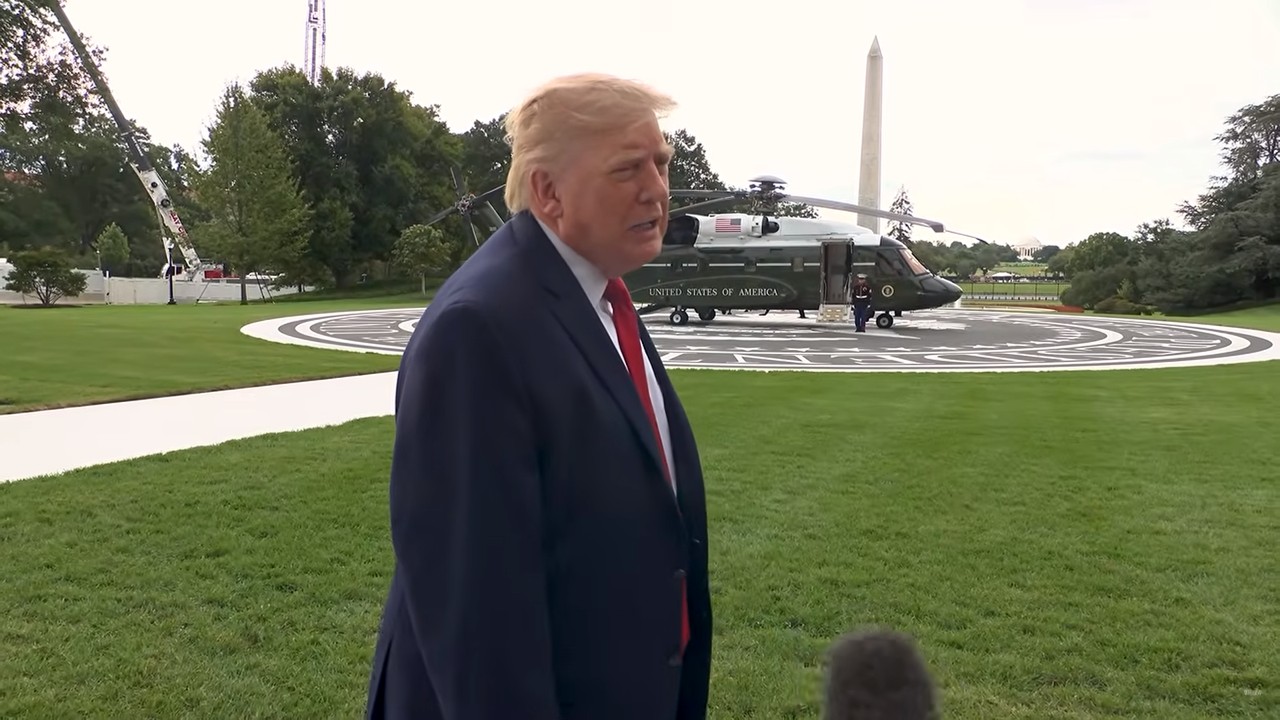
U.S. President Donald Trump said Iran had pushed beyond what Washington was prepared to accept in a proposal concerning the reopening of the Strait of Hormuz, suggesting Tehran’s terms were no longer in line with what he might have considered acceptable.
“They want to make a deal, but it is not the deal that I want to make,” Trump told Axios publication, a day after rejecting the proposal floated by Iranian Foreign Minister Abbas Araghchi.
Trump said the proposal resembled an arrangement the United States might have considered about a year ago, adding that Iranians had “overplayed their hand.”
The representatives of the two sides held indirect talks spanning three hours in New York, where Trump addressed the UN General Assembly.
Another round of indirect negotiations between Washington and Tehran could begin as soon as Monday, Axios reported.
Trump also said the volume of oil moving through the Strait of Hormuz over the weekend was the highest recorded since the war began, with more than 20 million barrels passing through the strategic waterway.
Reporter: Will you strike Iran after the midterms?
Trump: I’m rejecting their deal. They want to make a deal where they open the Strait immediately because they’re losing so badly.
They want to make a deal, and I think that’s fine. I like making a deal, too, but that deal would… pic.twitter.com/87rKbDySLN
— Clash Report (@clashreport) September 26, 2026
Asked whether he was contemplating another round of U.S. strikes against Iran, Trump did not rule out the possibility.
“I am always thinking about it,” he said.
US-Iran Impasse Persists Amid Uncertainty
The Middle East remains caught in a diplomatic impasse as efforts to find a negotiated end to the Iran-US conflict faced fresh obstacles, with the dispute over the Strait of Hormuz adding to wider shipping disruptions and renewed Houthi attacks on Saudi Arabia.
The oil prices have been a big concern in the United States and around the world.
The conflicting positions U.S. and Iranian positions point to a deadlock over the Strait of Hormuz, where the U.S. is maintaining a naval blockade of Iranian ports while Tehran does not allow ships to use alternative routes through the key waterway.
FM @araghchi to NBC News: “We are fully prepared for the war to be resumed. We stand firm in the face of any new aggression, even if it comes to a doomsday war.”
“At the same time, we stand ready for diplomacy. It is up to President Trump to choose.” pic.twitter.com/zIKKxm55BM
— IRNA News Agency ☫ (@IrnaEnglish) September 27, 2026
Tehran says it is still awaiting an official US response through intermediaries, indicating that diplomatic channels remain open even as military tensions continue.
The Strait of Hormuz has become the central issue in the confrontation. Before the conflict, roughly one-fifth of the world’s traded oil and gas passed through the waterway, making its disruption a major concern for international energy markets and economies across the region and Asia.
For Tehran, its ability to restrict passage through the waterway provides leverage against US military and economic pressure. Washington and Gulf states, meanwhile, regard the restoration of unrestricted shipping as a key objective.
The dispute has produced a difficult negotiating sequence. Iran wants sanctions and military pressure eased before giving up its leverage, while Washington is demanding the removal of that leverage before making major concessions. Negotiators have therefore been examining the possibility of reciprocal and verifiable measures being implemented at the same time.
🚨 BOOM! President Trump just walked out of the White House and confirmed oil will PLUMMET when Iran caves
“Oil will come dropping down as soon as Iran gives up, as soon as the war is over, which will be soon.”
“Oil is less expensive now than it was under the Biden…
— Eric Daugherty (@EricLDaugh) September 27, 2026
Iran warns of new capabilities
The diplomatic stalemate has been accompanied by increasingly forceful warnings from Iran’s Islamic Revolutionary Guard Corps.
The IRGC has warned that any further US escalation could lead Tehran to change its weapons, military tactics and targets. An IRGC spokesman said Iran would introduce “new weapons with new capabilities” and warned that the geography of the conflict could change.
Iran has also highlighted its growing use of unmanned and electronic-warfare capabilities in the maritime confrontation.
The IRGC Navy said it recently captured a US-made Remus 600 unmanned underwater vehicle operating in the Strait of Hormuz, describing the operation as a coordinated intelligence and electronic-warfare effort.
The IRGC said the vehicle was being used for intelligence-gathering and was subsequently handed over to Iranian specialists for examination and data recovery.
As of Sept. 23, CENTCOM forces have redirected 115 commercial vessels to maintain strict enforcement of America’s 🇺🇸 steel wall blockade. pic.twitter.com/6CW8sljNFt
— U.S. Central Command (@CENTCOM) September 23, 2026
The Iranian force also reiterated that the Strait of Hormuz remained blocked and said it was confronting what it described as dangerous activities and unauthorised passage through the strategic waterway.
The incident follows an earlier announcement by the IRGC Navy on September 8 that it had intercepted and captured another advanced US unmanned underwater vehicle near the entrance to the strait. Iran identified that vehicle as a Dive-LD, an autonomous underwater system developed by US defence technology company Anduril Industries.
The maritime incidents add another potential source of miscalculation at a time when diplomatic efforts are struggling to make progress.
Diplomatic contacts continue
Trump’s rejection of the seven-day proposal has complicated the immediate prospects for a negotiated de-escalation, but diplomatic contacts have continued through intermediaries.
Iranian and US officials recently held indirect talks in New York on the sidelines of the United Nations General Assembly. US officials have previously described contacts conducted through mediators as “positive and constructive”, while Iranian officials have continued to express readiness for negotiations.
Qatar has played an important role in facilitating communication between the two sides.
The main obstacle remains the sharply different objectives of Washington and Tehran.
The United States is seeking restrictions on Iran’s nuclear program and military activities, as well as guarantees on maritime security. Iran is demanding an end to the blockade and military attacks, relief from economic pressure and negotiations without what it considers coercive conditions.
The two sides also face a significant trust deficit.
An earlier interim understanding reportedly collapsed after a short period, with Washington and Tehran accusing each other of violating the arrangement. That experience has made both sides reluctant to make concessions without assurances that the other will fulfil its commitments.
Any new agreement would therefore have to address several unresolved issues, including the timing of a military halt, the lifting of the blockade, the reopening of Hormuz, verification of nuclear restrictions and the consequences of any alleged violation.
The role of regional governments would also have to be addressed, particularly in relation to Israel, Saudi Arabia, Lebanon and Yemen.
Wider regional risks
The confrontation is also being complicated by developments elsewhere in the Middle East.
Lebanon forms part of Iran’s proposed ceasefire framework, while renewed Houthi attacks on Saudi Arabia and developments involving the group in Yemen have added another layer of risk. The conflict also threatens maritime security around the Bab el-Mandeb, another vital trade route.
🇸🇦🇾🇪 Saudi unleashed massive airstrikes in southwestern Yemen to try and crush a Houthi offensive
Reports indicate a Saudi airstrike has just hit a central market in Taiz, leaving at least 7 dead as civilian areas get caught in the crossfire.
Government forces launched multiple… https://t.co/ugo613kTYc
— Mario Nawfal (@MarioNawfal) September 27, 2026
Gulf states are caught between their security relationships with Washington and their economic and strategic interest in avoiding a prolonged confrontation with Iran.
A settlement between Washington and Tehran would therefore not necessarily be sufficient to end the wider regional crisis. Other governments and armed groups would have to accept and observe any resulting arrangements.
The immediate trajectory remains difficult to predict. One possibility is a return to negotiations and a phased settlement; another is a continuation of military exchanges punctuated by temporary pauses and indirect talks. A further escalation could also bring additional regional fronts or maritime routes into the conflict.

Muhammad Luqman is Associate Editor at Views News Now. He writes on wide-ranging issues including economy, South Asia, the Middle East, agriculture, economy and innovation. Luqman has worked some of the leading news organizations and won acclaim for his original and research-based works.