Pakistan’s political conversation has sharpened in recent days around a blunt assessment of its governance model, which critics say has failed to deliver in the interest of the people.
Interior Minister Mohsin Naqvi statement that the existing system has collapsed has evoked a wide-ranging response from the coalition government and political parties. The military’s public relations chief followed with a carefully worded need for administrative reset if required for good governance.
Defense Minister Khawaja Asif, a longtime ally of the ruling Sharif family and an important voice in the current government, headed by Prime Minister Shehbaz Sharif, replied with a pointed call for the interior minister to start reforms in his own portfolio.
Meanwhile, resistance has hardened in Sindh, the federal government has remained largely silent, and speculation about deeper institutional experiments has grown.
Naqvi’s Diagnosis of the Collapsed System
Speaking at the Pakistan Economic Summit 2026 in Islamabad on July 30, Interior Minister Mohsin Naqvi stated:
“Whether you agree or not, the system we have been living under has collapsed.”
Naqvi, who is considered close to the military establishment in the current setup often described as “hybrid,” argued that the current administrative structure no longer delivers basic services, justice, or opportunity, particularly for the country’s large youth population.
The only solution, he said, was to take the question of new administrative units or provinces “to the public.”
Mohsin Naqvi:
“The system in which we live, is collapsed. Either you agree or not” pic.twitter.com/kmbiN5n3td
— Ihtisham Ul Haq (@iihtishamm) July 30, 2026
All political parties, he urged, should sit together “whether for a day, a month or a year” and settle national issues including new units.
Without such change, he warned, Pakistan would remain stuck discussing the same problems a decade from now.
Naqvi, who recently made several trips to Iran and accompanied Army Chief Field Marshal Asim Munir to Tehran as part of the mediation effort on U.S.-Iran conflict, also chairs the Pakistan Cricket Board.
He framed the call for additional provinces as essential for decentralizing power, improving service delivery, and creating space for new leadership. He noted that federal budgets are framed in the negative and that diplomatic successes amount to “firefighting” without fixing domestic fundamentals.
Military Spokesperson’s Response on Good Governance
Inter-Services Public Relations Director General Lieutenant General Ahmed Sharif Chaudhry, while addressing the media the following day, described good governance as “quintessential” for Pakistan’s security and stability.
“As a primary stakeholder in security, we would like to say that good governance is the key to security and stability. Without that, your issues cannot be solved,” he said, as per The Express Tribune reporting.
Chaudhry linked the point to the National Action Plan’s 14 points, most of which depend on effective administration rather than kinetic operations alone. He noted Pakistan’s population growth from roughly 65 million in the 1972 census to around 250 million today and asked whether existing structures still serve good governance.
The 🇵🇰 Establishment has said: Enough is enough. Everything is slipping out of the establishment’s hands, governance isn’t happening through them either, and the problems are only growing.
🚨 Neither can they manage the country’s security, nor are they able to provide anything…
— Asad Nasir (@asadnasir2000) July 31, 2026
“If good governance requires an administrative reset, then let that happen,” he stated. Any such change, he stressed, must occur through constitutional and legal methods, political representatives, and the will of the people, which he called superior.
He declined to comment directly on Naqvi’s specific wording but made clear that the military views governance as a core security issue.
Minister in the Sharif Family-Dominated Government Responds
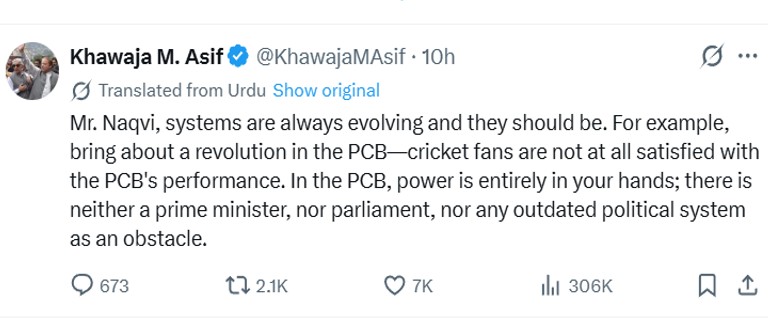
Defense Minister Asif responded on social media. He said he more or less agreed with Naqvi’s assessment of the system’s dire state and called the interior minister a “powerhouse.”
As a political worker, Asif added, he too felt the system’s evolution had been held captive to factional and personal interests for decades and needed freeing.
He then urged Naqvi to pursue change through the proper forums: Parliament, of which Naqvi is a member, or the cabinet.
When this report came out it was very conveniently ignored. The list of irregularities in the various aspects of the interior ministry are staggering.
They become even more striking when the interior minister sahjb has to give no answers or clarifications or is not held…
— Khurram Qureshi (@qureshik74) August 2, 2026
Asif, as cited by several media outlets, noted that Naqvi had held a powerful position for about three and a half years and could have advanced reforms earlier. He pointed to the National Action Plan, saying the armed forces were implementing the kinetic points at the cost of lives while the remaining points fell under the interior ministry’s responsibility and remained unimplemented.
“Begin the change in the system with the implementation of NAP; begin the change in the system with your ministry,” Asif wrote.
He also suggested Naqvi could start a “revolution” at the Pakistan Cricket Board, where he holds full authority without parliamentary or systemic obstacles.
Resistance in Zardari Family-Dominated Sindh Province
In Sindh, opposition has been firm. Allama Rashid Sumro, general secretary of Jamiat Ulema-e-Sindh, stated in a social media declaration that Sindh’s unity is a red line and that proposals for new provinces are unacceptable under any circumstances. His remarks came amid the broader debate ignited by Naqvi’s comments.
Sindh Chief Minister Murad Ali Shah and other PPP leaders have rejected division of the province.
The party, headed by Bilawal Bhutto-Zardari family, has referred the question of new administrative units to its Central Executive Committee for deliberation while insisting that any change must follow the constitutional route: a two-thirds majority in the relevant provincial assembly as well as in both houses of Parliament.
PPP’s Asif Ali Zardari is the president of Pakistan while his son Bilawal Bhutto-Zardari is chairman of the party.
PPP figures have long supported a South Punjab province where consensus exists but have consistently opposed carving Sindh or creating a separate Karachi province. Some nationalist voices and social media commentary have gone further, arguing that if new units are formed, Karachi should be placed under federal control to curb what they term “loot and plunder,” and that administrative provinces are needed to reduce linguistic and ethnic politics.
Federal Silence and Coalition Tensions
Prime Minister Shehbaz Sharif’s office and the broader PML-N leadership have not issued a coordinated position.
This silence stands out given that the ruling coalition includes both the PPP, which opposes any division of Sindh, and the MQM-P, which has long demanded provincial status for Karachi or broader administrative restructuring.
The silence has fueled questions about whether the center is testing the political temperature or awaiting clearer signals from other institutions.
In recent days, both the PPP and PML-N, the major ruling coalition partners, have turn on each other during intensely fought elections in Pakistan-administered Kashmir, called Azad Jammu and Kashmir.
Bilawal Bhutto-Zardari has reportedly accused the government the result of Form-47 manipulations, referring to the February 2024 elections, which jailed former prime minister Imran Khan’s party, and several political organizations say were rigged. The PML-N party has hurled back accusations at Bilawal’s party.
Sharif Family’s Reported Meeting
There have been several sources-based reports in the Pakistani media about a Sharif family expressing concern over the issue at a meeting, attended by PM Sharif, Punjab Chief Minister Maryam Sharif, former three-time prime minister Nawaz Sharif and deputy prime minister Ishaq Dar.
The party has not confirmed the meeting officially.
Journalist Mansoor Ali Khan has claimed that a conversation with an establishment personality indicated the government has been given roughly six months to create new provinces.
Such claims remain unverified and circulate primarily in media and online discussion. No official confirmation has appeared.
6 months deadline to the govt? pic.twitter.com/2b2UaSRsvr
— Murtaza Ali Shah (@MurtazaViews) August 2, 2026
Talk of a shift toward a presidential system has also surfaced in commentary, yet neither Naqvi nor the DG ISPR advocated replacing the parliamentary framework. Both have emphasized constitutional methods and the supremacy of the people’s will expressed through political processes.
The pattern of statements—from a civilian minister diagnosing collapse, a military spokesperson endorsing administrative review for security reasons, a senior coalition partner urging internal reform first, and provincial resistance—suggests a managed opening of a long-standing debate rather than an immediate structural overhaul.
Analysts say Pakistan’s population growth, uneven service delivery, and security challenges provide the rationale for long due reforms. However, political leaders must contend with constitutional requirements, coalition arithmetic, and provincial identities to pave the way for such reforms.

Kiran Asim is a writer who covers the U.S., Europe, South Asia, and the Middle East. Her reports and analyses look at the geostrategic issues and contemporary developments and their economic and political implications. She also writes about society and education.