Pakistan has increasingly found itself in the spotlight for its growing space ambitions. Last week, China announced it had selected two Pakistani candidates for its astronaut program, with one expected to participate in a future space mission. Shortly afterward, Islamabad confirmed the launch of its latest satellite—further amplifying attention on SUPARCO, the country’s national space agency.
In a relatively short span, Pakistan has quietly achieved a notable milestone: the deployment of five satellites over the past 16 months. These advanced Earth observation platforms are designed to monitor the planet from orbit, delivering high-resolution data with applications ranging from agriculture to national security.
This rapid expansion reflects growing confidence in space technology and a strategic effort to reduce reliance on external sources of intelligence and data.
China Picks Pakistanis as First Foreign Astronauts for Space Mission
Earth Observation: Expanding Governance Capabilities
Far from being purely scientific ventures, these satellites serve a broad range of practical functions aligned with Pakistan’s development priorities. They enable more precise crop monitoring and yield forecasting, supporting food security in an agriculture-dependent economy. Soil analysis and fertilizer tracking further enhance resource efficiency.
In urban areas, satellite imagery is being used to identify unauthorized construction and manage city expansion. Infrastructure planning, including transportation networks, benefits from accurate terrain and traffic data derived from space-based observation.
The satellites also strengthen maritime awareness by enhancing border surveillance and port monitoring—an important capability in a strategically sensitive region. In addition, they support geological surveys and mineral exploration, while providing critical insights into water and air pollution amid rising environmental concerns.
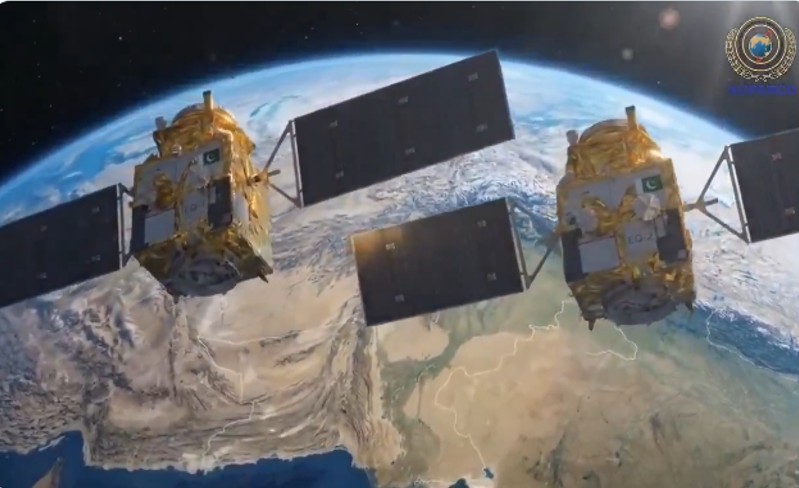
Footage shows manufacturing of Pakistan’s indigenous PRSC-EO3 satellite at the SUPARCO Satellite Research & Development Facility, later the footage demonstrates how EO3 satellite was airlifted via PAF IL-78 to China, footage also shows the final preparation of the satellite… pic.twitter.com/FW2dMKP8tn
— Pakistan Strategic Forum (@ForumStrategic) April 26, 2026
Domestic Capability on the Rise
A key highlight of this progress is Pakistan’s growing indigenous capacity. Four of the five satellites were fully designed and developed domestically, reflecting the maturation of the country’s aerospace engineering base. The fifth satellite was produced in collaboration with China, combining local expertise with external technical support.
Unearthing from space: Pakistan launching satellite for mineral and oil exploration
This shift underscores a broader policy direction: moving away from dependence on imported systems toward building a self-sustaining domestic space industry.
China Partnership Remains Central
Despite advances in local manufacturing, international cooperation—particularly with China—remains integral. All five satellites were launched aboard Chinese rockets, and Beijing has provided technical assistance throughout their development.
The partnership has enabled Pakistan to accelerate its space program while continuing to build internal expertise. Officials characterize the relationship as a pragmatic collaboration that balances immediate capability gains with long-term self-reliance.
Space Vision 2040: Long-Term Strategic Goals
These developments are part of Pakistan’s broader roadmap, known as Space Vision 2040. The initiative aims to achieve full technological sovereignty in space, including the ability to manufacture and eventually launch satellites independently from domestic facilities.
By steadily expanding its Earth observation fleet, Pakistan is laying the foundation for a more advanced and autonomous space program. The benefits extend beyond prestige—enhanced data capabilities are expected to improve policymaking, strengthen economic planning, and increase resilience to environmental and security challenges.
Pakistan Launches Indigenous EO-3 Satellite , Marking Major Space Milestone pic.twitter.com/JBtYAfQhuj
— Ministry of Foreign Affairs – Pakistan (@ForeignOfficePk) April 25, 2026
While Pakistan’s space efforts may not yet rival those of established space powers, their steady pace and clear strategic direction are gaining attention. In just over a year, five new satellites have begun providing critical insights across agriculture, infrastructure, environment, and security.
If current momentum continues, these launches could mark the early stages of a sustained and increasingly independent presence in space.

Kiran Asim is a writer who covers the U.S., Europe, South Asia, and the Middle East. Her reports and analyses look at the geostrategic issues and contemporary developments and their economic and political implications. She also writes about society and education.