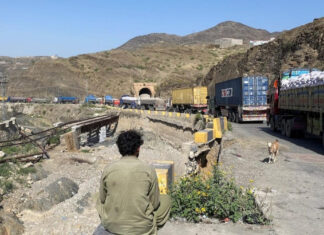
Pakistan’s Karachi Port has emerged as an unexpected beneficiary of escalating tensions in the Gulf, recording an extraordinary surge in cargo traffic as global shipping lines divert vessels away from conflict-affected waters near Iran.
Port officials say the facility handled what would normally be a year’s worth of transshipment in just 24 days, underlining the speed with which geopolitical disruptions can redraw global trade routes and elevate secondary ports into critical logistics hubs, Japanese newspaper Nikkei Asia reported.
The development follows escalating tensions linked to the ongoing Strait of Hormuz crisis amid the Middle East war. The conflict has severely disrupted maritime traffic through one of the world’s most vital energy corridors.
The Strait of Hormuz typically carries a substantial share of global oil and cargo shipments.
Chairman KPT Reviews Operations Amid Cargo Surge
On 29 Mar 2026, Chairman KPT, Rear Admiral Shahid Ahmed (Retd), visited key port areas to oversee intensified cargo operations, with 18 ships currently berthed and 7 more expected within 24 hours.
He reviewed security and safety… pic.twitter.com/t0EsfRZZI3
— Karachi Port Trust Official (@official_kpt) March 29, 2026
However, a combination of vessel attacks, rising military activity, and security warnings has sharply curtailed shipping operations, forcing companies to seek safer and more cost-effective alternatives.
Major international shipping firms have either suspended operations in high-risk zones or rerouted vessels altogether, triggering an urgent search for reliable transshipment hubs beyond the conflict area.
Against this backdrop, Karachi has rapidly positioned itself as a viable alternative.
“With strategic geography, improving infrastructure, growing operational readiness, and proactive diplomacy, Pakistan is fast emerging as a regional trade and logistics hub – and a true gateway to Asia’s trade corridors,” Karachi Port Trust said.
The Port Trust has also announced up to 60% tariff concessions to enhance competitiveness.
“This is not incidental – it is policy, preparedness, and execution in action: Rapid capacity expansion through on-dock and off-dock optimization, additional yard space created and empty containers shifted out to improve terminal utilization, Auctioned and stuck containers cleared to reduce congestion and free up space, 24/7 port operations including cargo handling on the first day of Eid for the first time in KPT’s 138-year history.”
Pakistan – Emerging Gateway to Asia’s Trade Corridors
Shifting dynamics in the Middle East and evolving global shipping routes are creating a new trade reality – and Pakistan is stepping up.
– At the same time, Pakistan is playing a constructive diplomatic role – facilitating… pic.twitter.com/928eV2JUAB
— Karachi Port Trust Official (@official_kpt) March 28, 2026
Shipping lines have increasingly redirected cargo to Pakistan’s largest port, using it as a transfer point for consignments that would otherwise pass through Gulf ports closer to the conflict zone. As a result, container volumes have surged within weeks.
Official figures indicate that Karachi Port processed over 8,300 containers in just 24 days in March, effectively matching its total transshipment volume for 2025. The increase—estimated at more than 1,400 per cent—highlights the scale of disruption in global supply chains.
Containers have accumulated across key terminals, including South Asia Pakistan Terminal, Hutchison Port, and Karachi Gateway Terminal, reflecting both the magnitude of inflows and the operational pressures accompanying the surge.
Industry experts attribute Karachi’s rise to a combination of geography and timely policy intervention.
Situated near major east-west shipping lanes yet outside the immediate conflict zone, the port offers a strategic balance between accessibility and security. This positioning has made it a natural fallback option for carriers navigating an increasingly volatile region.
At the same time, Pakistan has moved swiftly to capitalize on the opportunity by offering discounted port charges, enhancing the port’s competitiveness at a time when freight rates and insurance premiums have surged due to heightened war risks.
This blend of relative safety and cost efficiency has proven decisive for shipping companies seeking to minimize both financial exposure and operational uncertainty.
The disruption in the Gulf is reverberating across global trade and energy markets.
Analysts describe the Iran crisis as one of the most significant supply shocks in recent years, with oil flows disrupted and established shipping routes being rapidly reconfigured. As insurers reassess risk and vessels reroute, freight costs have climbed sharply, accelerating the shift toward alternative hubs such as Karachi.
The episode underscores how quickly global logistics networks can adapt—and how ports with latent capacity can seize strategic opportunities during periods of instability.
While the surge presents a rare economic windfall, it also raises critical questions about sustainability.
Pakistan’s broader maritime ecosystem—including Gwadar Port—stands to benefit if the country can consolidate its position as a regional transshipment hub.
However, this will require sustained investment in infrastructure, operational efficiency, and regulatory reforms.
Islamabad has already introduced measures such as reduced port charges, faster cargo clearance, and institutional reforms to support the transition. Specialized committees have also been constituted to recommend long-term improvements in the maritime and logistics sectors.
Stakeholders are pushing for deeper structural changes to fully capitalize on the momentum.
The Pakistan Textile Exporters Association has proposed the creation of a Centralized Monitoring & Response Unit to oversee cargo flows through the Pakistan Single Window platform.
The proposed unit would function as a real-time control center, identifying bottlenecks and coordinating responses across ports, terminals, and shipping lines.
Industry players have also called for clearly defined service-level benchmarks, alignment with international best practices, and mandatory advance manifest filing to improve transparency and efficiency across the supply chain.
Shipping companies are increasingly turning to Karachi to avoid the security and insurance risks associated with Gulf routes, positioning Pakistan as a relatively stable and cost-effective destination for transshipment and trade.
Yet, the central question remains: can this crisis-driven surge be transformed into lasting strategic relevance?
For now, Karachi’s performance offers a compelling example of how global disruption can create unexpected opportunities. Whether Pakistan can sustain and build upon this advantage will depend on its ability to translate short-term gains into long-term structural strength within the global supply chain.

Muhammad Luqman is Associate Editor at Views News Now. He writes on wide-ranging issues including economy, South Asia, the Middle East, agriculture, economy and innovation. Luqman has worked some of the leading news organizations and won acclaim for his original and research-based works.