As Israel and Hamas begin implementing the initial phase of the U.S.-brokered Gaza peace plan, a closer look reveals a mix of clear deliverables and more complex issues that demand scrutiny — especially given the volatile geopolitical context in which the Middle East now operates. The Knowns And Unknowns
Experts say that while President Donald Trump’s 20-point plan offers a potentially hopeful path out of the long-running Israeli-Palestinian conflict, significant challenges are likely to emerge once the parties move beyond the first phase of implementation.
Here’s what is known — and what remains uncertain — based on interpretations of the current peace plan.
Trump sees ‘real chance’ for progress days after unveiling plan to end Gaza war
The Knowns
These are elements of the peace/ceasefire plan that the parties have agreed or publicly confirmed:
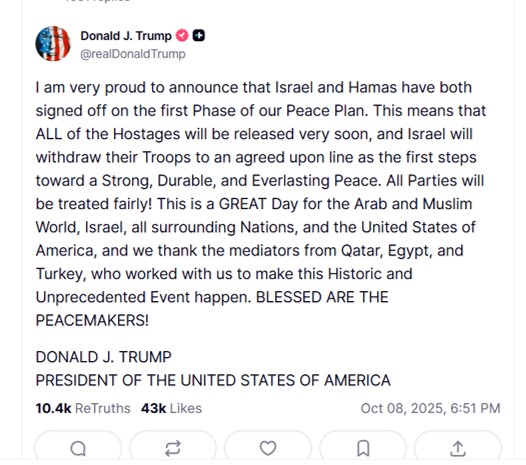
First Phase / Ceasefire: Israel and Hamas have agreed to the first phase of a U.S.-led peace plan.
The initial phase includes a ceasefire — a cessation of all hostilities.
Hostage Release & Prisoner Exchange: Within 72 hours of the agreement (in some reports 48 hours), all hostages held by Hamas (alive and dead) are to be released.
In exchange, Israel will release Palestinian prisoners, including life‐sentence inmates, plus those detained in Gaza during the war. Some reports give specifics: about 250 prisoners serving life sentences + about 1,700 people detained since the war erupted on October 7, 2023.
Israeli Troop Withdrawal / Redeployment
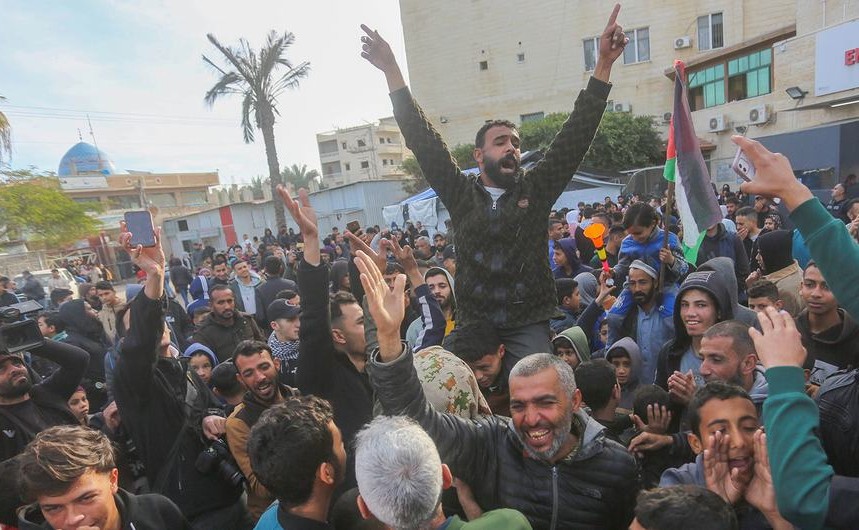
As per the first phase of the agreement, Israel will begin a withdrawal of troops to a mutually agreed line (“to an agreed‐upon line” or “withdraw their troops to a designated yellow line”).
However, this withdrawal has been interpreted as conditional: it’s linked to the disarmament of Hamas and deployment of an international security force to take over some of the security role as Israeli forces pull back.
Disarmament of Hamas / Demilitarization
The plan calls for Hamas’s military infrastructure — including tunnels and weapons — to be dismantled. Hamas must disarm, with those who surrender peacefully given some kind of amnesty.
Interim Governance & Security Force
Gaza will be run during the transition period by a body of technocrats (not Hamas) overseen by an international “Board of Peace” or similar body. This body will be apolitical and comprise technocrats.
Palestinian police forces are to be trained (for law and order) under international supervision.
SEE IT: Israelis take to the streets of Jerusalem and Tel Aviv to celebrate the end of the war in Gaza after Hamas accepts President Trump’s historic peace plan to free all hostages. pic.twitter.com/wGqAaSLkw2
— Fox News (@FoxNews) October 9, 2025
Humanitarian Aid & Reconstruction
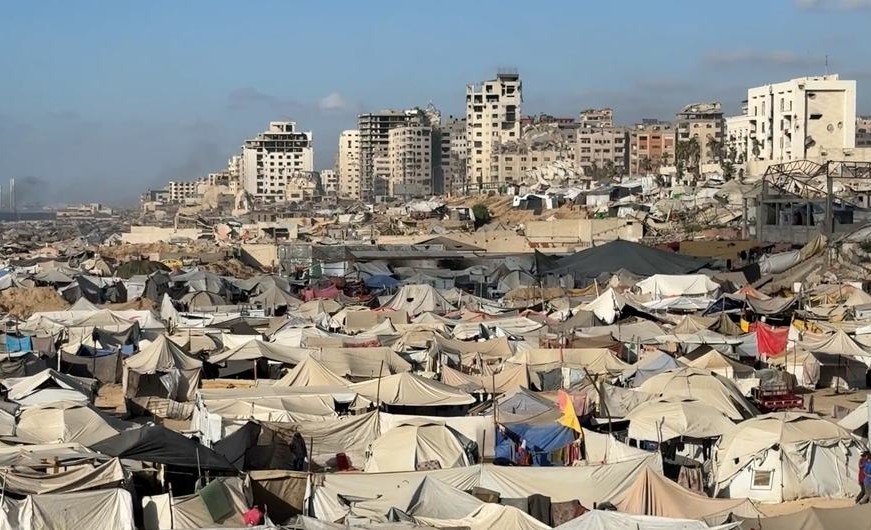
The agreement opens the way for large‐scale humanitarian aid flow into Gaza, where people have faced a lingering humanitarian catastrophe as infrastructure for basic health services has been decimated by the intense war.
The aid will be delivered via neutral international bodies (e.g. UN, Red Crescent).
There will be an international effort to rebuild war-shattered Gaza.
Palestinian Authority (PA) Role & Statehood Path
The plan envisions that the Palestinian Authority, assuming it undergoes internal reforms, would eventually play a governing role in Gaza.
The possibility of Palestinian self‐determination/statehood is mentioned, but conditionally and vaguely.
Mediators / International Actors
Qatar, Egypt, Turkey have been key mediators in negotiating the U.S.-led deal.
The “Board of Peace” may involve international figures. Tony Blair is mentioned in some reports as co‐chair or leading figure.
The Unknowns
These are the parts of the plan that remain unsettled, vague, or under negotiation.
Exact Timeline & Implementation Details
Although “first phase” is agreed, the precise schedule — when Israel’s withdrawal happens, when the international force enters, exactly when hostages are released — contains variable reports.
What counts as “all hostages” (who is included, which ones are alive or dead) is still being finalized.
How and when Israeli Withdrawal / Security Perimeter Works
The “security perimeter presence” is vague. Will Israel retain control over parts of Gaza (border zones, buffer zones)? The extent and nature of Israeli presence even after withdrawal is not fully clear.
The conditions under which the withdrawal is triggered (for example, full disarmament? all hostages released?) are contested.
Role & Fate of Hamas
Whether Hamas will accept total disarmament (they have expressed strong resistance), or what “amnesty” precisely would cover, or whether members can leave Gaza.
What of Hamas’s governing or political role after the transition? The plan says Hamas should have no part in administering Gaza. But how that is enforced, and what that means for day‐to‐day realities, is not fully settled.
The families of the hostages receive news of the agreement’s signing to return all 48 hostages with a mix of excitement, anticipation, and concern.
The Hostages Families Forum welcomes the signing of this agreement, designed to bring all the hostages home—the living for… pic.twitter.com/7MV5X4ApYF
— Bring Them Home Now (@bringhomenow) October 8, 2025
Governance Structure & Control During Transition
How exactly the “Board of Peace” will function, be staffed, be held accountable — how much power it has vs. local actors vs. international actors.
How much authority the Palestinian Authority will have, and when. Will there be full transition to PA control? Under what reforms?
Enforcement, Guarantees & Monitoring
What international force or peacekeepers will be deployed, from which countries, what rules of engagement, how long their mandate will last.
How compliance by both sides will be monitored, and what the remedies are if one side violates its commitments.
Territorial / Border Arrangements
Where exactly is the “agreed line” to which troops withdraw? Which areas will Israel continue to control (if any)?
Whether the plan allows any annexation or constitutes territorial changes. Israeli government has expressed opposition to a Palestinian state; PA involvement contingent on reforms, although some experts say the plan leaves open the possibility of two states existing side by side.
“Without a long-term vision in mind, the implementation of the short-term and medium-term steps could easily flounder and remain vulnerable to spoilers and opponents of progress. Netanyahu’s current government, with backing from a strong majority of the Israeli public, opposes a two-state solution. Saudi Arabia and other leading Arab countries favor a two-state solution, as evidenced by a months-long campaign that culminated in a symbolic but ultimately hollow recognition of a State of Palestine last month,” Brian Katulis a Senior Fellow at the Middle East Institute, wrote in a commentary.
“Since many of those countries will be expected by Trump and Israel to underwrite in money, diplomacy, and possibly security forces any post-war plan for Gaza, those countries presumably would have some leverage to shape the trajectory of the conversation about elements of Trump’s 20-point plan,” the expert added.
Security Issues & Long‐Term Stability
Whether Gaza will be fully demilitarized and what becomes of Hamas’s military capabilities.
How security will be maintained once Israeli forces pull back; whether the international force plus local police will be sufficient.
Humanitarian Aid / Reconstruction Logistics
The exact numbers (how many aid trucks per day), the routes of aid, which agencies will deliver, whether the Gaza Humanitarian Fund continues.
Who will pay for rebuilding, how to ensure materials arrive without diversion, how to restore infrastructure. There have been suggestions that Arab and Islamic countries should take part in massive reconstruction work needed to restore essential life infrastructure on Gaza Strip.
Political Controversies & Internal Opposition
Israeli domestic opposition (especially from hardliners) to ceding control to the PA or involving international bodies.
Hamas’s positions: whether it will accept disarmament, whether it will participate at all in the governance structure, under what terms
The Gaza peace plan, though imperfect and incomplete, marks a potential step away from the cycle of violence that has defined the region for decades. Its first-phase implementation offers a chance to rebuild not only shattered infrastructure, but also fragile trust. While many details remain uncertain, the willingness of both sides to engage — even cautiously — suggests that progress is possible.
“The UN will provide its full support.
We and our partners are prepared to move – now. (…)
We need full, safe and sustained access for humanitarian workers; the removal of red tape and impediments; and the rebuilding of shattered infrastructure.” – @antonioguterres pic.twitter.com/DEd1Fe2H3T
— UN News (@UN_News_Centre) October 9, 2025
UN Secretary-General António Guterres said the deal offers “a glimmer of relief” for Israelis and Palestinians alike – but urges leaders to translate that into lasting peace.He called for a credible political path forward, leading to a two-State solution and security for the whole region.
“This breakthrough shows us the power and potential of diplomacy…“The solutions to conflicts are not found on the battlefield, they must be forged at the negotiating table. And then, crucially, they must be fully implemented – the world is watching,” he said, according to UN News.
The coming weeks will be critical in testing whether this plan can move beyond the knowns, navigate the unknowns, and open a path toward a more stable and humane future for all involved.
Follow for more: Twitter (X) | Facebook | Instagram | LinkeIn

Ali Imran is a Washington-based journalist, who has worked for leading world news organizations as a correspondent, expert and in editorial positions. He is a published author and poet.