At least 14 newborn babies perished in a devastating fire that tore through the maternity ward of one of Pakistan’s most prominent state hospitals. The blaze broke out in the early hours of Wednesday, engulfing the neonatal intensive care unit at the Pakistan Institute of Medical Sciences, the largest state-run hospital in the capital.
Parents of the infants who were present at the scene voiced anguish over official negligence and apathy, pointing to what they described as a delayed response from emergency services—including the fire department—which they believe only deepened the tragedy. As flames consumed the ward, mothers wailed over the loss of their children.
Hospital administration confirmed that 14 infants in the ICU died in the fire. Dr. Aneeza Jalil, a hospital spokesperson, told Dawn newspaper that 15 babies were in the ward at the time—and that only one was saved, pulled from the flames by a doctor.

In the chaos, women who had just given birth were forced to flee down several flights of stairs, climb out of windows, and descend ladders to escape the thickening smoke and searing heat.
Health Minister Mustafa Kamal said many of the infants had been in incubators or on oxygen support, and that the oxygen canisters likely accelerated the fire’s spread.
Preliminary investigations pointed to a faulty air-conditioning unit that exploded inside the nursery, where the most vulnerable newborns lay sleeping under intensive care—unaware of the horror closing in around them.
𝟭𝟰 𝗡𝗘𝗪𝗕𝗢𝗥𝗡𝗦 𝗗𝗘𝗔𝗗 𝗔𝗙𝗧𝗘𝗥 𝗙𝗜𝗥𝗘 𝗕𝗥𝗘𝗔𝗞𝗦 𝗢𝗨𝗧 𝗔𝗧 𝗣𝗜𝗠𝗦
14 infants have died in a fire at PIMS Islamabad, yet Health Minister Mustafa Kamal shamelessly defended the hospital, claiming that blaming the management is unjustified because it is already… pic.twitter.com/yhnsrtNbBg
— T.M (@BlueMist911) August 26, 2026
Among the anguished witnesses was Sardar Atti ur Rehman, 38, whose wife had given birth to a baby girl just a day earlier.
He had been sleeping at the hospital and rushed into the maternity ward as the fire spread, desperately searching for his wife and child. He recalled scenes of sheer panic as thick, black smoke filled the corridors, turning the ward into a suffocating maze.
“I could not see my family—including my newborn baby—in the room, but I kept searching,” he said, his voice heavy with emotion.
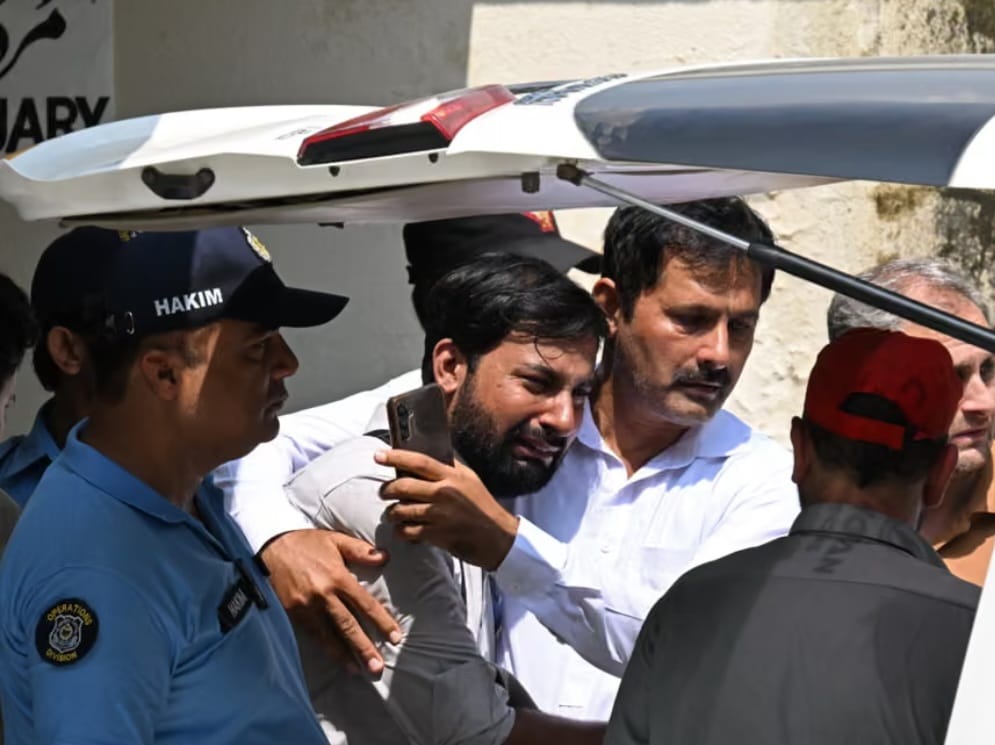
“My heart was heavy.” He later learned that both his wife and daughter had escaped alive. He described helping to drag a woman on a stretcher out of the ward, but noted that other mothers refused to leave, crying out hysterically for their babies.
“I saw a mother screaming for her child who was inside the ICU,” he said. “I tried to enter, but the smoke was too thick. I couldn’t see anything and could barely breathe. I begged her to save herself first—that we would look for the child later.”
Rehman also lamented the lack of staff on the ward at the time, saying families were largely left to fend for themselves in the critical first moments of the fire.
PIMS Fire: A Tragedy That Must Force Us to Rethink Hospital Safety
The fire at the Pakistan Institute of Medical Sciences (PIMS) in Islamabad today is not merely a tragic news story. It is a devastating reminder of how vulnerable patients can become when a healthcare facility… pic.twitter.com/kZGUjm5xMS
— Dr. Faisal Wadood (@DrFaisalWadood) August 26, 2026
Another father, whose newborn son was among the deceased, claimed that the nursery door had been locked—and that no staff member was present to unlock it.
Rescuers were ultimately forced to smash the windows to reach the trapped infants. Sohail Ashraf, the Islamabad chief commissioner, said the emergency call was received just before 7 a.m., and that rescue and police teams arrived swiftly—but for many, those minutes proved fatal.
The hospital administration issued a statement saying, “The fire was immediately brought under control, and the children were shifted to the intensive care unit without delay.” But for the grieving families, that assurance rang hollow—and came far too late.
Alamzaib Khan, 26, was another who tried to race into the burning ward. His wife had given birth to a baby girl two days earlier and was still recovering from a C-section, though their infant had already been taken home. “I was sleeping on the pavement when I heard people screaming and wailing,” he said. “I ran toward the ICU and children’s ward—and I saw my wife climbing down a ladder.”
“UNICEF is deeply saddened by the tragic loss of at least 14 newborn lives following a fire at the Pakistan Institute of Medical Sciences (PIMS) hospital in Islamabad today.”
Read our full statement: https://t.co/Ep7TGRfAbb pic.twitter.com/ciW4jNU8Rt
— UNICEF Pakistan (@UNICEF_Pakistan) August 26, 2026
After ensuring her safety, he turned to help others. “But the moment I approached the children’s ward, I couldn’t see anything—the smoke was suffocating. I tried to go inside, but it was impossible.”
“People were crying, screaming, begging for help. Women from the operation theater had to run for their lives,” he added, his voice trembling.
“They were in pain themselves, yet they cried and pleaded with everyone to save their children. It’s hard to describe such a terrible moment.”

Asim Tanveer is a seasoned journalist working for TV and electronic and print media outlets. He has been working for some of the world’s leading news organizations including Associated Press (AP), Reuters, BBC, CNN, CNBC, Star TV, Voice of America and The New York Times for more than 20 years. He has won several awards for his live coverage of events that include a Reuters News Agency World Award and the Pride of Performance award in 2010.