
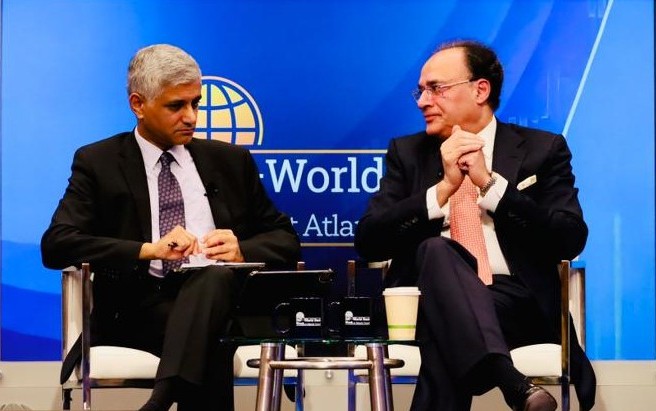
Pakistan faces two major challenges in the form of high population growth and climate change, the country’s finance minister said, highlighting Islamabad’s efforts to stabilize the national economy and build resilience.
Finance Minister Senator Muhammad Aurangzeb said the fact that Islamabad is financing rescue and relief efforts in the wake of last month’s massive floods through domestic resources rather than external appeals, reflects the country’s “strengthened fiscal capacity.”
“We are dealing with two existential issues for Pakistan. One is population, and the other is climate change,” he told a gathering of experts at an Atlantic Council-hosted event in Washington D.C. on the theme “Reform Efforts in Pakistan and the Challenges Ahead.”
Aurangzeb, who is representing Pakistan at the annual IMF-World Bank fall meetings, said the government has launched a 300-day national plan to accelerate rehabilitation and build climate resilience, while revising growth forecasts modestly to above 3 percent for FY2025.
“We are dealing with two existential issues for Pakistan,” says @Financegovpk Pakistani Finance Minister Muhammad Aurangzeb at the Atlantic Council.
“One is population, and the other is climate change,” he adds. #AnnualMeetings pic.twitter.com/3I6Gj2kC8R
— Atlantic Council (@AtlanticCouncil) October 16, 2025
Pakistan, he said, had consolidated macroeconomic stability over the past year, backed by external validations from the IMF and major global rating agencies.
He noted that the government’s disciplined fiscal management had restored confidence, improved sovereign spreads, and contributed to the first current account surplus in 14 years, according to the Finance Ministry.
According to World Population Review, Pakistan has a population of over 255 million, making it the 5th largest country in the world. The country must meet its growing economic, energy and job challenges for its population, particularly its young people in order to build a modern economy and sustain high growth.
Climate change: Will India and Pakistan be able to feed their large populations?
Speaking about fiscal reforms, Aurangzeb underscored the importance of ongoing structural changes aimed at broadening and deepening the tax base.
He outlined recent initiatives to bring agriculture, retail, and real estate sectors into the tax net, improve compliance through technology and AI-driven analytics, and curb leakages in sales tax collection.
He reaffirmed the government’s commitment to raise the tax-to-GDP ratio from 10.2% to 11% this year, and to 13% over the medium term, ensuring fiscal sustainability, the finance ministry said in a statement.
Federal Minister for Finance and Revenue, Senator Muhammad Aurangzeb, attended an extensive session today at The Atlantic Council in Washington D.C. on the theme “Reform efforts in Pakistan and the challenges ahead.”
The session was opened by Mr. Fred Kempe, President and CEO of… pic.twitter.com/HbVLEQyfnP
— Ministry of Finance, Government of Pakistan (@Financegovpk) October 16, 2025
Discussing intergovernmental fiscal relations, Senator Aurangzeb highlighted the National Fiscal Pact signed with provincial governments, setting the stage for deliberations on a new NFC Award. He informed that the inaugural NFC meeting is expected to convene in early November after being deferred due to the flood situation.
He also sketched out a growth pathway for the country in the years ahead, saying Pakistan is pursuing a private sector-led, export-driven growth model.
He noted that the new National Tariff Policy aims to reduce import dependence and enable export competitiveness through the gradual reduction of customs and regulatory duties on raw materials and intermediate goods.
Pakistan sends first rare earth minerals shipment to US in historic $500M deal
On the positive side, he cited emerging opportunities in IT, mineral exports, and projects like Reko Diq as future growth drivers.
On monetary and exchange rate policy, Senator Aurangzeb reaffirmed the government’s commitment to maintaining a competitive, market-based exchange rate under the oversight of the State Bank of Pakistan, adding that productivity gains and structural reforms are as vital as external price competitiveness in sustaining export growth.
Fred Kempe, President and CEO of The Atlantic Council, and moderated by Dr. Aasim M. Husain, former Deputy Director of the IMF’s Middle East and Central Asia Department. Dr. Husain, who recently authored the Council’s issue brief “Rescuing Pakistan’s Economy.”
Follow for more: Twitter (X) | Facebook | Instagram | LinkeIn

Kiran Asim is a writer who covers the U.S., Europe, South Asia, and the Middle East. Her reports and analyses look at the geostrategic issues and contemporary developments and their economic and political implications. She also writes about society and education.







