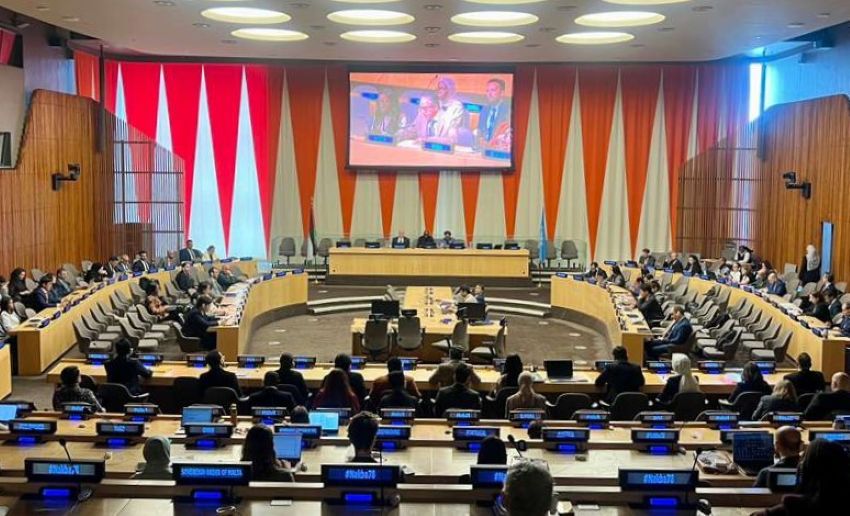
Diplomats speaking at a United Nations panel marking the 78th anniversary of the Nakba reaffirmed support for an independent Palestinian homeland where Palestinians can live in dignity and security, while stressing that a just and lasting resolution of the Middle East conflict remains essential for regional peace.
Nakba — the Arabic word for “catastrophe” — refers to the mass displacement and dispossession of Palestinians during the 1948 Arab-Israeli war. The events led to the displacement of an estimated 750,000 Palestinians, the destruction of hundreds of villages, and the loss of homes and livelihoods.
The meeting, organized by the UN Committee on the Exercise of the Inalienable Rights of the Palestinian People, heard testimonies from bereaved families and survivors affected both by the events of 1948 and the ongoing conflict in Gaza. Among those remembered was Hind Rajab, the five-year-old girl from Gaza whose killing has become emblematic of the civilian toll of the war.
Khaled Khiari, UN Assistant Secretary-General for the Middle East, Asia and the Pacific at the Department of Political and Peacebuilding Affairs, described the Nakba as “the world’s longest-standing protracted refugee crisis” and said the issue remained painfully unresolved.

He stressed that the path forward was rooted in international law, relevant UN resolutions and renewed political engagement aimed at achieving a negotiated two-state solution, with Israel and Palestine living side by side in peace and security.
Khiari said these efforts must include ending unlawful practices, protecting civilians, supporting Palestinian governance and institution-building, and reviving a credible political process.
He added that the 20-point U.S. proposal to end the Gaza conflict, endorsed through UN Security Council Resolution 2803 (2025), could provide a framework for addressing longstanding issues if implemented comprehensively.
The United Nations is commemorating the 78th anniversary of the Nakba, the catastrophic mass displacement of Palestinians in 1948 pic.twitter.com/b1vdy5s8o2
— TRT World (@trtworld) May 15, 2026
Diplomats at the meeting reiterated what they described as their “unwavering” solidarity with the Palestinian people and support for their right to self-determination.
Pakistan’s Permanent Representative to the United Nations, Ambassador Asim Iftikhar Ahmad, said support for Palestine remained deeply rooted in Pakistan’s own historical experience of independence and partition.
“Tragically, for the Palestinians, the Nakba is not a closed chapter of history,” the Pakistani envoy said. “It remains a continuing reality marked by occupation, displacement, dispossession and denial of rights.”
He noted that UN General Assembly Resolution 194, which affirmed the right of return for Palestinian refugees, remains unimplemented, while millions of Palestinians continue to live in refugee camps that have become symbols of prolonged statelessness and suffering.
To the Nakba glorifiers:
The Nakba was the result of the Arab rejection of the UN Partition Plan & decision to launch war to annihilate the State of Israel.
You can’t start war, openly vow to “throw the Jews into the sea,” and then pretend being the victim of the conflict you… pic.twitter.com/2jgUIO81eZ
— Israel Foreign Ministry (@IsraelMFA) May 16, 2026
“Today, as we commemorate the Nakba, we are also witnessing its most devastating contemporary manifestation in Gaza,” Ambassador Ahmad said, referring to the humanitarian devastation caused by the conflict.
He said the majority of Gaza’s population had faced repeated displacement, while the deaths of civilians — including children such as Hind Rajab — reflected the heavy human cost of the war.
Diplomats also voiced concern over developments in the occupied West Bank and East Jerusalem, citing continued settlement expansion, settler violence, forced displacement and restrictions imposed on Palestinians.
Several speakers condemned repeated incursions into the Al-Aqsa Mosque compound and warned that escalating tensions risk further destabilizing the region.

Israeli officials, meanwhile, continued to reject characterizations of the Nakba as a one-sided act of dispossession.
Israel’s Foreign Ministry said recent Nakba commemorations overlooked what it described as the rejection of the 1947 UN partition plan by Arab states and the subsequent war launched against the newly established Israeli state. Israeli officials argued that the displacement of Palestinians took place within the context of a broader regional conflict rather than what Palestinians describe as a campaign of ethnic cleansing.
Israeli Prime Minister Benjamin Netanyahu also used remarks during recent commemorations to underscore Israel’s military position in Gaza, saying Israeli forces had expanded operational control across large parts of the enclave amid the ongoing conflict.
At the same time, tensions remained elevated in Jerusalem during annual Jerusalem Day events, where nationalist marches through East Jerusalem drew criticism after some participants were reported chanting anti-Arab slogans, further highlighting the continuing volatility surrounding the Israeli-Palestinian conflict.
“On this solemn anniversary, remembrance alone is not enough,” Pakistan’s Ambassador Ahmad said. “The Nakba must not be allowed to continue into another generation. It must end through justice, accountability and an end to occupation.”
He reiterated support for the establishment of an independent and sovereign Palestinian state based on the pre-1967 borders, with East Jerusalem as its capital.
President of the UN General Assembly, Annalena Baerbock, urged member states to recommit to the New York Declaration adopted at the 2025 high-level conference on the peaceful settlement of the Palestinian question and implementation of the two-state solution.
She also called attention to the worsening humanitarian conditions in Gaza, where access to aid remains limited and civilian casualties continue despite ceasefire efforts announced in late 2025.
Palestinian President Mahmoud Abbas, in remarks delivered by Palestinian UN observer Riyad Mansour, said nearly 950,000 Palestinians had been forcibly displaced during the 1948 conflict amid what he described as efforts to erase Palestinian history and identity.
He said more than 531 towns and villages had been destroyed and stressed the role of the Palestine Liberation Organization in preserving Palestinian national identity and advancing international recognition of Palestine.
Abbas welcomed renewed diplomatic initiatives, including U.S.-backed ceasefire efforts and growing international recognition of Palestine, now recognized by 160 countries, as important steps toward achieving an independent Palestinian state with East Jerusalem as its capital.
Looking ahead, he emphasized the importance of reconstruction and national unity, calling for “one State, one Government, one law and one weapon,” alongside a complete Israeli withdrawal from Gaza.
Abbas also criticized Israel for what he described as continued non-compliance with international law and numerous UN resolutions affirming Palestinian rights.
Concluding his remarks, he urged the international community to formally acknowledge the Nakba, arguing that recognition remained essential to justice, historical accountability and lasting peace in the region.

Iftikhar Ali is a veteran Pakistani journalist, former president of UN Correspondents Association, and a recipient of the Pride of Performance civil award