Bangladesh is maintaining an open approach toward potentially joining a trilateral defense and economic framework involving Saudi Arabia, Pakistan, and Türkiye, foreign policy advisor Humayun Kabir reportedly said in a recent interview.
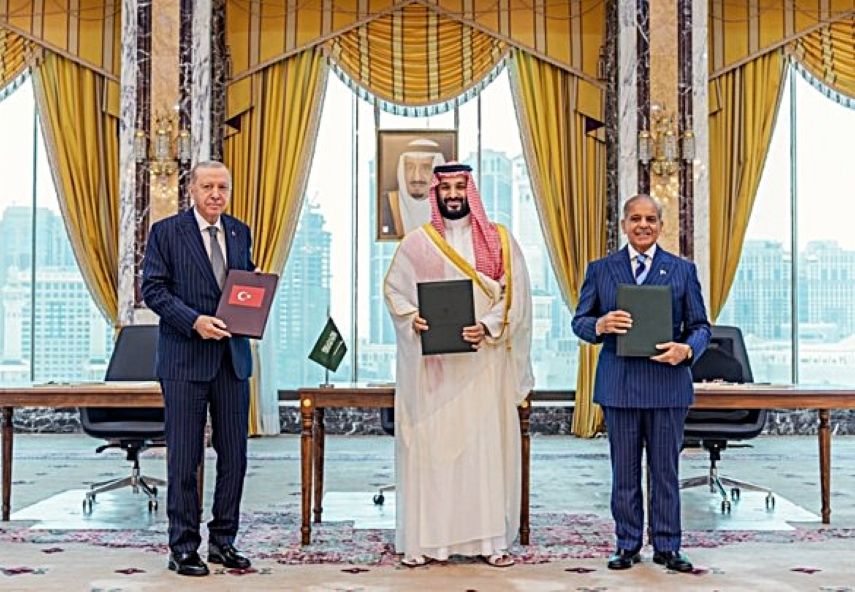
The comments, widely reported in the Indian media, follow the recent signing of a joint defense pact in Makkah between Riyadh, Ankara, and Islamabad, as the three nations formally agreed to treat an armed attack against any member state as an attack against all.
“Bangladesh maintains a positive approach towards the possibility of joining an economic or defense framework involving Saudi Arabia, Pakistan and Türkiye, taking into account its own interests and the changing dynamics of the global economy and trade,” Kabir stated.
Bangladesh open to joining Mecca pact considering its own interests—Foreign Affairs Adviser Humayun Kabir
Debdutta Chakraborty @debdutta_c reports #ThePrintForeignAffairs https://t.co/bSqisc2NyF
— ThePrintIndia (@ThePrintIndia) August 20, 2026
Strained Bilateral Relations with India
Kabir spoke at length regarding Dhaka’s shifting foreign policy, noting that a top-level visit to India by Bangladesh Prime Minister Tarique Rahman is currently not “justified”.
“There is no justification for rushing into a top-level visit by going beyond the national interest,” Kabir remarked, adding that the trajectory of future bilateral ties depends on a change in New Delhi’s perspective.
“The neighboring country must properly understand the reality of Bangladesh’s July mass uprising, which took place through the sacrifices of more than 1,500 people.”
The potential inclusion of Bangladesh into this pan-Islamic economic and security umbrella is expected to significantly expand Pakistan’s strategic reach along India’s eastern flank
Writes: @manojkumargupta | #Pakistan https://t.co/9CRGhdE5bF
— News18 (@CNNnews18) August 21, 2026
Ties between the South Asian neighbors have cooled following the 2024 ouster of former Prime Minister Sheikh Hasina, who fled to India after student-led protests ended her tenure. While Dhaka has repeatedly requested Hasina’s extradition, New Delhi has maintained that the matter remains under examination.
Despite reports in Indian media suggesting a potential diplomatic visit by Prime Minister Rahman to New Delhi from August 23–25, his press secretary clarified on Friday that no decision regarding an official trip has been finalized.
Expanding Ties with Pakistan and China
Amid cooling relations with New Delhi, Dhaka is actively broadening its strategic partnerships elsewhere in Asia.
With Pakistan, Bangladesh is deepening diplomatic engagement with Islamabad, focusing on strengthening economic trade links and people-to-people connectivity.
With China, Dhaka’s relations have reached “a new height,” according to Kabir, as Bangladesh explores deeper bilateral cooperation through a “Two Plus Two” mechanism while navigating broader geopolitical pressures.
New Delhi Monitoring Developments
Responding to reports of Dhaka’s potential interest in the Makkah agreement, Indian Ministry of External Affairs (MEA) spokesperson Randhir Jaiswal stated during a weekly press briefing that India is actively monitoring regional shifts.
India “continues to stand for peaceful resolution of conflict in West Asia…”, says MEA Spox pic.twitter.com/mTTPlAKyHU
— Sidhant Sibal (@sidhant) August 21, 2026
“We continue to closely follow developments that are happening in West Asia. This is what I have to say at this point in time,” Jaiswal said. When asked about Prime Minister Rahman’s prospective visit to India, Jaiswal added that the ministry currently had no official updates to share.
Ganga Water Treaty Renewal
Apart from having water disputes with neighbors China and Pakistan, India has also serious friction with Bangladesh over a water treaty.
Addressing bilateral water management, the MEA spokesperson noted that discussions regarding the 1996 Ganga Water Treaty continue through technical channels via the Joint Rivers Commission.
The landmark agreement—which governs the sharing of the Ganga River waters between India and Bangladesh—was established for a 30-year period and is scheduled for review and renewal upon its expiration in December.

Muhammad Luqman is Associate Editor at Views News Now. He writes on wide-ranging issues including economy, South Asia, the Middle East, agriculture, economy and innovation. Luqman has worked some of the leading news organizations and won acclaim for his original and research-based works.