

Pakistan’s finance minister said this week that expatriate remittances are likely to reach an unprecedented $43 billion in 2026.
Muhammad Aurangzeb’s optimism came as Islamabad warily watched the escalating conflict between Yemen’s Houthi militants and Saudi Arabia—home to more than three million Pakistanis whose remittances account for nearly $10 billion of that total.
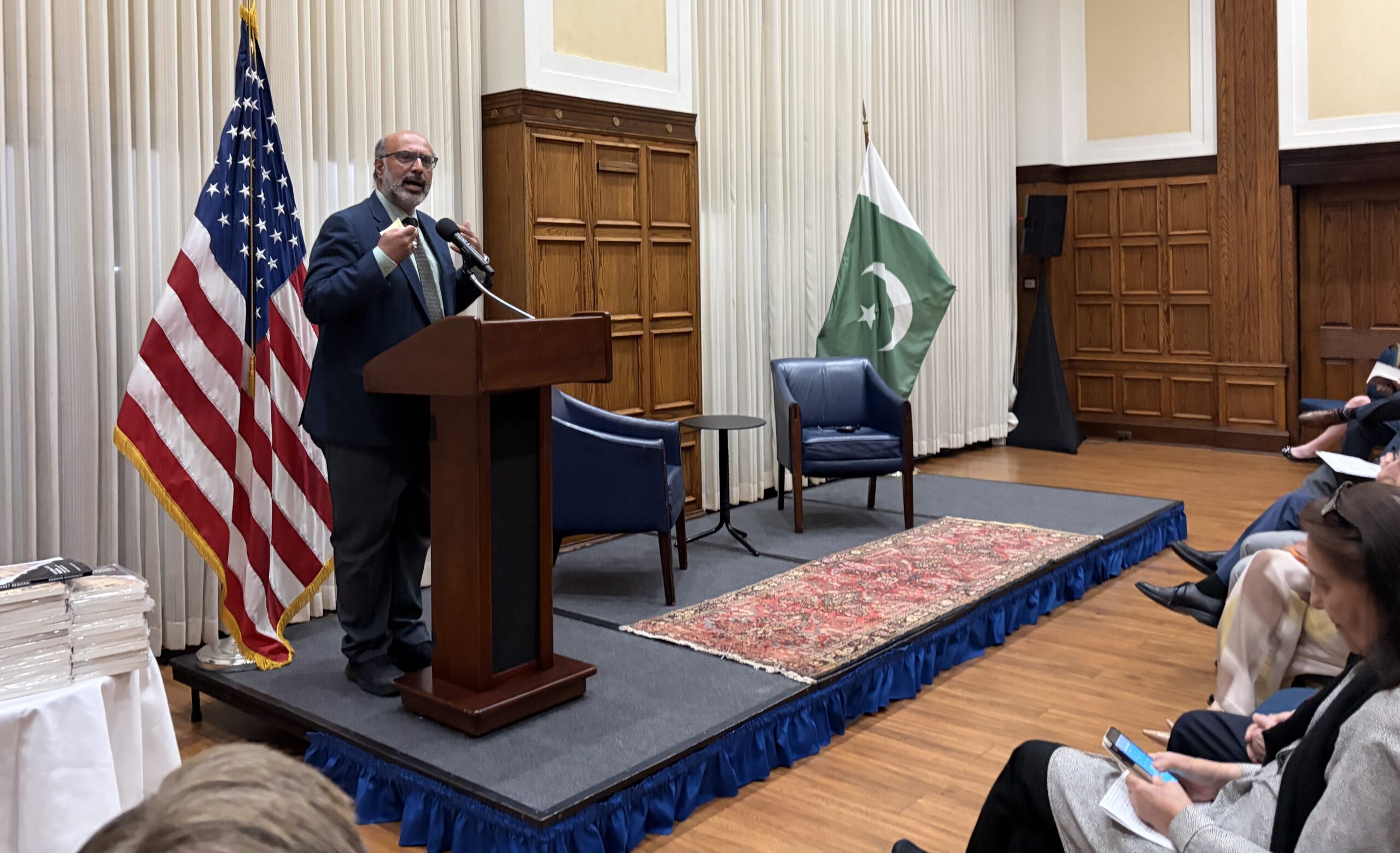
The irony of the situation prompted reflection among participants gathered at Washington’s National Press Club for the launch of a new book, A Global Asset Reborn: Pakistan Diaspora and Soft Power Politics.
The wealth flowing from the Kingdom is precisely what the Houthi conflict now threatens, and it is that same diaspora that Islamabad is counting on to keep the numbers climbing as it grapples with economic challenges.
Barrister Dawood Ghaznavi talks about his book A Global Asset Reborn — Pakistani Diaspora and Soft Power Politics pic.twitter.com/SAq4hcp237
— Views&News (@ViewsNewsMag) September 20, 2026
Speaking to the gathering, author and barrister Dawood Ghaznavi anchored his discussion on how the country’s vast, widely spread diaspora might contribute to its overall uplift—not merely as a source of foreign exchange, but as a political and strategic asset in its own right.
As the last few years have shown, the Pakistani diaspora is critically important to its country of origin in many more ways than simply as a pillar of foreign exchange reserves, Ghaznavi said.
For example, as detailed in the book, Pakistani expatriates can be veritable ambassadors of their country of origin by excelling in economic, academic, and cultural fields.

A constant theme throughout the discussion was the significance of the soft power that immigrant communities bring. For example, Professor Akbar S. Ahmed, Ibn Khaldun Chair at Washington’s American University, drew attention to how participation in academia, media, and the political process could boost the community’s image and help fight Islamophobia.
Dr. Abdul El-Sayed’s bid for U.S. Senate in the November midterm is a litmus test for the Pakistani and Muslim communities as they strive to elevate their voice in American political system, Dr. Ahmed said.
Dr. Hasan Abbas, an academic and author, suggested that Pakistani American doctors are highly successful as individuals and render important services in the medical field, but they could do even better collectively.
For instance, he opined, APPNA, the Association of Physicians of Pakistani Descent of North America, could build a hospital like other communities have, one that would stand out as an example of Pakistani Americans’ contribution.
Similarly, he said, having Pakistani chairs at universities would be a huge step toward highlighting the importance of the country, but he lamented that Pakistani entrepreneurs and doctors have ignored that area for a long time, and even the Quaid-e-Azam chair remains without a scholar after him due to lack of funding.
The question of political empowerment also figured prominently as Pakistanis abroad grow in numbers and wealth.
In the face of political developments, anti-immigration policies, and rising Islamophobia, some speakers called for a much more vigorous role that Pakistanis could play in the United States.
Critics often draw parallels between how politicians of Pakistani origin in Britain have earned representation in the House of Commons while not a single Pakistani has made it to the U.S. House of Representatives.
PAKPAC, the Pakistani American Public Affairs Committee, which interacts with U.S. lawmakers on Capitol Hill to empower Pakistani Americans, and APPAC, the American Pakistani Public Affairs Committee, which recently supported Zohran Mamdani’s NYC mayoral election campaign, have their work cut out for them as they advance their efforts in America’s political cycle, with narratives often becoming headwinds in the face of domestic developments and international conflicts.
Dawood’s book mentions some of the recent issues that need to be addressed to help the diaspora contribute more meaningfully to its country of origin. On the political level, that brings into play the role of the state.

For instance, he favors Pakistanis abroad having the right to vote in Pakistan’s national elections, and he considers incarcerated former prime minister Imran Khan’s rule as having been the most amenable to the policy of giving the Pakistani diaspora the opportunity to serve in government positions.
“The struggle of the Pakistani diaspora for its right to vote in Pakistan is a story marked by repeated disappointments… as of 2025, the government has taken a legal stance against extending voting rights, even after judicial orders,” Barrister Ghaznavi writes in the book.
Another key area where Islamabad could take the lead in utilizing the capital and expertise of the expatriate communities is to create a “stable environment” that would encourage entrepreneurs to make “meaningful” foreign direct investment and thereby step up the pace of economic growth. In his study, the author cites examples of China, India, Taiwan, and Vietnam, which have benefited enormously from their diasporas’ FDI accompanied by technology transfer.

The discussion repeatedly turned to the question of identity, and how the second and third generations of Pakistani origin could foster a link to the country, especially when they grow up in a capitalist system with apparently no direct relevance to their career or growth pathways in Pakistan. According to Barrister Ghaznavi, both the diaspora communities and the Pakistani state have an equal responsibility to establish such links through well-organized, institutionalized engagement.
At the moment, Ghaznavi recognized in a discussion moderated by journalist Raza Rumi that media could also be a big vehicle to strengthen the relationship between diaspora families and their country of origin.
The book attempts to cover a sweeping array of dimensions related to a dynamic diaspora—a massive undertaking that involves anthropological work, research, and first-hand experiences. Although the book was completed before the unsettling developments in the Middle East—home to more than half of the Pakistani immigrants—it has direct relevance to how immigrant communities could shape Pakistan’s economic development and leverage its potential as a country of immense importance to world peace.
Maha Khan, Chairwoman of the Muslim American Leadership Alliance, who set the stage for discussion in her introductory remarks about the book, noted that “as Americans first, deeply committed to full civic engagement and integration, the time has come for the Pakistani diaspora to unite under a cohesive vision and shared purpose.”
Michael Kugelman, a foreign policy expert specializing in South Asian affairs, called A Global Asset Reborn a book “that needed to be written,” and one that “will be of interest to Pakistani policymakers and the Pakistani diaspora itself, as well as to scholars of diaspora and migration studies.”
While Islamabad’s mediation role in the U.S.-Iran conflict, and now its central role in the Makkah Defense Alliance as a member along with Saudi Arabia and Türkiye, point to a major player in South Asia and the Middle East, Pakistani immigrants, who excel as individuals in fields of endeavor in the United States, Canada, and European countries, also need to unify their voices, as noted by several speakers. Meanwhile, the diaspora communities also expect their country of origin to offer them a congenial environment in which to benefit fully from their potential and experience in advanced countries.

Ali Imran is a Washington-based journalist, who has worked for leading world news organizations as a correspondent, expert and in editorial positions. He is a published author and poet.







