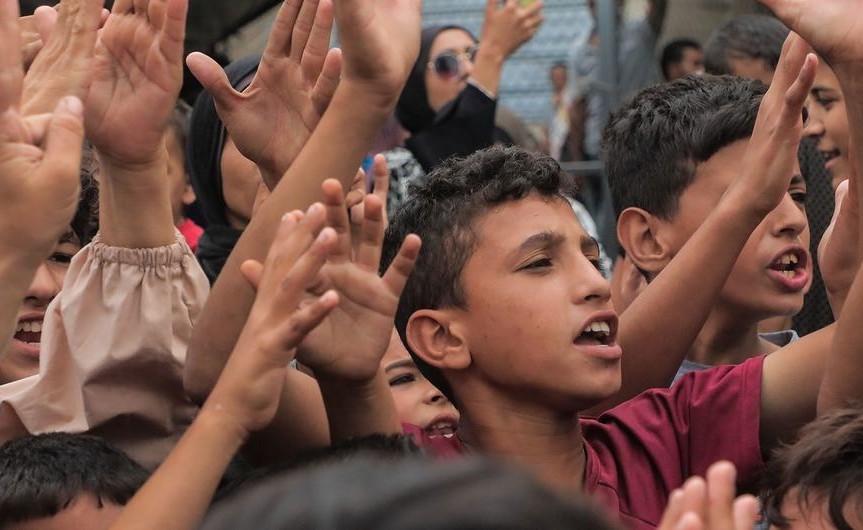
At least 300 children in Gaza have reportedly been killed in the roughly 300 days since a ceasefire agreement came into effect last October to suspend military operations between Israel and Hamas, the UN Children’s Fund (UNICEF) said Thursday.
The warning came amid reports of a new United States-led peace plan for the war-shattered enclave and a recent increase in Israeli airstrikes on alleged Hamas targets in Gaza. UNICEF said families are now confined to approximately one-third of the Strip, sheltering among destroyed buildings, rubble and uncleared waste.
“A ceasefire that leaves an average of one child dead each and every day is failing children,” said UNICEF Regional Director for the Middle East and North Africa, Edouard Beigbeder. “With hundreds more children injured, many severely, children in Gaza are still waiting for the end to the violence they were promised.”
Responding to reports about the mooted Gaza peace plan, Beigbeder welcomed recent announcements suggesting “steps towards ending hostilities” and scaled-up deliveries of humanitarian relief.
Speaking from Amman, @UNICEF spokesperson Louise Wateridge reports that at least 300 children in Gaza have been killed since a ceasefire agreement came into effect last October. pic.twitter.com/1i1HHRjmVu
— UN News (@UN_News_Centre) August 6, 2026
“For children in Gaza, the test is simple. Does the killing stop? Does aid reach them at scale? Do hospitals reopen and water flow? Will children return to school safely in September?” Beigbeder said. “Children have heard promises before. This time, agreements must translate into action.”
UNICEF and other UN agencies and humanitarian partners warned that children across the Strip continue to face acute malnutrition, disease, unsafe water and damaged sanitation systems.
Despite repeated calls for aid to enter Gaza at scale, UNICEF health workers describe exhausted and hungry mothers continuing to arrive at health centres carrying severely malnourished children.
Another consequence of the chronic lack of assistance is a worrying increase in premature births, along with more newborns in critical condition.
“There’s not enough incubators and in some cases [health workers are] saying they see two or even three babies sharing a single machine,” explained UNICEF spokesperson Louise Wateridge. “In Gaza, children only days old are already fighting to stay alive, born into partially functioning hospitals lacking equipment and medicine.”
Ms. Wateridge added: “This is what the world has chosen to tolerate. The killing must stop, aid has to enter at scale and children must be protected.”
“The world calls it a ceasefire but families in Gaza are still burying their children,” the UNICEF spokesperson continued.
In its latest update on Gaza, the UN aid coordination office, OCHA, said airstrikes in Gaza had reportedly resulted in civilian casualties and damage to critical medical supplies and civilian infrastructure.
“Ongoing military operations near the so-called ‘Yellow Line’ – coupled with strikes reported in other parts of the Strip – are disrupting civilian life, damaging shelters, driving renewed displacement, and restricting access to life-saving services,” the agency said, in reference to the line of separation consisting of concrete blocks erected by Israeli soldiers.
Citing the Gazan health authorities, OCHA said that the overall casualty toll since the announcement of a ceasefire agreement on 10 October 2025 is 1,209 people killed and 3,943 injured.
Israel in the past dismissed accusations that it intentionally killed Palestinian children.
Reacting to a UN report in June 2026, Israel rejected allegations that its forces deliberately target children. Commenting on a report by the UN Independent International Commission of Inquiry that accused Israeli authorities and security forces of deliberately targeting Palestinian children, Israel dismissed the findings as a “libelous sham” and denied that it targets children.
The Commission’s report covered the period since October 2023 and said its findings included cases in which Palestinian children were deliberately targeted and killed.
Meanwhile, last weekend after attacks on a medical storage facility next to Al-Aqsa Hospital in Deir al-Balah the UN World Health Organization (WHO) said that essential medical supplies had been destroyed, including some delivered by the agency.
Amid the violence, the UN and its partners continue to respond “wherever and whenever they can”, OCHA said. This included work to improve 3,000 makeshift shelters in Gaza City last week and the distribution of emergency shelter and essential items to 9,000 households, including kitchen sets, tarpaulins, blankets, mattresses, solar lights and clothes.
“To scale up assistance and carry out further upgrades of makeshift shelters, it is critical that timber, ropes, more solar lights and tools are allowed to enter Gaza in a timely manner,” OCHA insisted.
On Tuesday, UNICEF delivered more than 600 pallets of recreational kits, school bags and soap into Gaza. The supplies will be distributed ahead of the new school year, expected to begin in about two weeks.
Other partners working on education continue to provide support, too. More than 250,000 pre-school and school-aged children are participating in summer learning activities, helping to provide a sense of routine and stability while helping students recover some of the learning lost during the hostilities.
The war in Gaza erupted on October 7, 2023, when Hamas launched an attack on southern Israel, which according to Israeli officials killed around 1200 people. In response, Israel conducted massive military operations across the strip, which it said targeted Hamas militants. According to Gaza health officials, more than 70,000 Palestinians have been killed in the Gaza conflict.

Iftikhar Ali is a veteran Pakistani journalist, former president of UN Correspondents Association, and a recipient of the Pride of Performance civil award