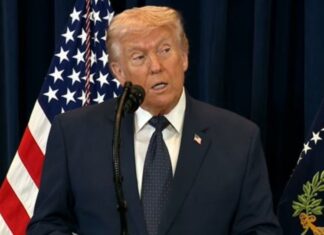
President Donald Trump on Monday framed upcoming U.S.-Iran negotiations as a final, decisive crossroads, warning that diplomatic failure would clear the path for intensified American military action.
“This is the last chance for them to sign a good document,” Trump told reporters in the Oval Office, striking a tone of both urgency and ultimatum.
He laid out the two-phased process: first, reopening the strategic Strait of Hormuz, followed by a longer-term push for denuclearization.
“The first phase is the opening of the straits. The second phase will be the denuclearization,” he said. “And that will take a little while.”
.@POTUS on negotiations with Iran: “I want to give them every last chance before decapitation… If I am given a chance to let a lot of people live, I want to give that chance.” pic.twitter.com/echyAagbKS
— Rapid Response 47 (@RapidResponse47) August 3, 2026
Trump said the talks are going on with Iran despite Tehran’s denial.
“We are talking right now, at the request of Iran,” he said, adding the talks are taking place at the request of Saudi Arabia, Qatar and the United Arab Emirates.
The president’s reference to opening the straits appears to encompass both the Strait of Hormuz and the Red Sea.
Iranian proxy forces—the Houthis—have launched attacks on Saudi oil tankers in recent days. Meanwhile, the Strait of Hormuz itself remains a cauldron of tension: the U.S. has maintained a strict naval blockade of Iranian ports, while the Islamic Revolutionary Guard Corps’ repeated firings on commercial vessels have driven trading ships away from the oil- and gas-rich Gulf states. Control over this vital waterway has rapidly emerged as the central flashpoint in the broader confrontation.
While Trump projected confidence in the U.S. military’s recent decimation of Iranian leadership and naval forces, he also acknowledged a tactical pause—one he said came at the urging of Gulf allies and even unnamed Iranian officials.
According to the president, a plan for “the biggest attack since World War II” was set for Sunday but was shelved after appeals from Saudi Crown Prince Mohammed bin Salman, along with leaders from Qatar and the UAE.
BREAKING:
Trump on talks with Iran:
“They’re going on right now… This is the last chance. This is the last chance for them to sign a good document” pic.twitter.com/IBjlWX7Dhw
— Visegrád 24 (@visegrad24) August 3, 2026
Yet the president made clear that his patience is wearing thin. He expects the status of the talks to become clear “today or tomorrow.”
On part of mediator Pakistan, Interior Minister Mohsin Naqvi is expected to travel to Tehran in the coming days to discuss revitalizing the negotiation process, though Islamabad has not yet formally announced the visit.
Officials are hopeful of achieving measurable progress this week, noting that both sides continue to exchange messages through intermediaries in an effort to restart direct negotiations under the framework of the Islamabad Memorandum of Understanding.
That document, signed by Washington and Tehran on June 17 with Pakistan serving as mediator, committed both parties to pursuing negotiations toward a comprehensive settlement of several longstanding disputes—including Iran’s nuclear program—within a 60-day window. However, renewed hostilities over the past month have cast significant doubt on the agreement’s implementation.
According to sources familiar with the matter, the United States and Iran are expected to commence with indirect talks through mediators, aiming to establish a baseline level of mutual understanding before transitioning back to direct negotiations.
The nuclear issue, sources added, is not anticipated to feature in the initial phase of discussions. Rather, the immediate priority will be consolidating the current pause in hostilities and restoring the status quo that existed prior to July 9.
Behind the rhetoric, however, Tehran appears to be calculating that it can outlast Trump—banking on dwindling U.S. munitions stockpiles and a war-weary American public heading into November’s midterm elections. The president, who has relished in the military campaign’s early successes, now faces the dual challenge of sustaining leverage abroad while managing political headwinds at home.
Yet according to a New York Times analysis, the president’s repeated decisions to pull back from launching massive military strikes on Iran have only reinforced Tehran’s prevailing narrative that Washington is loath to engage in direct conflict. By mobilizing regional allies to threaten critical energy shipping lanes, Iran is seeking to exploit this perceived U.S. hesitation as a strategic bargaining chip, the newspaper reported.
Behind closed doors, the administration is grappling with significant operational constraints, including mounting concerns over the depletion of defensive missile inventories, the analysis noted.
Tehran has continued to raise the stakes in its confrontation with Washington—raising questions about whether and when it might return to a short-lived peace negotiation framework that collapsed last month, according to the Times.

Muhammad Luqman is Associate Editor at Views News Now. He writes on wide-ranging issues including economy, South Asia, the Middle East, agriculture, economy and innovation. Luqman has worked some of the leading news organizations and won acclaim for his original and research-based works.

Iftikhar Ali is a veteran Pakistani journalist, former president of UN Correspondents Association, and a recipient of the Pride of Performance civil award