
The U.S. economy hit a speed bump in the spring, expanding more slowly than expected as government spending retreated and business investment softened, the Commerce Department reported Thursday. Beneath the weaker headline, however, resilient consumer spending continued to underpin economic growth.
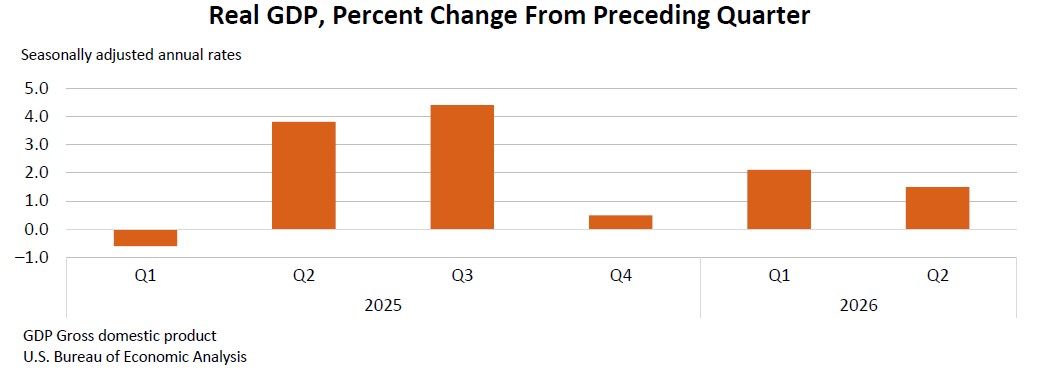
Real gross domestic product (GDP)—the value of all goods and services produced—grew at an annualized rate of 1.5% during the April-to-June period, slowing from a 2.1% pace in the first quarter. The advance estimate from the Bureau of Economic Analysis (BEA) came in below economists’ expectations of roughly 1.8%.
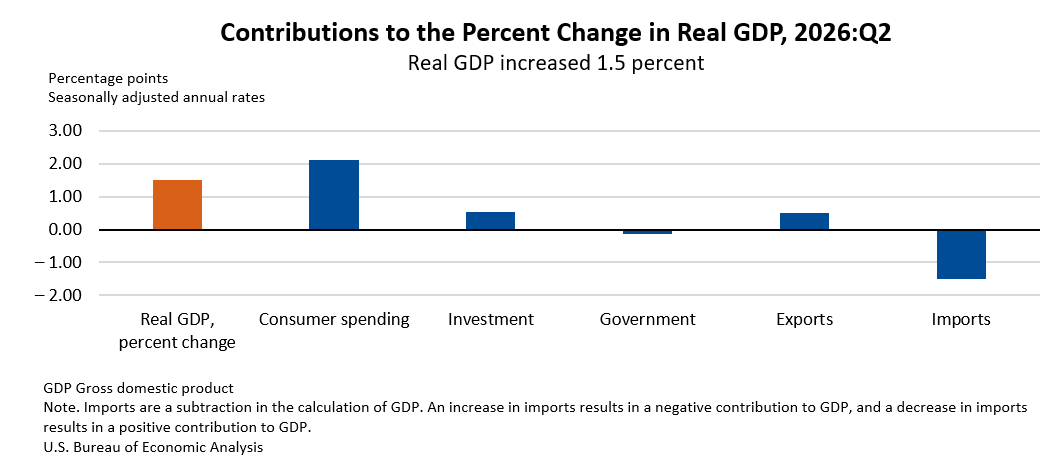
The slowdown largely reflected a pullback in government spending, softer business investment, and weaker export growth. Faster import growth—which subtracts from GDP calculations—also weighed on the headline figure.
The report’s underlying details painted a stronger picture. Consumer spending, which accounts for roughly two-thirds of U.S. economic activity, rebounded sharply, accelerating to a 3.2% annualized pace after nearly stalling in the first quarter.
As a result, real final sales to private domestic purchasers—a key gauge of underlying demand that excludes government spending, inventories, and trade—rose a robust 3.9%, more than double the prior quarter’s 1.7% gain.
The data suggest that private-sector demand remained resilient even as households continued to grapple with elevated prices. The gross domestic purchases price index—a broad measure of prices paid across the economy—accelerated to 5.7% in the second quarter from 3.6% in the prior period.
The Federal Reserve’s preferred inflation gauge, the personal consumption expenditures (PCE) price index, rose 5.1% over the same stretch, while core PCE—which excludes volatile food and energy prices—eased modestly to 3.4%.
The report comes a day after the Federal Reserve, under Chairman Kevin Warsh, left interest rates unchanged for a fifth consecutive meeting, with policymakers acknowledging that progress in bringing inflation back to target remains uneven. While the weaker-than-expected GDP reading may initially disappoint investors, the report’s underlying details point to an economy that continues to expand at a moderate pace, supported by resilient consumer spending despite elevated borrowing costs and persistent geopolitical uncertainty in the Middle East.

Muhammad Luqman is Associate Editor at Views News Now. He writes on wide-ranging issues including economy, South Asia, the Middle East, agriculture, economy and innovation. Luqman has worked some of the leading news organizations and won acclaim for his original and research-based works.