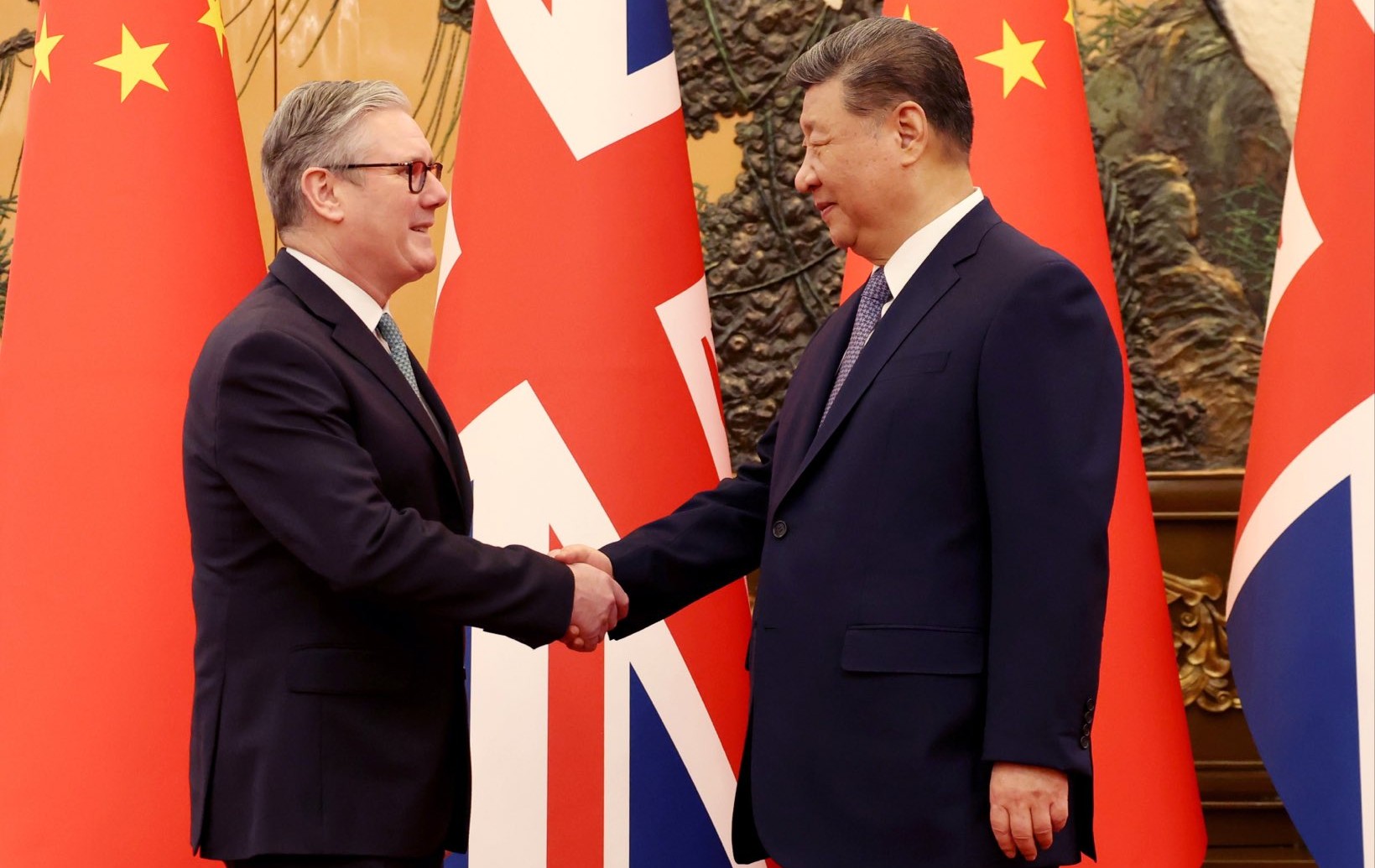
In a significant diplomatic shift in relations between London and Beijing, British Prime Minister Keir Starmer and President Xi Jinping displayed pragmatic approach to expanding economic cooperation.
The high-stakes summit at the Great Hall of the People on Thursday, the two leaders met after years of frost and diplomatic “twists and turns.”
Starmer’s visit is the first by a British leader since 2018.
Prime Minister Starmer characterized the visit as an effort to move past the “inconsistency” of previous years, advocating for what he termed a “more sophisticated” and “mature” relationship.
Speaking at the start of the 80-minute meeting, Starmer emphasized that engaging with the world’s second-largest economy is a matter of pragmatic necessity rather than a abandonment of values.
Touched down in China – I’m here to deliver for the British people. pic.twitter.com/kzCJNsuBw3
— Keir Starmer (@Keir_Starmer) January 28, 2026
“China is a vital player on the global stage,” Starmer told reporters. “It is essential that we build a relationship that is consistent and predictable, serving the interests of the British public while addressing global challenges.”
President Xi Jinping responded with a notably conciliatory tone, acknowledging that the bilateral relationship had weathered “twists and turns” that served neither nation.
He praised the current UK government’s focus on “fixing the foundations” of its economy—a nod to Starmer’s domestic policy—and expressed a readiness to establish a long-term strategic partnership.
Xi emphasized that despite differences in history and social systems, the “broad space for cooperation” in trade, clean energy, and financial services remains vast.
Touched down in China – I’m here to deliver for the British people. pic.twitter.com/kzCJNsuBw3
— Keir Starmer (@Keir_Starmer) January 28, 2026
He called for both nations to adopt a “rational and objective perspective” on one another’s development.
The meeting yielded several tangible wins for the UK’s economic and security agenda:
Significant progress was made on reducing tariffs for British whisky and expanding visa-free travel to China for British citizens (up to 30 days), a major boost for business travelers and the tourism sector.
In a surprise joint announcement, the two leaders agreed to collaborate on dismantling human trafficking networks. UK and Chinese intelligence services will now share data to disrupt the supply chains used by gangs involved in irregular migration.
Plans were finalized for Chancellor Rachel Reeves to visit Beijing later this year to revive the Economic and Financial Dialogue, with a heavy focus on the “clean energy transition.”
Chinese President Xi Jinping and visiting British Prime Minister Keir Starmer agreed on Thursday in Beijing that the two countries should develop a long-term, stable comprehensive strategic partnership.
·China and Britain, as permanent members of the United Nations Security… pic.twitter.com/CKzkuYQtbS
— FU Cong 傅聪 (@ChinaAmbUN) January 29, 2026
While the focus was heavily on growth, the dialogue was not without its friction points. Starmer confirmed he raised “sensitive” topics, including the ongoing detention of pro-democracy tycoon and British citizen Jimmy Lai in Hong Kong, as well as human rights concerns regarding the Uighur minority in Xinjiang.
Starmer described these exchanges as “part and parcel” of an honest relationship, noting that the two leaders had agreed to avoid “surprises” by maintaining open channels of communication even when they disagree.
The timing of this reset is critical. With shifting dynamics in the United States’ foreign and trade policies and global economic uncertainty, Starmer is betting that a “pragmatic” China policy will help deliver his promise of making Britain the fastest-growing economy in the G7.
Xi’s remarks suggest he may be seeing the meeting a chance to stabilize relations with a key European power at a time of “radical uncertainty.”

Kiran Asim is a writer who covers the U.S., Europe, South Asia, and the Middle East. Her reports and analyses look at the geostrategic issues and contemporary developments and their economic and political implications. She also writes about society and education.