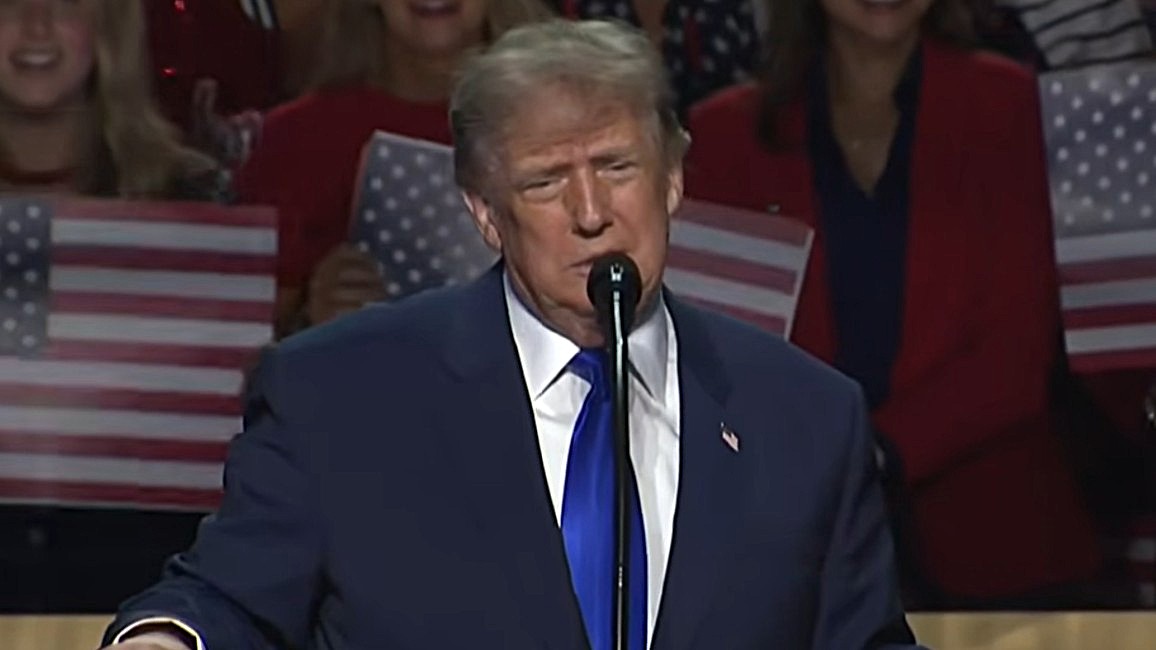
Pesident Donald Trump used the Republican Party’s first-ever midterm convention in Dallas this week to offer a sweeping financial incentive to voters: a $5,000 payment to every adult U.S. citizen if Republicans retain control of both the House and Senate in November.
He called it the “Trump Dividend,” comparing it to a successful company’s cash distribution to shareholders and tying it explicitly to “our tremendous strength and success economically.”
The additional condition he mentioned was that the money must be spent inside the United States.
The proposal immediately raised questions about presidential authority, congressional power, and cost.
Republican midterm convention boos Senate Majority Leader John Thune when President Trump mentions him. pic.twitter.com/ZKOq4RjTt8
— CSPAN (@cspan) September 10, 2026
Under the U.S. Constitution, the power of the purse rests with Congress. No president can unilaterally order broad cash payments of this scale without legislation appropriating the funds.
Current estimates put the price tag at roughly $1.35 trillion, depending on the exact number of adult citizens covered—on top of a national debt that recently surpassed $40 trillion and a federal deficit that had already reached roughly $1.8 trillion in the first 10 months of fiscal 2026.
This is not Trump’s first such promise. Earlier in his second term he floated a “DOGE dividend” linked to savings from the Department of Government Efficiency and later floated tariff-rebate checks of up to $2,000.
Neither materialized. Congress has not enacted either proposal, with fiscal and legal concerns standing in the way even as Republicans have controlled both chambers. Vice President JD Vance later suggested the latest payments would not go to the wealthy, but offered no detailed funding mechanism beyond pointing to tariff revenue. Tariff collections have totaled hundreds of billions since 2025, yet fall far short of covering a trillion-dollar payout, particularly given the legal and refund complications surrounding some of the administration’s tariffs.
Pennsylvania Democratic Senator John Fetterman made a surprise video appearance at the RNC midterm convention to introduce Pennsylvania Republican Senator Dave McCormick. pic.twitter.com/mzPHdEvkDc
— Newsweek (@Newsweek) September 10, 2026
Background: Unified Republican Government Heading Into Midterms
Republicans currently control the White House, the Senate, and the House of Representatives—the first time the party has held all three since the early years of Trump’s first term.
The 119th Congress began with a narrow Republican edge after the 2024 elections. As of early September 2026, the Senate stands at 53 Republicans, 45 Democrats, and two independents who caucus with Democrats. The House has 218 Republicans, 214 Democrats, one independent (who caucuses with Republicans), and two vacancies.
These majorities are slim. Democrats need only a handful of additional House seats to claim the speakership, with the precise number affected by vacancies and special-election outcomes. Historical midterm patterns favor the party out of the White House, and recent generic-ballot polls have shown Democrats leading. Prediction markets and nonpartisan analysts have given Democrats a strong chance—and in some measures a clear advantage—of flipping the House, though the Senate map remains more favorable to Republicans.
Trump has reshaped the Republican Party during his second term. He has prioritized loyalty, backed primary challenges against senators and representatives he viewed as insufficiently aligned (including successful efforts against figures such as Sen. John Cornyn of Texas and others), emphasized tariffs over traditional free-trade orthodoxy, and centered the party around a populist, working-class appeal. The Dallas convention itself reflected this shift, with the president dominating the stage even as some Republicans privately debate the party’s direction after he leaves office in 2029.
Approval Ratings and Economic Pressures
Trump’s job approval has hovered in the high 30s to around 40 percent in recent national averages, with disapproval often near or above 57–60 percent. Aggregators such as RealClearPolitics and others have shown net approval in negative double digits, lower than at comparable points in many previous presidencies. Among Republicans the numbers remain higher, but overall public sentiment has weakened.
Economic challenges form a central part of the backdrop. Inflation, measured by the Consumer Price Index, stood at 3.4 percent year-over-year in July 2026 after peaking higher earlier in the year. Energy prices have been a major driver. Oil prices climbed again in early September, with Brent crude moving above $100–$105 per barrel at points and U.S. gasoline recently approaching $4.28 a gallon—up sharply from a year earlier. The unemployment rate has remained relatively low and stable, at 4.1 percent in the latest data, with job growth continuing though at a moderated pace. These pressures—higher costs at the pump and in grocery stores, combined with tariff effects—have weighed on public assessments of the economy even as overall growth has continued and the labor market has avoided sharp deterioration.
The Iran Conflict and Its Economic Spillover
A military confrontation with Iran that began in late February 2026 has compounded energy-price volatility. U.S. and Israeli strikes targeted Iranian military and nuclear-related infrastructure; Iran’s then-Supreme Leader Ali Khamenei was killed. Fighting has moved through phases of intense exchanges, including a preliminary ceasefire accord reached in June that later unraveled, followed by renewed military action. Control of the Strait of Hormuz, a critical oil-shipping route, has been repeatedly contested and severely disrupted, contributing to higher global oil prices and domestic gasoline costs.
As of early September, both sides have continued intermittent military actions and economic pressure campaigns while stopping short of full-scale renewed war. The conflict has lasted more than six months, with U.S. forces still heavily engaged in the region and oil markets remaining sensitive to each new development.
What Comes Next
Trump’s $5,000 offer places the midterm election itself at the center of a direct fiscal promise. Delivery would require Congress to write and pass legislation, an outcome that past similar proposals have not achieved even with Republican majorities.
Democrats have characterized the pledge as an empty campaign device timed to the November vote—a politically potent promise whose enormous price tag and lack of a concrete funding mechanism leave its practical prospects in serious doubt.
The GOP faces the dual task of defending narrow majorities while navigating the president’s low approval ratings, elevated living costs, and an ongoing overseas conflict that continues to influence energy markets.
The November results will determine whether Republicans keep unified control of Washington or whether Democrats reclaim the House—and with it the ability to check the White House for the final two years of Trump’s term. The $5,000 figure has focused attention on the widening gap between campaign rhetoric and the constitutional and budgetary realities that govern actual spending. Whatever its political appeal, the proposal cannot become a trillion-dollar check without Congress—and without confronting a fiscal reality. Meanwhile, analysts say the November 3 midterm stakes keep rising for the GOP and the White House as Democrats seek to build on voter discontent.

Kiran Asim is a writer who covers the U.S., Europe, South Asia, and the Middle East. Her reports and analyses look at the geostrategic issues and contemporary developments and their economic and political implications. She also writes about society and education.