U.S. President Donald Trump announced tight economic measures against Iran, calling it an Economic D-Day for the Persian Gulf country as he also warned world countries of severe consequences if they provide Tehran a financial lifeline.
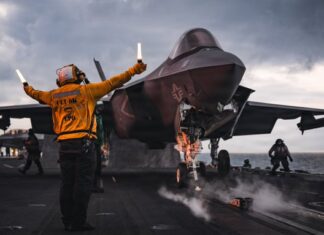
Trump’s latest announcement follows weeks of intensive U.S. strikes on Iran’s military and nuclear infrastructure, which have systematically degraded the country’s air defense systems, naval assets, and key weapons production facilities.
The escalating campaign has left Iran’s conventional forces severely weakened and its economy reeling under the weight of existing sanctions and the naval blockade, setting the stage for today’s dramatic escalation in economic warfare.
In a blistering statement posted on Truth Social today, Trump declared he is unleashing the “MOST CRUSHING ECONOMIC OPERATION EVER TAKEN AGAINST ANY COUNTRY,” asserting that Iran’s military capabilities are already in ruins and its economy is collapsing. “Their navy is gone, their air force is destroyed, their military factories are now rubble, their currency is worthless, and their country is hanging by a thread,” he wrote.
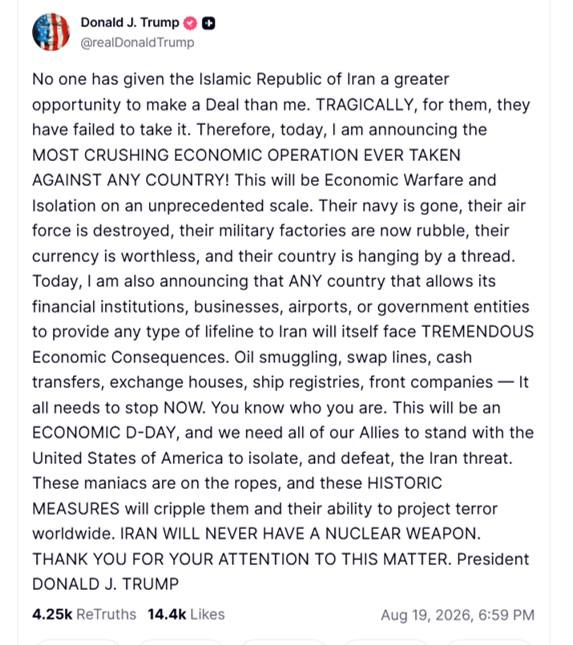
The U.S. president lamented that Tehran squandered what he characterized as an unparalleled diplomatic opening under his leadership. “No one has given the Islamic Republic of Iran a greater opportunity to make a Deal than me. TRAGICALLY, for them, they have failed to take it,” Trump stated.
As part of the sweeping new campaign, Trump issued a stark ultimatum to the international community: any nation allowing its financial institutions, businesses, airports, or government entities to provide any form of support to Iran will face “TREMENDOUS Economic Consequences.” He demanded an immediate cessation of all financial channels, including oil smuggling, swap lines, cash transfers, exchange houses, ship registries, and front companies, warning, “You know who you are.”
Framing the initiative as an “ECONOMIC D-DAY,” the President called on all U.S. allies to join Washington in isolating and defeating the Iranian threat. He closed with an unequivocal vow: “IRAN WILL NEVER HAVE A NUCLEAR WEAPON.”
The six-month-old conflict, which erupted on February 28 with coordinated U.S. and Israeli strikes against strategic targets inside Iran, has already sent shockwaves across the region. The U.S. has already enforced a naval blockade of Iranian ports, severely restricting Tehran’s ability to export oil and import essential goods, while Iran has repeatedly targeted commercial ships in retaliation.
As a result, traffic through the key Strait of Hormuz waterway remains fragile and low, with several vessels reportedly attacked or forced to reroute. The instability has upended oil supplies and fueled volatility in global energy markets, compounding inflationary pressures already felt worldwide.
In retaliation for the sustained U.S. strikes, Tehran has also repeatedly attacked neighboring Gulf countries, including the United Arab Emirates and Saudi Arabia, through a combination of missile strikes, drone swarms, and alleged proxy operations.
These reprisals have spread instability across the energy-rich Middle East, raising fears of a wider regional conflagration and testing the resolve of U.S. allies who now find themselves caught between Washington’s aggressive posture and Tehran’s capacity for asymmetric retaliation.

Kiran Asim is a writer who covers the U.S., Europe, South Asia, and the Middle East. Her reports and analyses look at the geostrategic issues and contemporary developments and their economic and political implications. She also writes about society and education.