In the high-stakes standoff over the Strait of Hormuz, U.S. President Donald Trump has laid out a stark choice for Tehran: accept the terms under discussion or face renewed military escalation.
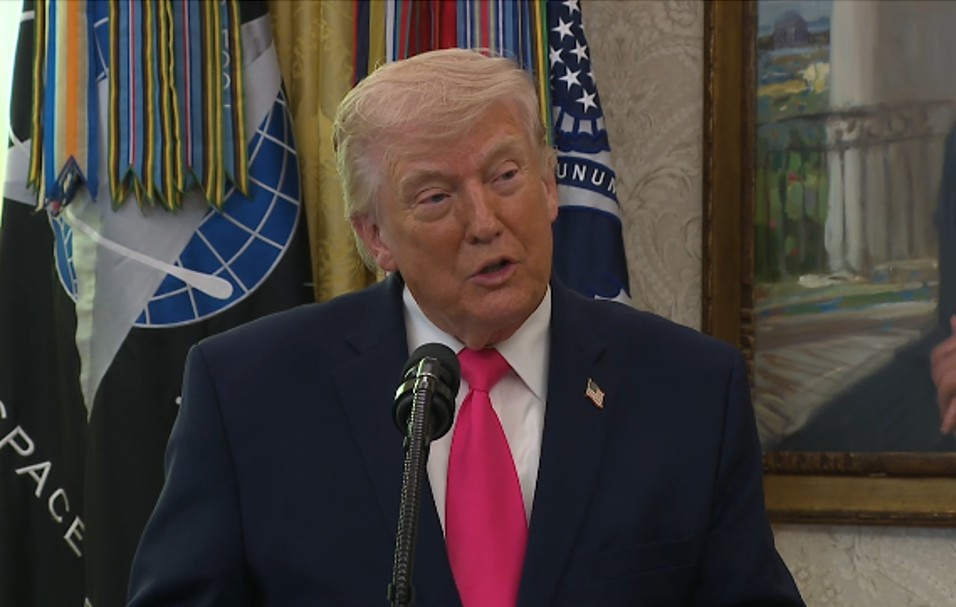
In a Truth Social post on Wednesday, Trump said “Operation Epic Fury” — the U.S. military campaign against Iran — could be ended if Tehran complies with agreed conditions, including reopening the strategic waterway to all traffic, including Iranian vessels.
His remarks came as Axios reported that Washington and Tehran are moving closer to a framework agreement covering key issues such as a suspension of Iran’s nuclear enrichment, the reopening of the Strait of Hormuz, and potential easing of U.S. sanctions.
“Assuming Iran agrees to give what has been agreed to, which is, perhaps, a big assumption, the already legendary [Operation] Epic Fury will be at an end, and the highly effective blockade will allow the Hormuz Strait to be open to all, including Iran,” Trump wrote.
US, Iran Move Closer to Framework Deal; Islamabad, Geneva Emerge as Potential Venues
He added a warning that failure to comply could lead to renewed military action “at a much higher level and intensity than it was before.”
The comments reflect a dual-track approach—combining pressure with conditional openness—as reports indicate the two sides are nearing a concise memorandum of understanding that could frame broader nuclear and security negotiations.
However, Trump told the New York Post that it remains “too soon” for direct leader-level engagement.
President Trump told me it’s “too soon” to start packing my bags for Islamabad after reports that the US and Iran are close to a peace deal.
“It’s too far. No, it’s too much,” he said.
He’s previously told me he’d go to Pakistan for a deal signing, but we’re not there yet.
— Caitlin Doornbos (@CaitlinDoornbos) May 6, 2026
Ceasefire Extensions and Pakistan’s Key Role
The latest rhetoric comes against the backdrop of repeated ceasefire extensions that have significantly reduced daily casualties.
Pakistan’s Deputy Prime Minister and Foreign Minister Ishaq Dar, speaking to the Ulema Council on May 6, expressed cautious optimism that the truce could become permanent.
He highlighted Islamabad’s role in facilitating direct U.S.-Iran engagement—described as the first such contact in nearly five decades—as well as securing successive extensions of the ceasefire.
I am grateful to President Donald Trump for his courageous leadership and timely announcement regarding the pause in Project Freedom in the Strait of Hormuz.
President Trump’s gracious response to the request made by Pakistan and other brotherly countries, particularly the…
— Shehbaz Sharif (@CMShehbaz) May 6, 2026
“Pakistan’s efforts had been directed towards securing direct negotiations and a ceasefire — first it happened, then it was extended, then extended a second time, then a third time — that had at least stopped the deaths of several hundred people daily,” Dar said.
He added that Pakistan’s focus has now shifted toward consolidating the ceasefire into a durable arrangement for regional stability.
Trump has also acknowledged Pakistan’s role, noting that pauses in operations such as “Project Freedom”—aimed at escorting ships through Hormuz—were influenced in part by requests from Islamabad and other countries.
“Assuming Iran agrees to give what has been agreed to, which is, perhaps, a big assumption, the already legendary Epic Fury will be at an end… If they don’t agree, the bombing starts, and it will be, sadly, at a much higher level and intensity than it was before.” – President… pic.twitter.com/WawLkequWU
— The White House (@WhiteHouse) May 6, 2026
Prime Minister Shehbaz Sharif welcomed the decision to pause the initiative, while Pakistan’s army chief called for collective restraint amid what officials described as a delicate diplomatic phase.
Iran’s Position: Caution and Conditional Engagement
Tehran has responded with a mix of skepticism and conditional openness.
Ebrahim Rezaei, spokesperson for Iran’s National Security Committee, dismissed reports of an imminent agreement as “a wishlist of the Americans rather than a reality.”
Meanwhile, Foreign Ministry spokesperson Esmaeil Baghaei emphasized that any meaningful negotiation must be conducted in “good faith,” rejecting what he described as pressure tactics, including coercion and unilateral demands.
Update |
Chinese Foreign Minister Wang Yi met with Iranian FM Seyed Abbas Araghchi to discuss 𝐝𝐞-𝐞𝐬𝐜𝐚𝐥𝐚𝐭𝐢𝐧𝐠 the regional crisis. Beijing reaffirmed its support for Iran’s sovereignty while emphasizing that a comprehensive cessation of hostilities “brooks no delay.”… pic.twitter.com/qWDyPoffCo
— South Asia Times (@_southasiatimes) May 6, 2026
He referenced international legal principles to underline that negotiations should aim at genuine dispute resolution rather than imposed outcomes.
Araghchi in Beijing: China’s Emerging Role
Amid the diplomatic activity, Iranian Foreign Minister Abbas Araghchi traveled to Beijing on May 6 for talks with Chinese Foreign Minister Wang Yi, marking his first visit since the conflict escalated.
According to Al Jazeera, Wang expressed concern over the conflict and called for a comprehensive ceasefire and the reopening of the Strait of Hormuz.
The visit comes ahead of Trump’s planned meeting with Chinese President Xi Jinping, positioning Beijing—one of Iran’s largest oil customers—as a potential intermediary with a vested interest in stabilizing energy flows.
A Region on Edge: Diplomacy or Escalation
With oil markets reacting to every signal of progress or breakdown, the coming days remain critical.
Trump’s calibrated mix of pressure and pause, Iran’s insistence on equitable terms, Pakistan’s mediation efforts, and China’s cautious engagement have created a fragile diplomatic convergence. Yet skepticism persists, shaped by past breakdowns and the high stakes of nuclear and regional security.
The ceasefire has held, but its durability remains uncertain. A single miscalculation could reverse recent gains and reignite broader confrontation.
For now, the question remains whether the Strait of Hormuz will reopen through negotiated compromise—or once again become the epicenter of escalation. In this increasingly complex geopolitical landscape, intermediaries such as Pakistan may prove as consequential as the principal actors themselves.

Ali Imran is a Washington-based journalist, who has worked for leading world news organizations as a correspondent, expert and in editorial positions. He is a published author and poet.

Kiran Asim is a writer who covers the U.S., Europe, South Asia, and the Middle East. Her reports and analyses look at the geostrategic issues and contemporary developments and their economic and political implications. She also writes about society and education.