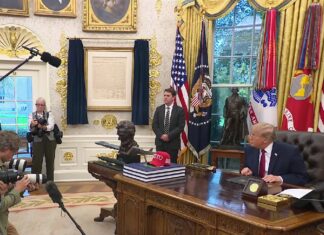
U.S. President Donald Trump has confirmed reports that he used expletives during a tense phone call with Israeli Prime Minister Benjamin Netanyahu as he pressed Israel to avoid further military escalation in Lebanon.
In an interview published by the New York Post on Wednesday, Trump was asked about reports that he had sharply confronted Netanyahu over Israel’s ongoing conflict with Hezbollah and potential strikes on Beirut.
When asked whether he had told Netanyahu, “Are you f****** crazy? What are you f****** doing? I helped you stay out of jail,” Trump replied: “I did.”
“I was a little bit perturbed at his constantly fighting with Lebanon,” Trump said, adding that he urged the Israeli leader to de-escalate tensions.
“I said, ‘Bibi, we gotta stop this.'”
The remarks offer a rare public glimpse into tensions between Trump and Netanyahu, who have maintained a close political relationship for decades despite periodic disagreements.
The phone call took place as Iran said it would suspend talks with the United Sates if Israel went ahead with its planned attack on Beirut city. Israeli attacks on Lebanese populated ares have drawn widespread international criticism. Lebanese officials say more than 3300 people have been killed.
Tehran insists any peace arrangement with the United States must include ceasefire in Lebanon.
Trump Berates Netanyahu in Heated Call Over Lebanon Escalation
Trump Calls Conversation ‘Very Productive’
Despite the reported exchange, Trump stressed that his relationship with Netanyahu remains strong.
“We’ve worked very well together. I like Bibi a lot. And I work very well with him,” he said.
According to Axios and ABC News, Trump was concerned that Israeli threats to strike Beirut could undermine efforts to revive negotiations with Iran and further inflame regional tensions.
Other reports cited Trump as telling Netanyahu: “I’m saving your a***. Everybody hates you now. Everybody hates Israel because of this.”
Trump on Axios report that he told Netanyahu “you’re f*cking crazy”:
I did. I always get angry.
I was a little bit perturbed at him, constantly fighting with Lebanon….
You know, at some point I said we’re going to stop this. pic.twitter.com/4c6Tpo1GkZ
— Clash Report (@clashreport) June 3, 2026
Nevertheless, Trump characterized the disagreement as a difference of opinion between two leaders operating under wartime pressures and insisted that cooperation between Washington and Jerusalem remains intact.
Following the call on Sunday, Trump wrote on his Truth Social platform that he had held “a very productive call” with the Israeli prime minister.
The exchange comes as Washington seeks to advance broader diplomatic efforts across the Middle East.
How Netanyahu Described the Call
In an interview aired Wednesday, Netanyahu downplayed the tensions as disagreements between friends.
Netanyahu portrayed the disagreement as a routine difference between close allies.
“Sometimes, as in the best of families, we have these tactical disagreements. We always find a way to work them out,” he told CNBC Channel TV18 when asked about the U.S. president’s call with him.
The Israeli prime minister described Trump and himself as “great friends.”
“We can disagree in the morning, and we have a common action by the afternoon.”
Q: Trump called you “fucking crazy.”
Netanyahu: Sometimes, as in the best of families, we have these tactical disagreements. We always find a way to work them out.
We can disagree in the morning, and we have a common action by the afternoon. pic.twitter.com/fNedBpFm3l
— Clash Report (@clashreport) June 3, 2026
Concerns Over Iran and Regional Stability
Trump has repeatedly insisted that Iran must not acquire nuclear weapons and has emphasized the importance of keeping shipping lanes through the Strait of Hormuz open.
Asked whether disruption to maritime traffic could continue through the U.S. Labor Day holiday in September, Trump said:
“I think it could be, but I think it’s unlikely. I think this will resolve itself fairly quickly.”
A Decades-Long Political Partnership
Trump and Netanyahu have moved in overlapping political and business circles since the 1980s, when Netanyahu served as Israel’s ambassador to the United Nations and Trump was emerging as one of New York’s most prominent real estate developers.
Their relationship evolved into one of the most consequential partnerships between a U.S. president and an Israeli prime minister in recent decades.
During Trump’s first term, his administration delivered several major policy victories sought by successive Israeli governments. Trump recognized Jerusalem as Israel’s capital and relocated the U.S. embassy there, recognized Israeli sovereignty over the Golan Heights, and brokered the Abraham Accords between Israel and several Arab states.
The close bond between the two leaders was evident in public appearances. During the unveiling of Trump’s Middle East peace plan in 2020, Netanyahu praised him as “the greatest friend that Israel has ever had in the White House.”
Strains Beneath the Surface
Despite their close ties, the relationship has experienced occasional strains.
The most significant rupture came after the 2020 U.S. presidential election, when Netanyahu quickly congratulated Joe Biden on his victory.
Trump later expressed frustration, telling Israeli journalist Barak Ravid that Netanyahu had made “a terrible mistake” by publicly recognizing Biden’s win so soon.
By 2024, relations appeared to have largely recovered, with Netanyahu emphasizing shared concerns about Iran as Trump prepared for a return to the White House. Even before Trump’s inauguration, Netanyahu said the two leaders saw “eye to eye on the Iranian threat.”

Muhammad Luqman is Associate Editor at Views News Now. He writes on wide-ranging issues including economy, South Asia, the Middle East, agriculture, economy and innovation. Luqman has worked some of the leading news organizations and won acclaim for his original and research-based works.