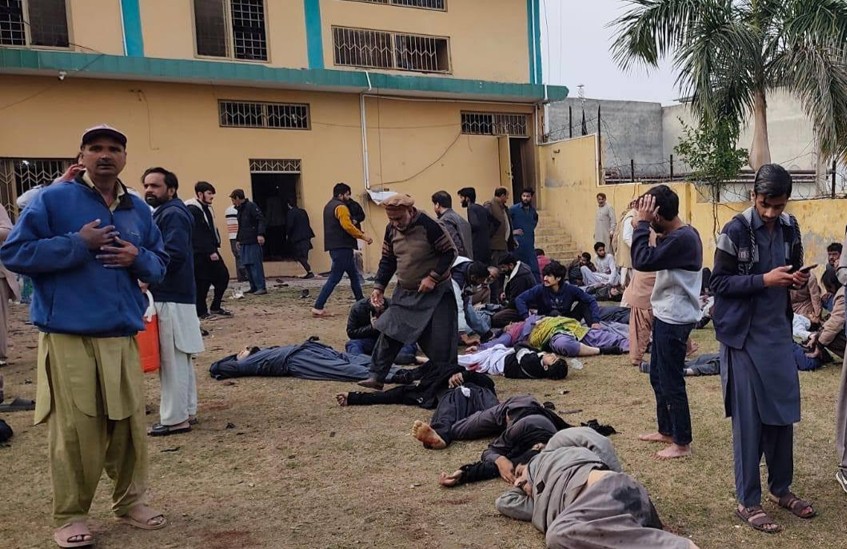
A suicide bombing tore through a mosque in Pakistan’s federal capital on Friday, killing at least 31 people and injuring 169 others, officials said.
The attack targeted the Imambargah Khadijah al-Kubra in Islamabad’s Tarlai area during Jumma congregational prayers. While investigations remain at a preliminary stage, Islamabad Capital Territory Police spokesperson Taqi Jawad said initial evidence strongly indicates the blast was carried out by a suicide bomber.
Hours after the attack, Pakistan’s defense minister Khawaja Asif linked the attack to Afghanistan and India, saying “it has been established the terrorist involved in the attack travelled to and from Afghanistan. The collusion between India and Afghanistan is being revealed.”
“After a humiliating defeat, India is fighting a war through its proxies. It doesn’t have the courage to fight directly now,” Asif added in a social media post.
مسجد میں نمازیوں کو شہید کرنے والے دین اور وطن دونوں کے دشمن ھیں ۔ حملے میں ملوث دھشت گرد کاافغانستان آنا جانا ثابت ھو ا ھے ۔ ھندوستان اورطالبان کے گٹھ جوڑ کے تانے بانے مل رہے ھیں۔ سیکورٹی گارڈوں نے اسکو چیلنج کیا جس کے جواب میں اس نے فائرنگ کی اور نمازیوں کی آخری قطار میں اپنے…
— Khawaja M. Asif (@KhawajaMAsif) February 6, 2026
Minister of State for Interior Tallal Chaudhry said while the attacker was not an Afghan, the authorities had been able to determine through forensic tests the number of times he had travelled to Afghanistan.
Following the explosion, authorities imposed a complete security lockdown in the area.
The tragedy struck close to the police leadership itself. Jawad confirmed that a cousin of Islamabad Inspector General of Police (IGP) Syed Ali Nasir Rizvi was among those killed, while another relative of the police chief sustained injuries in the attack.
An eyewitness told me “there were three attackers. One began firing outside the main gate and continued shooting as he entered. The other two attackers were already inside. The blast occurred a few seconds after Friday prayers had begun.”#IslamabadBlast pic.twitter.com/UQCBn99fUf
— Qurrat ul Ain Shirazi (@annie_shirazi) February 6, 2026
Local law enforcement personnel and Rescue 1122 teams rushed to the scene to carry out lifesaving operations. Due to the large number of casualties, a state of emergency was declared at major medical facilities in the capital, including the Pakistan Institute of Medical Sciences (PIMS), Polyclinic Hospital, and CDA Hospital.
District administration officials deployed assistant commissioners to these hospitals to personally oversee the treatment of the injured.
Additional support arrived from neighboring Punjab province. Chief Minister Maryam Nawaz announced on social media that 25 ambulances had been dispatched to Islamabad. She also placed hospitals in Rawalpindi district on high alert, ensuring the availability of specialized surgical, orthopedic, and neurosurgical teams, as well as fully stocked blood banks.
The timing of the attack is particularly sensitive, as it coincided with the two-day state visit of Uzbek President Shavkat Mirziyoyev.
The incident follows a series of coordinated attacks in Pakistan’s Balochistan province, where the Balochistan Liberation Army and affiliated groups killed around 50 civilians and several security personnel over the weekend.
Pakistan’s top leadership swiftly condemned the attack. President Asif Ali Zardari described the targeting of civilians as a “crime against humanity,” extended condolences to the bereaved families, and directed authorities to provide the best possible medical care to the injured.
Prime Minister Shehbaz Sharif also expressed “deep grief” over the loss of life and strongly condemned the act of violence.
Security forces have since cordoned off the site, while forensic teams continue to collect evidence in what is being described as one of the deadliest attacks to hit the capital in recent years.

Kiran Asim is a writer who covers the U.S., Europe, South Asia, and the Middle East. Her reports and analyses look at the geostrategic issues and contemporary developments and their economic and political implications. She also writes about society and education.